1. Household Pennants
A household pennant is a long, narrow flag flown at private residences and summer cottages
throughout Finland, primarily to indicate that the occupants are present. The tradition is
especially common during the summer months, when families travel to their summer cottages
and raise the pennant upon arrival. The custom is Scandinavian in origin and became
increasingly popular in Finland during the 1950s.
Household pennants may take the form of a family, home region, city, municipal, provincial,
or a national blue cross pennant. The choice of pennant is typically personal, with owners
most commonly selecting one that represents their region of birth or family heritage.
Swedish-speaking Finns often fly their own regional variants of the provincial pennants
or a red-and-yellow cross pennant. Provincial pennants are most common.
Blue cross pennant
Swedish-speakers
Åland islands
Uusimaa
Swedish Uusimaa
Finland Proper
Tavastia
Southern Ostrobothnia
Central Ostrobothnia
Northern Ostrobothnia
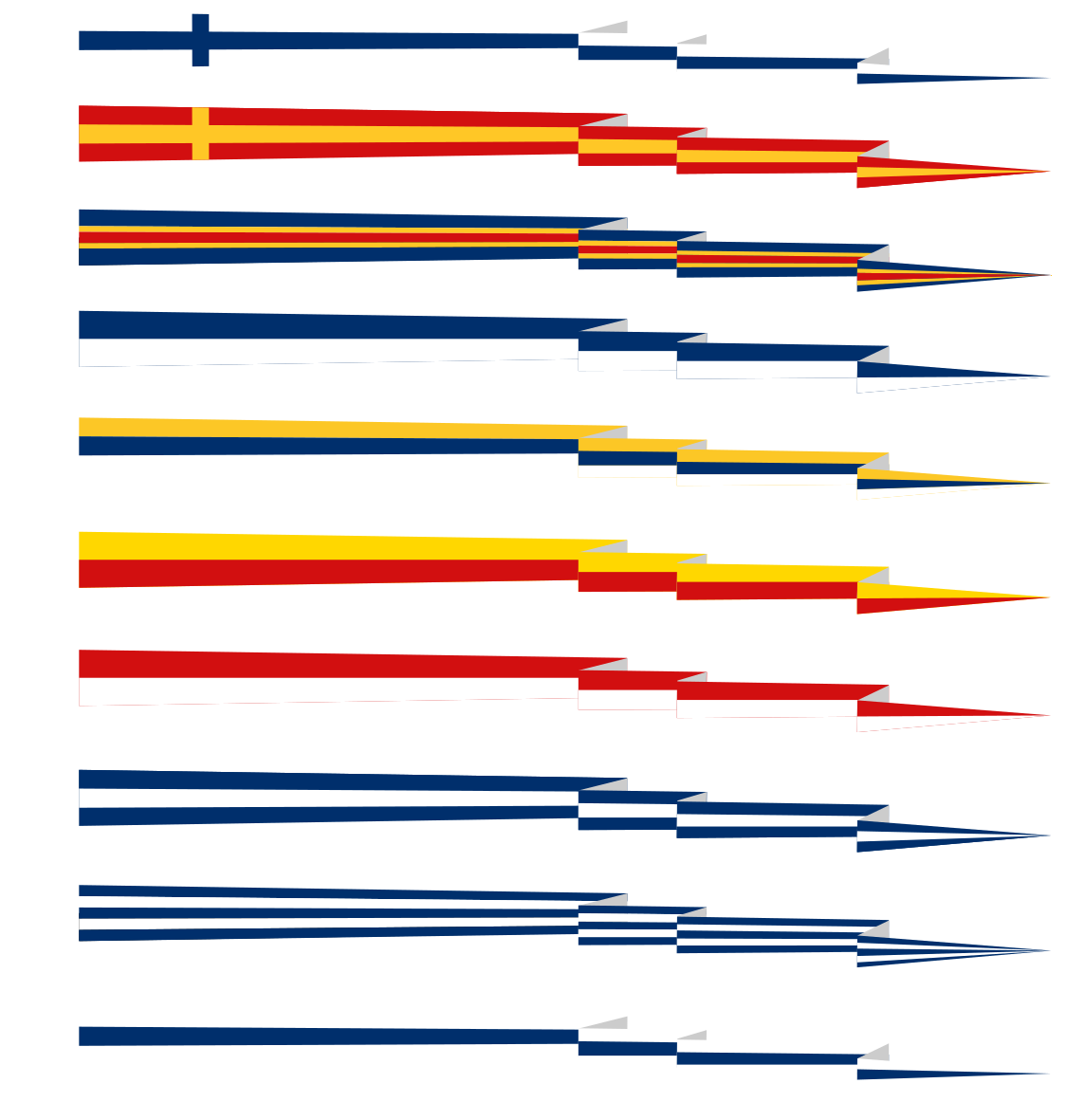
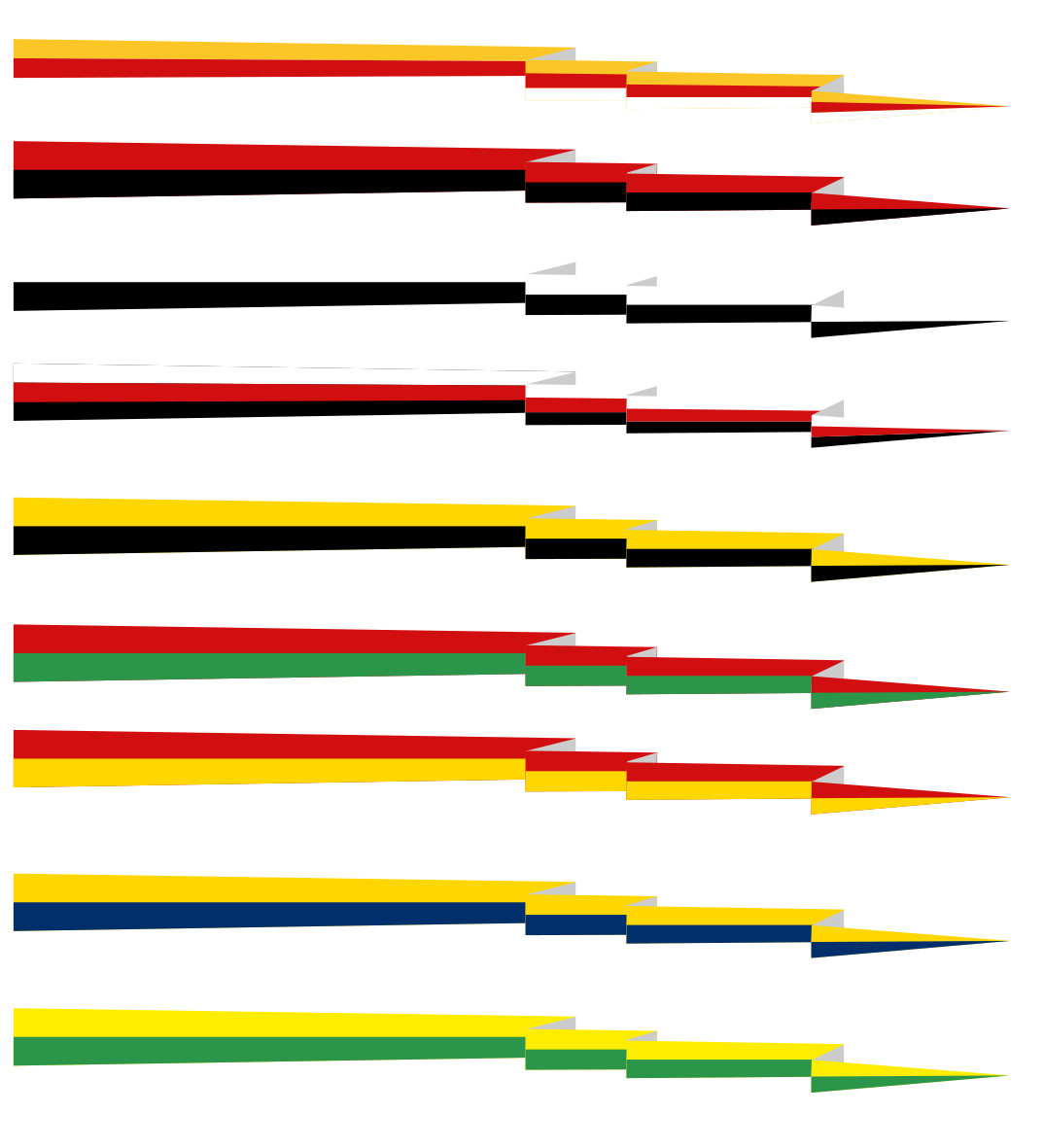
South Karelia
Karelia
Kymenlaakso
Central Finland
Savonia
Lapland
Swedish Ostrobothnia
Satakunta
Kainuu
Unlike national flags, household pennants are not subject to official flag-flying regulations. They may therefore be displayed at the owner's discretion and left on the flagpole at any hour of the day or night. However, established custom holds that the pennant should be lowered on official flag days. Household pennants are not used for mourning purposes and are never flown at half-staff.
2. Flags of Finnish Minorities

People's Party, 1907. A. Federley. [source]
2.1. Swedish-speaking Finns
The unofficial flag of the Swedish-speaking Finns is a red-and-yellow cross flag, whose colours derive from the Finnish coat of arms, which was adopted in the late 16h-century when Finland was a part of Sweden. The red-and-yellow cross flag first appeared during the great flag debate of 1862–63, when Senate secretary Carl Forsman proposed it as the merchant flag for the Grand Duchy of Finland. Finland was not granted a merchant flag at that time, but until independence there was lively debate in Finland about what the national flag and its colours should be. Swedish-speakers generally supported red and yellow, and the most typical forms of these colours were either a cross flag with a yellow cross or a lion flag. There were other red & yellow designs as well, but these two were the most common.

Borgåbladet wrote on 13th of August, 1912, about the red-and-yellow cross flag:
» Among Swedish speakers, there is unanimous agreement on the significance of the cross, and naturally, they prefer a yellow cross on a red background. In fact, the use of a cross-shaped flag with a yellow cross on a red field has already become quite common, and for good reason. Such a flag has great meaning for us, symbolising many of the finest ideas that have taken root here. It reminds us that the first seeds of civilisation and culture were sown in these lands under the christian cross. It also testifies of our connection with the Nordic region, as flags in all Nordic countries have adopted the cross flag. In Sweden they sing: "Hail, our cross-banner in blue!", why should we not sing: "Hail, our cross-banner in red!" » [1]
When Finland gained independence in 1917 and the Civil War ended in a White victory in the spring of 1918, parliament held a heated debate over
the national flag. The Senate attempted to adopt the lion flag as the state flag, and it had served in that capacity unofficially during the war,
but by May 1918 it was replaced by the blue cross flag. The decision was hastened by the fact that the colour red, in the aftermath of the Civil War,
was seen by many as stained and associated with socialist rebellion. Yet within the Swedish-speaking circles, many stubbornly maintained the country's
old heraldic colours. The red and yellow had been used by the constitutional movement in its resistance to Russification, and were thus associated
with Finland's Swedish legal traditions and its Western civic order. Swedish-language newspapers and representatives strongly criticised the blue
cross flag, calling it, amongst other things, too Russian on account of its resemblance to imperial yacht flags and the naval ensign.
Although the red-and-yellow flag lost its status as a state symbol, it did not disappear from use. In the 1920s it became associated with the
Swedish-speaking population and the Swedish People’s Party (SFP). Both lion flags and red-and-yellow cross flags continued to be used in
Swedish-speaking areas long after the blue cross flag had been adopted. At commemorative events of the Civil War, for example, red-and-yellow
flags were prominently displayed, particularly in Ostrobothnia, which led to tensions with Finnish-speakers, who insisted on the exclusive
use of the blue cross flag. In some areas, the red-and-yellow flag were regarded as politically divisive well into the 1930s.
[2]
Already in the first parliamentary elections of 1907, the SFP had used Alex Federley’s campaign poster Mannen med flaggan (“The Man with the Flag”),
depicting a lion flag flying in a quintessentially Finland-Swedish coastal scene. The poster quickly became an iconic expression of
Finland-Swedish national sentiment. The theme of the man with the flag was not confined to party campaigning but was widely adopted
in various illustrations whenever Finland-Swedish identity and pride were to be conveyed. The imagery alternated between the red-and-yellow
lion flag and the cross flag. The motif remained in the SFP’s election material until the parliamentary elections of 1966.
[3]

(Swedish Central Archive)

(National Library of Finland)
Although the SFP has largely stopped using red-and-yellow flags, and the lion flag is no longer associated with Swedish-speaking Finns, the red-and-yellow cross flag has become established as their unofficial flag. It has never been made official, but it appears from time to time on Swedish-speaking holidays and cultural events. No proportions have been codified for the cross flag, but its cross has usually been narrower than that of the blue cross flag. The shades of red and yellow are the same as in the coat of arms. The red-and-yellow cross household pennant is more common than the flag itself.
2.2. Åland Islands
The flag of Åland is a yellow-and-red cross on a blue field. The flag was established in the Åland Islands Act in December 1953, and confirmed by the President of the Republic in March 1954. It was first raised on the flagpole at Mariehamn town hall on 3 April the same year.

Before Finland’s independence, people in the Åland islands generally leaned towards red-and-yellow colours in the flag question, although it was never as significant of a matter as in mainland Finland. On the eve of independence, however, red-and-yellow was set aside as Åland experienced a strong movement to unite with Sweden. At this time the blue-and-yellow colours became the most important for Ålanders, being both the colours of the Swedish flag and those of Åland’s centuries-old coat of arms. Although the Åland question was ultimately resolved in Finland’s favour in 1922, the blue-and-yellow colours remained popular in Åland.

The first proposal for Åland’s own provincial flag appeared in 1922. Bookseller Frithiof Liewendahl designed a three striped flag (blue–yellow–blue), which was produced for the Åland song festival. The flag became an unofficial provincial symbol, and Liewendahl sold it in his own bookshop. The Finnish blue-and-white flag was rather rare in Åland, as the region’s identity was still strongly Swedish. A flag decree issued in Finland in 1934 required that alongside other flags, the Finnish flag had to be raised above them. The decree was mainly intended to restrict the use of socialist flags in mainland Finland, but it was also applied in Åland, where it caused dissatisfaction.[3]
In the 1930s, discussion began in Åland about making their own flag official by law. Representative Herman Mattsson supported resolving the flag question and reportedly favoured the three striped flag. Provincial archaeologist Matts Dreijer submitted a statement on the matter to the provincial assembly in 1939. He considered the blue-and-yellow colours the most natural, given Åland’s historical background, and included two sketches: Liewendahl’s flag and a white flag with a blue-and-yellow cross. The outbreak of the Winter War halted further discussion.[4]


but rejected by President Paasikivi, 1951.

in Erik Tudeer’s book.


in 1953.
The new Self-Government Act of 1951 gave Åland the legally recognised right to its own flag. Representatives then debated between Liewendahl’s three striped flag and a blue-yellow-blue cross flag. The provincial government decided to propose the latter, but President J. K. Paasikivi vetoed it, believing the design resembled the Swedish state flag too closely.
New proposals were then needed. The provincial government now suggested a yellow flag with a blue cross, a kind of inverted version of the Swedish flag, but this did not gain support among representatives. Discussions revived the previously suggested 1939 white flag with a blue-and-yellow cross, as well as a yellow version of the same. State Archivist Yrjö Nurmio, responding to the representatives’ inquiry, proposed adopting a banner-of-arms for the province. Liewendahl’s flag was also brought up again. Finally, a new proposal emerged: a blue flag with a red-and-yellow cross. In the end, these two last designs remained the strongest candidates. The provincial assembly held extensive discussions, and the majority backed the blue-red-yellow cross flag. This version was approved in the Åland Islands Act in 1953, confirmed by the President of the Republic the following spring, and officially adopted as Åland’s flag in 1954.[4]
2.3. The Sámi Flag
The official Sámi flag, adopted at the 13th Sámi Conference in Åre in 1986, is vertically divided into a red field on the left and blue on the right, separated by a narrow green-and-yellow stripe. At the center, a half blue, half red circle spans across the colours. According to its designer, artist Astrid Båhl, the flag’s design is rooted in Sámi mythology and nature. The circle represents the sun and the moon, as traditionally depicted on the Sámi drum, while the colours reflect those of the gákti, the traditional Sámi dress. The circle also relates to the sun as the life-giving force to the earth. [5]


Båhl's design is similar to the flag designed by another artist, Synnøve Persen, back in 1977. Persen's flag lacked the green stripe and the circle from Båhl's later design, but was otherwise very reminescent of it. Persen had designed her flag during her studies and it gained popularity in the 1970's and 80's among the Sámis during the protests against the damming of the Alta river in Norway. During those protests the flag became linked with the ČSV movement, which was a Sámi youth movement that advocated for Sámi rights and gained widespread attention at Alta. [5]
According to Persen the flag drew inspiration from gákti dresses and Sámi handicrafts. The gákti dresses from Buolbmát (Pulmanki) and Varjját specifically are noted to incorporate similar red-yellow-blue elements. The design had also been used in other Sámi political banners and, for example, on the cover of the 1971 catalogue over Sámi literature at Karasjok library. [6]
The Alta river demonstrations, the ČSV movement and Persen's flag were somewhat controversial during the 1970's and 80's. They were accused of extremism and separatism and even some Sámis became vary of trying to adopt a separate flag for the minority. However, as Sámi activism became more organised and increasingly accepted within the broader Nordic political landscape, the symbolism of a distinct Sámi flag gradually lost its earlier controversy, especially after Greenland adopted its own flag in 1985, making the idea of indigenous flags more familiar in the region. In 1985, the Nordic Sámi Council organised a flag competition whose submissions would be reviewed at the Sámi Conference the following year. Nineteen designers’ proposals were accepted into the competition, nine of which were presented at the conference. Persen’s 1977 flag was added as a tenth option, even though it had not been formally submitted. In the end, the conference narrowed the choice to two designs: Persen’s original flag and Båhl’s version featuring the green stripe and the circular sun–moon symbol. Båhl’s design was favoured for being more representative of the broader Sámi community - thanks to its inclusion of green, a traditional colour in some regional gákti - and for breaking European heraldic traditions regarding the rules of tincture, which Persen’s flag had followed. [5]


Even before Persen’s flag, some Sámi artists had experimented with the idea of a Sámi flag, though none of these early proposals gained wider attention. The earliest known attempt was likely by Nils-Aslak Valkeapää, also known as Àillohaš , who was a Sámi artist from the Finnish side of the border. According to fellow artist Hans-Ragnar Mathisen, Valkeapää sent a flag design to the editor-in-chief of the Sámi newspaper Ságat in 1967. His proposal featured a red field with stylised reindeer antlers and a Sámi knife arranged in a manner reminiscent of the hammer and sickle of the Soviet Union.
Dr. Saara Alakorva from the University of Lapland wrote in her 2022 article on the Sámi flag:
» The source of this information is Sámi artist and member of the Máze artist collective Hans-Ragnar Mathisen (born in 1945), known also by his artist name Keviselie. According to Mathisen, in 1967 Nils-Aslak Valkeapää had sent a picture of his design for a Sámi flag to Odd Mathis Hætta, the editor in chief of the Sámi-language magazine Ságat. The design borrowed elements from the red flag of the Soviet Union with its hammer and sickle, but in place of the hammer and sickle, it had reindeer anlters and a Sámi knife. Although, at least in Mathisen’s understanding, Hætta and Valkeapää thought alike in many areas, Hætta nevertheless considered the flag design far too radical to be published in the magazine. It is hard to determine what motivated Valkeapää to produce such a design. He did not actively take part in party politics, but he probably supported more left-leaning ideas. The generally leftist atmosphere at the time undoubtedly influenced his thinking. » [5]
Hans-Ragnar Mathisen also took an early interest in a Sámi flag in 1970. His principal proposal was a red cross laid over an orange cross on a dark green field, and he submitted it to the newspaper Ságat in 1970. He also urged the paper to organise a public flag competition, though Ságat ultimately chose not to pursue the idea [7]. He also participated in the 1985-86 flag competition by the Sámi Council.
Mathisen's letter to Ságat, 1970:
» Why should not Ságat newspaper take the initiative to announce a contest for a Sámi national flag? It would be preferable to have it as an inter-nordic matter, so that Sámit in Sweden and Finland, and for that sake also Russia could participate as well? I am fully aware of that many would find this too candid, unheard of, ‘national-romantic’, and what not. Yet I want to stress the importance of the matter, it is truly of mayor significance. Well, to not be the last one, here is my own suggestion: Red cross over yellow/orange cross on a dark green base. » [7]
3. Swedish Volunteers
3.1. Swedish Brigade during the Finnish Civil War
When the Finnish Civil War broke out in January 1918, a volunteer force of roughly one thousand Swedes travelled to Finland to fight on the White side. Known as the Swedish Brigade (Svenska brigaden), the unit saw significant action, including the fierce battle of Tampere in March 1918. The Brigade carried three flags during and after the campaign.
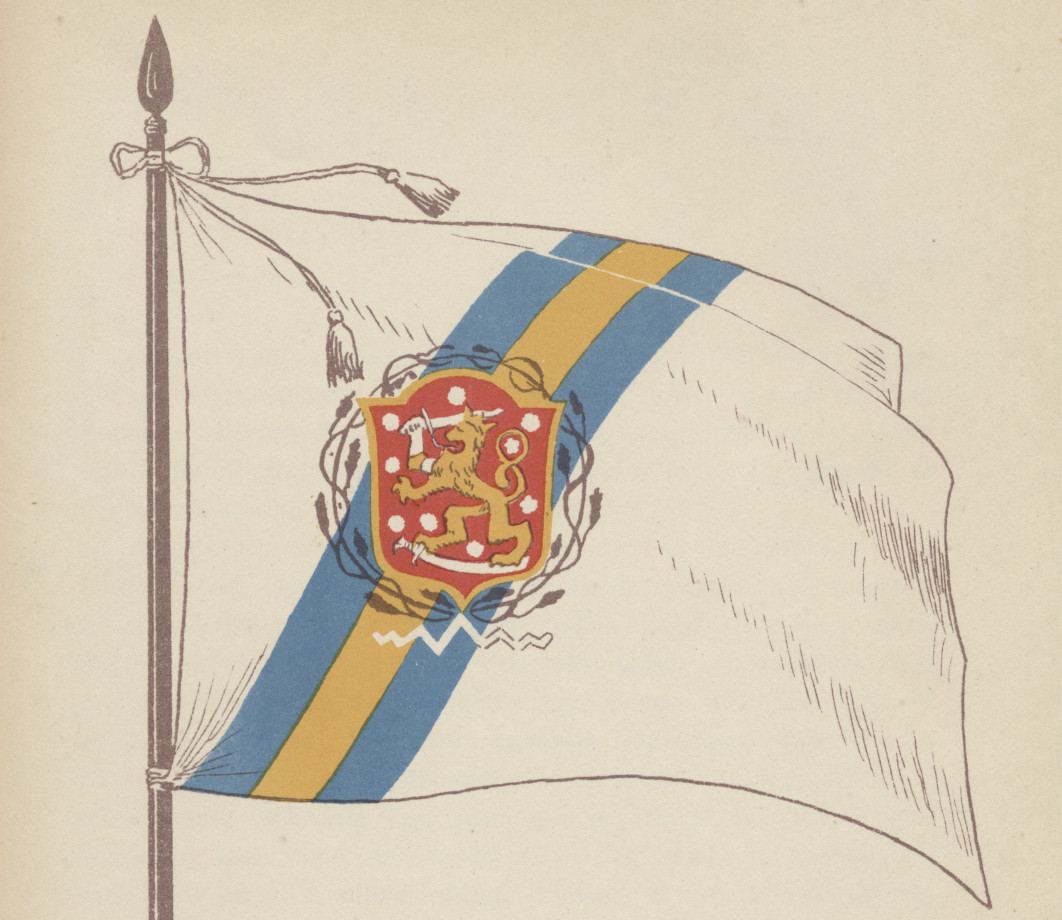
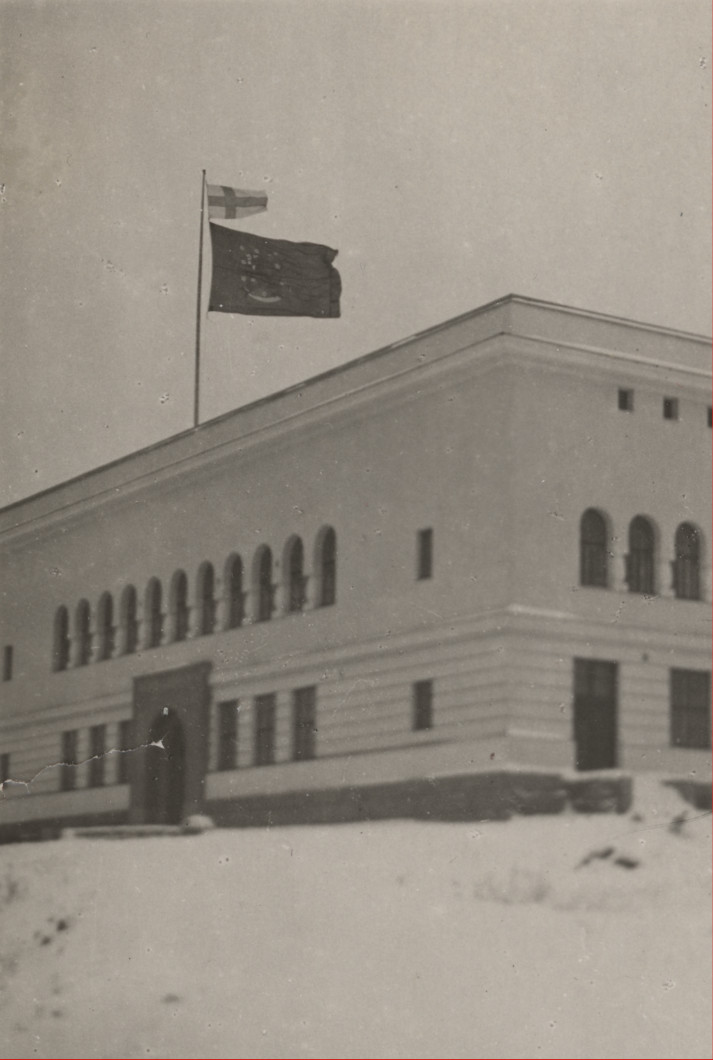
The first flag was donated by women in Uleåborg in Finland, where the brigade gathered and trained before being sent to battle. The flag was given to the brigade the 25th of March, 1918. The flag was a white satin bottom with a blue-and-yellow diagonal stripe across the field. In the centre of the stripe is Finland's coat of arms surrounded by oak leaves. This flag accompanied the brigade throughout the entire campaign, and was carried at the head of the column during the victory march into Helsinki on the 17th of May 1918. [8]
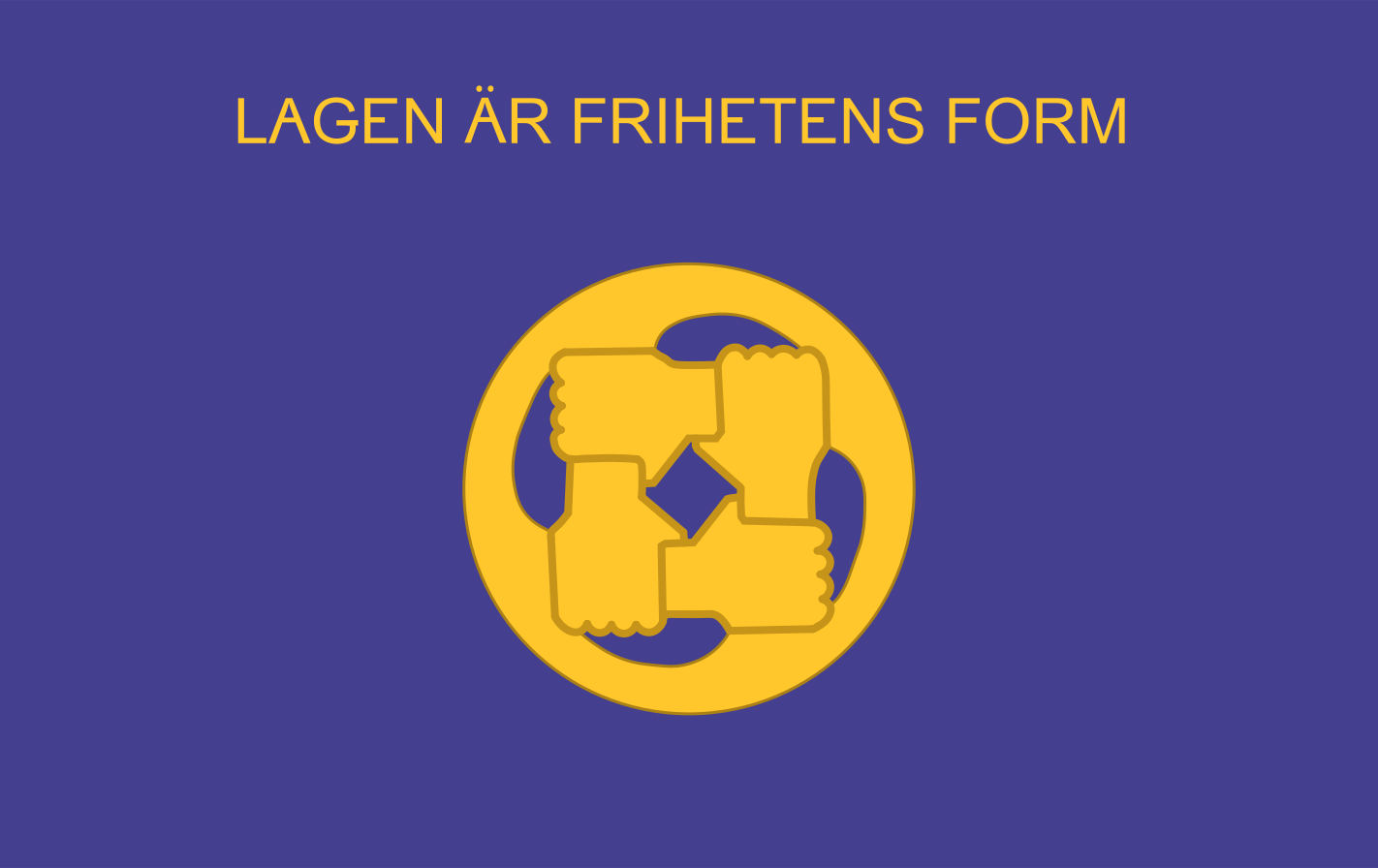
The second flag was made of blue taffeta and was designed by the Swedish artist Gunnar Hallström (1875–1943), brother of archaeologist Gustaf Hallström, who led the Brigade's Stockholm office and was a key organiser and recruiter. The flag features four hands arranged in a square, each gripping the others' wrists, surrounded by a circular ring, embroidered in gold and yellow silk. Along the upper edge runs the inscription » Law is the form of freedom ».
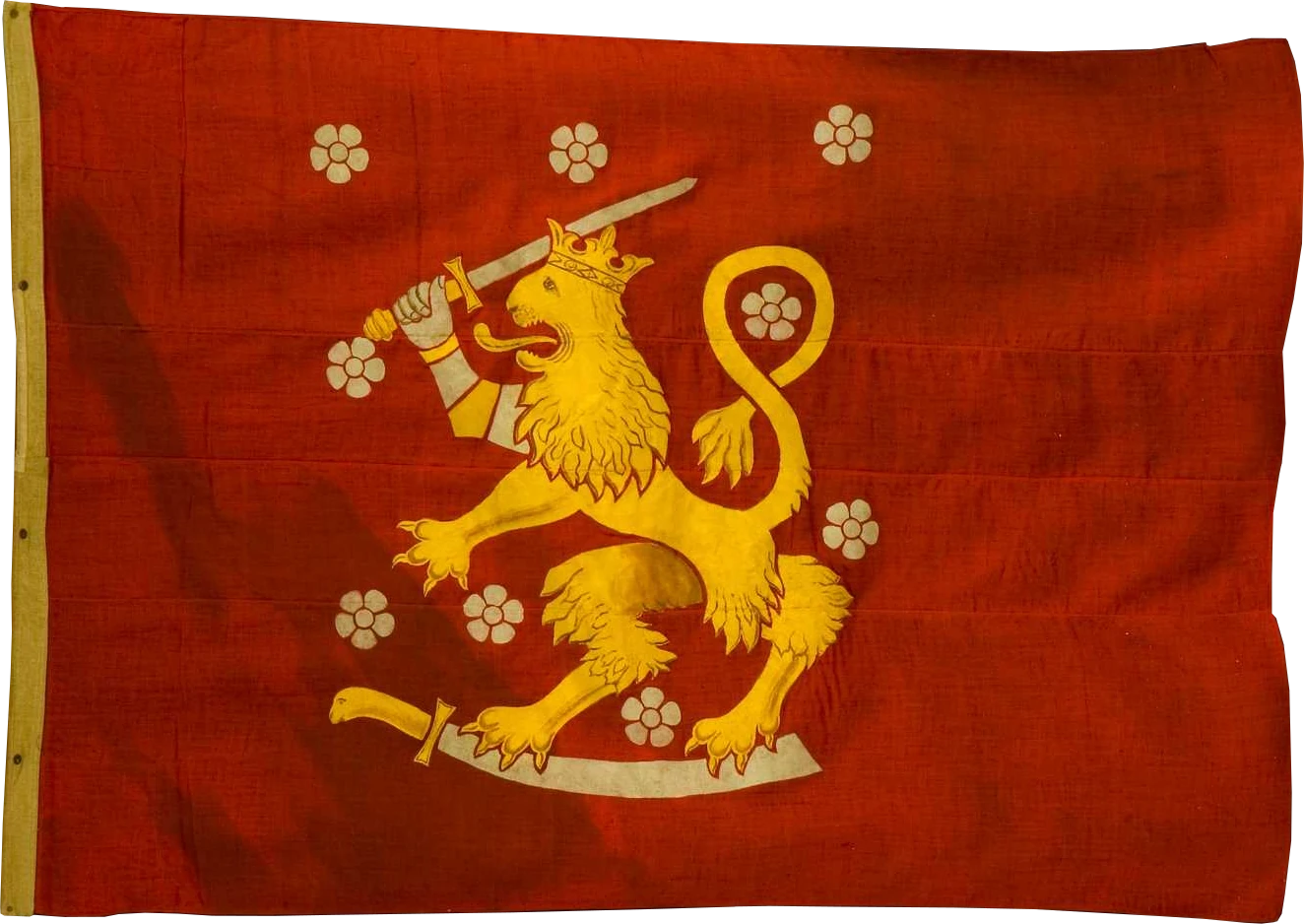
Produced by the Licium company in Stockholm, and funded partly by the Brigade itself, the flag was delivered at the end of the war the 16th of May 1918 and handed over to the brigade to be carried during the victory parade in the capital. The flag was carried in the parade alongside the first flag from Uleåborg. Hallström's four-hands motif later became the emblem of Samfundet Nordens frihet, an organisation that supported Scandinavian volunteers during the Winter War and Continuation War. [10] The third flag was a lion flag, the unnofficial flag of White Finland, and was given to the brigade by women in Vasa, where the brigade's fallen were buried. [9]
3.2. Swedish Volunteer Battalion (SFB) during WW2
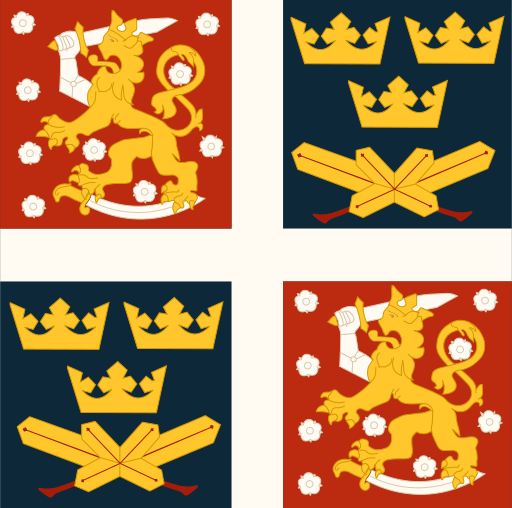
Flag adopted by the Swedish Volunteer Battalion (Svenska frivilligbataljonen) during the Winter War. The flag was designed by Einar Kedja. [11]
4. Independence League
The Independence League (Itsenäisyyden Liitto) was a patriotic Finnish association between 1924-1946 that played a central role in popularising the use of the Finnish flag in the 1920-30s. The association's own flag was consecrated on the independence day of 1930. The flag was designed by artist Gallen-Kallela. The flags motif, the Finnish lion on a red-and-black checkered field, was the same which Gallen-Kallela had unsuccessfully proposed as the updated coat of arms for Finland a year prior in 1929. [12]
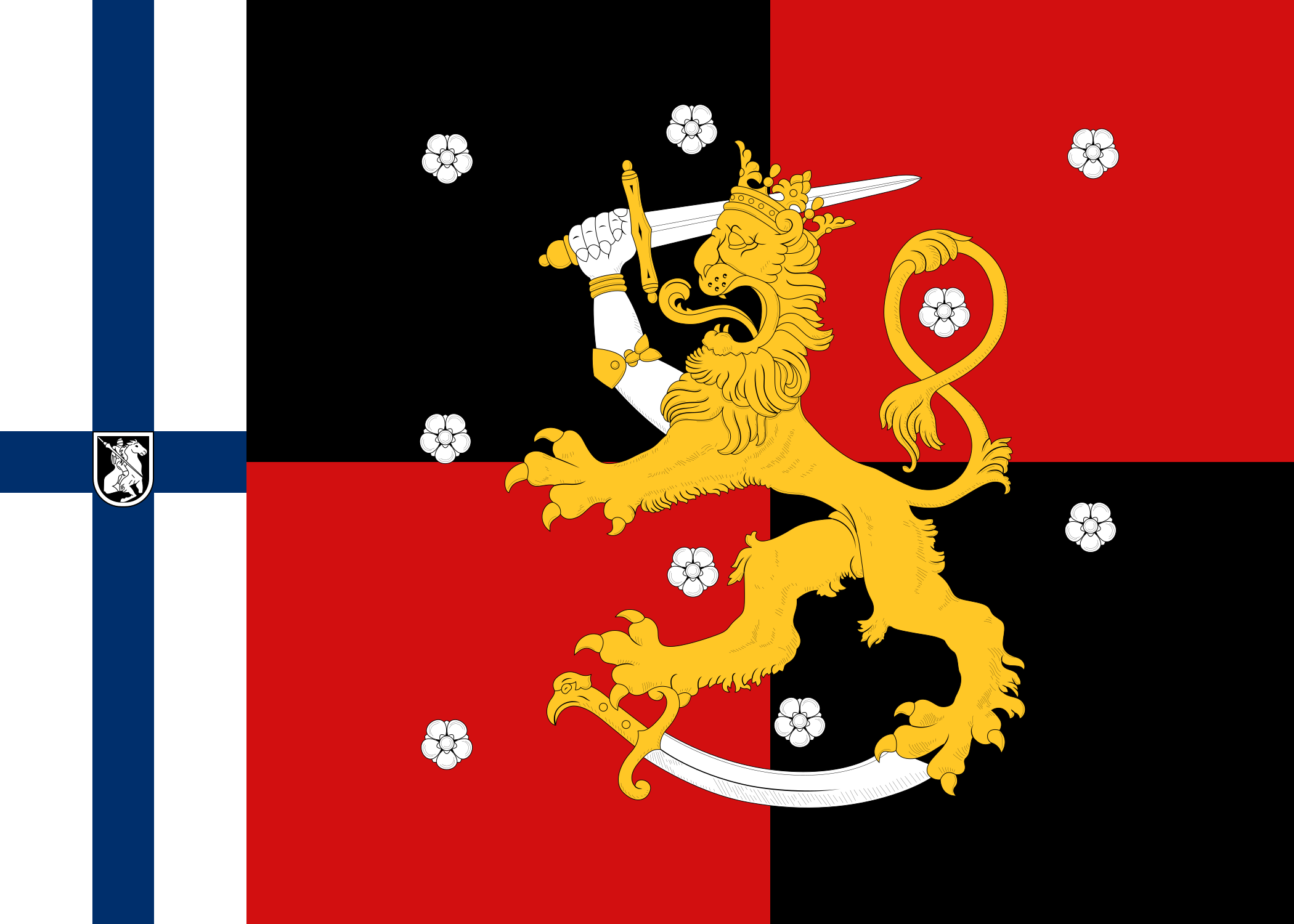
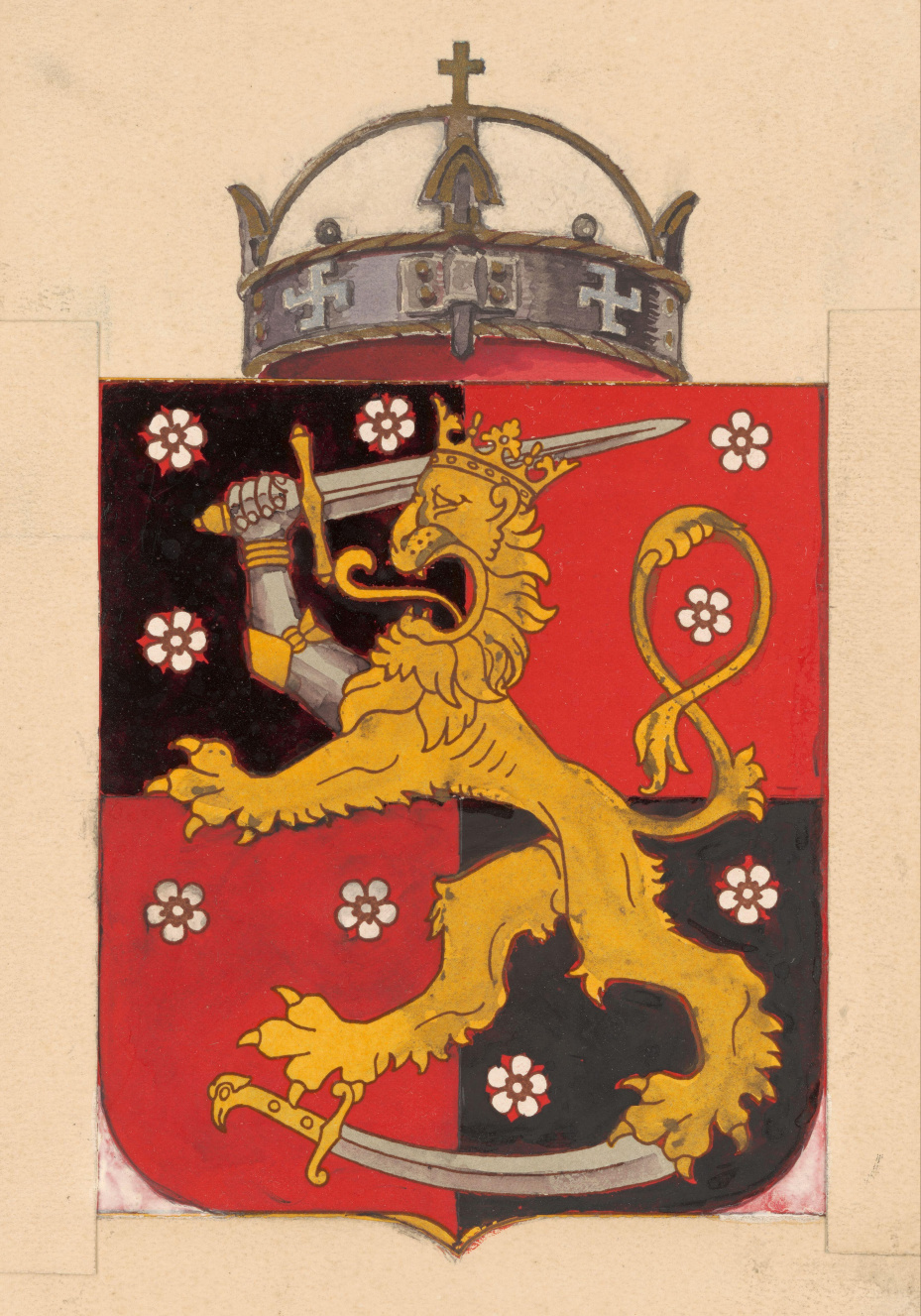
of Finland by Gallen-Kallela, 1929. [12]
The Independence League was founded in October 1924. Its stated aims were to strengthen Finnish independence by promoting patriotism and uniting a divided nation. The League was conceived as a more moderate alternative to the Academic Karelia Society (Akateeminen Karjala-Seura), which, as a more radical Finnish-nationalist association, took a considerably harder line towards the Swedish-speaking population of Finland. Its most prominent figure was the writer Erkki Räikkönen, of Ingrian background, who had resigned from the Karelia Society a year prior. The League sought to foster cooperation not only with Swedish-speaking Finns but also with left-wing circles, aiming to promote patriotism across all classes of society. Its overarching goal was the reconciliation and unification of the Finnish people. [13]
The main practical objective of the league was to promote Finnish flag culture. The Independence League worked to broaden the use of the recently adopted Finnish flag, which in the 1920s remained inconsistent and lacked tradition and settled customs. The league disseminated information on the symbolic significance of the flag, published guides on flag-flying practices and distributed flags at affordable prices. Its target audiences in this endeavour were the working class, who were wary of the blue and white colours' association with the Civil Guard, and Swedish-speaking Finns, among whom the colours were still associated with the Finnish-nationalist Fennomans. The League became the central force in shaping Finnish flag culture during the 1920s and 1930s. [13]
In the course of the 1930s, the league's politics shifted markedly to the right as it evolved into an increasingly radical right-wing organisation. Räikkönen served as the chairman from 1930 to 1933, and during his tenure the League began to support the fascist Lapua Movement. It also formally incorporated anti-communism into its programme, which became its principal political mission throughout the decade. As far-right and National Socialist elements joined its ranks, moderate members and those of left-wing sympathies gradually withdrew or were actively expelled. The organisation was dissolved after the Second World War in accordance with the terms of the armistice agreement, which forbid any fascist organizations in Finland. [14]
5. Flags in Jest
Finland's path to settling on a national flag was long and bumpy, and the debate between competing colour schemes and designs dragged on for years, growing heated enough to become a national joke in itself. The sheer variety of flags Finns flew prior to independence only added to the absurdity: if a people couldn't agree on a simple piece of cloth, what hope did they have of running a country?
5.1. Juhani Aho's Pinwheel Flag
In 1895, for its christmas special issue, the Artist's Association of Finland incquired a range of prominent Finns on their opinion regarding the national colours of Finland. The state archivist of Finland, Reinhold Hausen, had earlier in the year made the case for the red and yellow colours in the newspapers, which had once again kickstarted the colour-debate that had in previous years become somewhat dormant. One of the persons asked was Juhani Aho, a prominent author. In his reply, which was printed in the beginning of the article, he jokingly proposed the adoption of a brown flag.

» For so long have I been reading and hearing talk of Finland's national colours, that eventually they've begun spinning
before my eyes. It was for this reason, when I was asked the above question, that I came to the conclusion; let them spin then.
I painted a children's pinwheel white, blue, yellow and red, and let it spin. It turned brownish green.
There, then, would be a way to solve this colour-dispute.
Isn't it lovely? Surely the brownish green coniferous forests are both beautiful and national. And swamps, also brownish green,
are so very national and above all thoroughly Finnish. What a wonderful way to merge all the different factions -
both language and colour parties - each of which, on this question, appears to be pulling from its own end of the rope!
Let us, therefore, in all haste, hold a grand celebration of the merger of all these factions! And let us, for the occasion,
dress in brownish green evening suits. If some quests would then happen to wear blue and white or red and yellow pants,
well - it hardly matters anymore. [16]
5.2. Janne Ankkanen
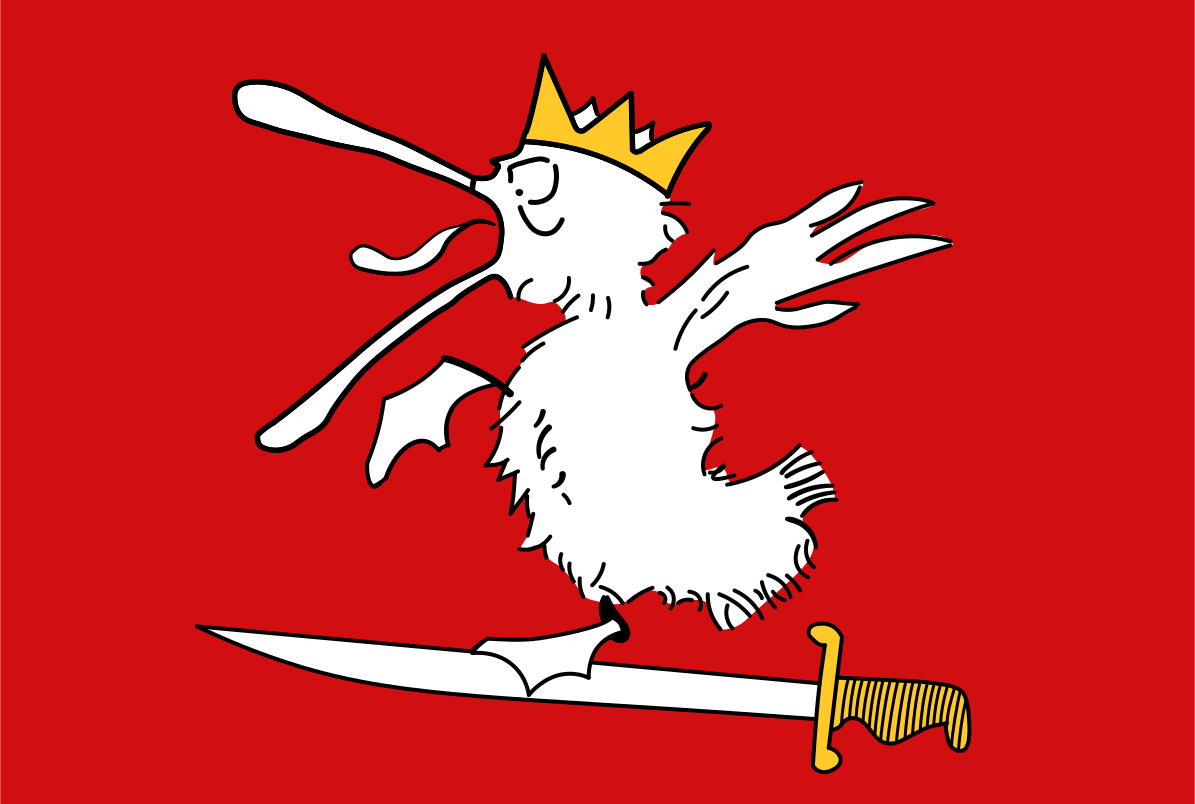
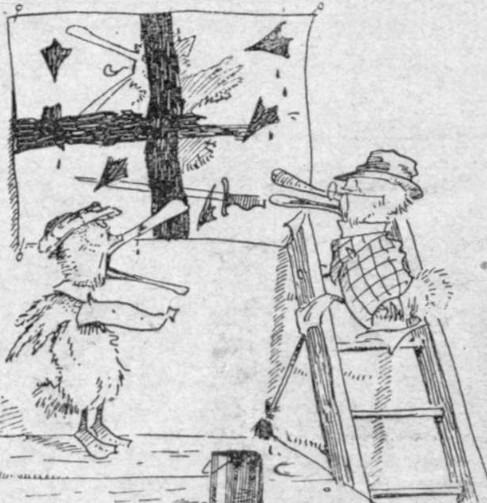
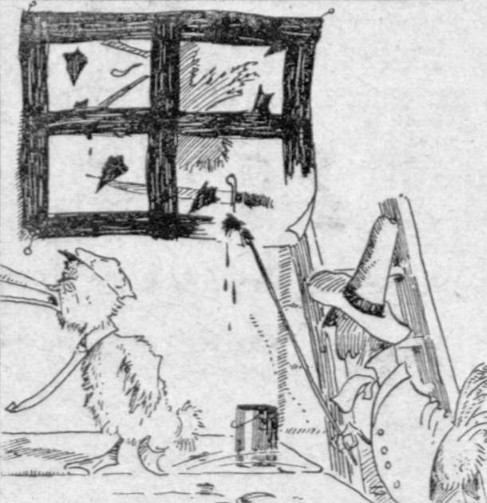
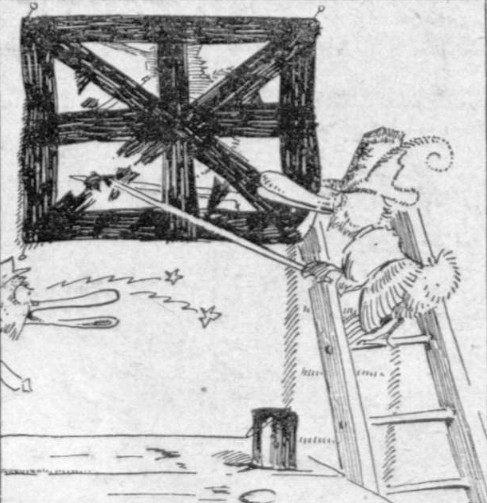
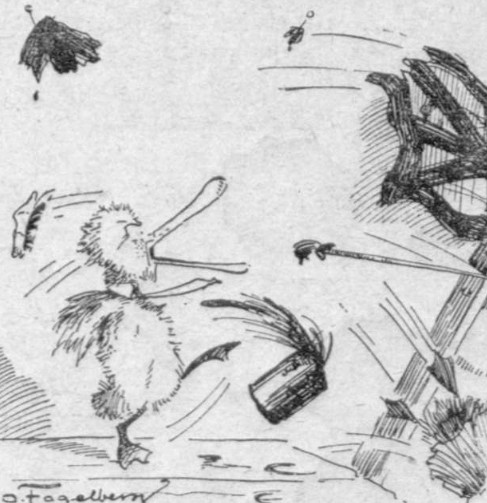
Janne Ankkanen was a comic strip character published in the magazine Suomen Kuvalehti in 1917-1918.
Janne was the main character in the series "The Remarkable Adventures of Janne Ankkanen in the Crosscurrents
of the Modern Age" where he engaged in a satirical manner with the political and social issues of the day.
The strip was created by artist Ola Fogelberg and author Jalmari Finne.
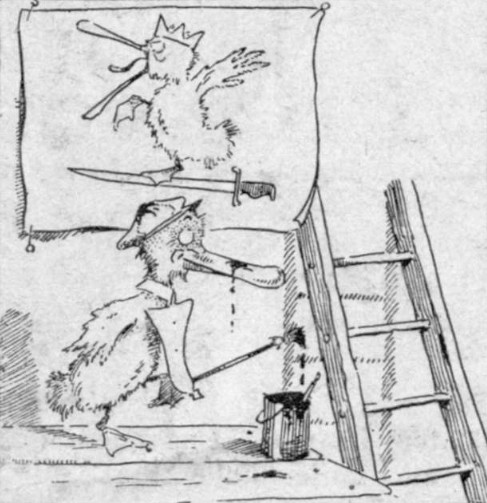
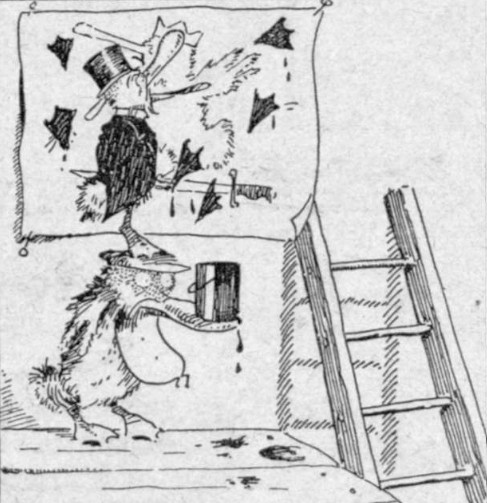
In January 1918, when the senate had proposed the adoption of the lion flag, the comic strip took on the topic.
They satirize the flag debate and its convoluted and heated character where everyone has their own opinion.
Janne Ankkanen decides to participate in the debate and designs a flag where he replaces the Finnish lion with himself. [17]
When the Finnish people began to quarrel over the form of their flag, Janne Ankkanen decided to settle the matter in his own way.
 Up
Up