
1. Lion flags
[a]
[b]
[c]
[d]
[e]
[f]
[g]
[h]
[i]
Original examples:
[a] [b] [c] [d] [e] [f] [g] [h] [i]

The roots of the Finnish lion coat of arms go back to the late 16th century, during the
reign of King John III. Under Swedish rule, it served as the coat of arms for the whole of
Finland and appeared on military flags, particularly among units raised in Southwest Finland.
In 1809, when Finland came under Russian rule as a Grand Duchy, the lion was retained as
the official emblem of the territory, its use confirmed by Tsar Alexander I.
The symbolism of the lion began to connect with a distinct sense of national identity after
the mid-19th century, although it had not yet acquired the meaning of political resistance
or separatism. A notable event in Finnish vexillological tradition occurred in 1848, when
during the so called Flora Day student festivities, the Student Union of Helsinki
adopted a flag bearing the Finnish lion coat of arms on a white background. Although this
was technically merely the flag of a student organization rather than a national ensign,
it was the first time a Finnish flag was designed with explicit nationalist sentiment. The
adoption of the flag was linked to the » Springtime of Nations » in Europe, when
nationalist movements were sweeping the continent. The purpose of the lion was to celebrate
a Finnish identity that stood apart from its historical rulers, Russia and Sweden. While
the flag caused concern among university administrators and Finnish officials, who feared
it might be interpreted as an act of separatism by the Russians, the national movement was
not yet revolutionary, and the flag did not lead to immediate reprisals. During the flag's
debut on the Gumtäkt Field outside Helsinki, the future national anthem of Finland, Maamme
("Our Land"), was sung in public for the first time. The Flora Day of 1848 is considered
to have been the awakening of Finnish nationalism.
During the Years of Oppression the Lion Flag gained further political meaning and became a
symbol of resistance in Finland. As Russification policies sought to dismantle Finnish
autonomy, the Russian authorities banned the use of the Lion Flag in the late 1890s. This
prohibition only strengthened its power, the ban itself confirmed the lion as the true
symbol of Finnish sovereignty. While simpler bicolour flags were used since they were less
strictly regulated, the Lion Flag became the primary emblem of the Constitutionalist
movement. For them, the lion did not just represent Finland, but the Finnish State and its
Constitution. The imagery of the lion brandishing a Western straight sword and trampling an
Eastern curved scimitar perfectly encapsulated their legalistic argument: that they were
defending a liberal western legal tradition against Eastern autocracy and illegality.
A distinction often arose among Finnish-speaking activists: while the blue-and-white colours
were embraced as the national colours of the Finnish people and culture, the Lion Flag was
revered as the state flag. Thus, while the other red-and-yellow flags remained largely a
Svecoman phenomenon, the Lion Flag found broad support across linguistic lines among those
opposing Russian overreach. The most radical of the Constitutionalists eventually moved
over to active resistance, culminating in the assassination of Governor-General Bobrikov
by Eugen Schauman in the summer of 1904. Following the assassination, the prohibited Lion
Flags were defiantly raised on the flagpoles of the Senate, the Bank of Finland, and the
State Archives. The following year, during the General Strike of 1905, the liberalized
atmosphere allowed Lion Flags to be flown openly and widely throughout the capital and
the country.


When the Imperial power collapsed in the February Revolution of 1917, the lion flag was flown in celebration. In Helsinki, on the 21st of March, it was raised on the flagpoles of the town hall and other public buildings to symbolise freedom and national self-determination. Helsingin Sanomat wrote on 22 March 1917:
» And when we went back to the city about an hour later, we noticed that the large crowds moving along the main streets were also adorned with flags. Small blue/white and red/yellow flags fluttered on people's shoulders, hands, hats, and lapels, and some had both red, red/yellow, and blue/white flags for the sake of neutrality. The 'Lion Flag', a yellow Finnish lion on a red background, was also in many hands or pinned to their chests. More and more people, with joyful faces, appeared on the streets. As we came along Aleksanteri street to the university corner, we saw that a considerable group of people had gathered there. Large lion flags fluttered on the roofs of the university and the Senate House. What would have been said to a prophet a couple of weeks ago if, stroking his long grey beard, he had predicted that on the 21st of March 1917, the Finnish lion flag would fly on the roof of the Senate? »
Thus, by the early 20th century, the lion flag was deeply entrenched in the Finnish popular consciousness as a national symbol. It was not only rooted in heraldic tradition, it also connected with early expressions of Finnish identity, and became increasingly associated with political resistance. Though many other designs emerged in the search for a national flag, the lion flag remained as perhaps the most prominent design.
2. Two-striped Flags
Period photographs:
[a] [b] [c] [d] [e] [f] [g] [h]
Original examples:
[a] [b] [c] [d] [e] [f]

The blue-and-white colours emerged in the latter half of the 19th century as the colours
of the Finnish nationalist Fennoman movement. Unlike the red-and-yellow, which were usually
associated either with the Swedish-speaking population of Finland, or with the
constitutionalist movement, blue-and-white were primarily the ethno-national colours of
the Finnish-speaking population. They represented the national and cultural awakening of
the Finnish nation. Blue-and-white flags appeared frequently at Finnish-language cultural
events and public celebrations. Contemporary supporters of the colours claimed, as a
particular strength of these colours, that they were widely approved by the common class
of Finland, while red-and-yellow were claimed to be more elitist in nature.
In 1906, on the 100th anniversary of the birth of J.V. Snellman (an influential Fennoman)
the Fennoman movement organized the first annual Snellman Day festivities. The event became
a high point of the pre-independence Finnish nationalist movement. Newspaper Uusi Aura
wrote on the 17th of May about the festivities held in Salo, and about the flag used on
that day:
» In the evening, a joint festive dinner was held at the Salo Finnish Co-educational School. The overall impression left by the celebration was an unforgettable memory. In the preparations, there had been unanimity. By common accord, work in shops and factories was laid aside for the entire day, and even the farmer, amid his pressing tasks, tore himself away from the black soil of the fields. In this same spirit of unanimity, upon the rooftops of both rich and poor alike, there was raised the beautiful symbol of the Finnish movement: the two-part blue-and-white flag. » [1]


Of all blue-and-white flags, the two-part horizontal flag - also called the Marstrand
flag - was clearly the most widespread. Topelius had designed this flag during the Great
Flag Debate of the 1860s. Although Topelius was originally inspired by the blue-and-white
flag of the Russian navy, by the end of the century the
colours had shed any association with Russia, and had instead been appropriated by the
Finnish nationalist movement. However, during the Years of Oppression, the colours became
associated with the so called Old Finns, who advocated for compromise in face of the
mounting russification policies. The Old Finns represented the conservative line within the
Fennoman Finnish Party, and while during previous decades they had been considered
radical in their strong advocacy of Finnish nationalism, they now became seen as cautious and
conservative due to their compliant attitude towards the russification policies. They argued
that active resistance would merely result in a harsher response by the Russians, and
tenacious compromise would, instead, allow the Fennomans to better safeguard the advances
made in regards to the status of the Finnish language. Their stance was, however,
controversial, and internal disputes within the movement would eventually lead to the
founding of the Young Finnish party in 1905, which would instead focus on more
aggressive resistance. Later on, however, even the Old Finns would become more supportive
of resistance, once it became clear the Russian administration was looking to remove any and
all autonomy that Finland had enjoyed.
Although red and yellow featured more prominently as the colours of resistance, blue and
white were also used to express protest. During the years of oppression - especially in
connection with the General Strike of 1905 - the red stripe was sometimes torn from Russian
tricolours, producing blue-and-white flags. It was also common among Fennomans to use both
colours combinations depending on the context: the red-and-yellow lion flag represented the
Finnish state while blue-and-white represented Finnish language and nationalism.
Author Gustaf von Numers wrote in support of the blue-and-white flag in October 1895:
» So, blue and white in our wreaths, floral arrangements, emblems, and decorations—and where our colours are to appear as a flag, two horizontal panels of blue and white, with the Finnish coat-of-arms shield in the middle, if one so wishes, surrounded by a golden thread. Away, then, with the Spanish colours from Finland's pine; we have no right to possess that which is not ours. Let those flaming tongues of fire, that crackling blaze, remain in the sun-worshipping homeland; here we have the frosty auroras against the bleak dark-blue background. Blue and white! » [2]


Two-part horizontal flags were especially common in blue and white, though red-and-yellow versions also existed. Horizontal flags appeared both with and without the lion, and the lion might be placed either in the centre or in the canton. In rarer cases, the flag appeared with blue on top, or with a diagonal division.
Sources
- Uusi Aura: Snellman-juhlat lähiseudulla. Salossa. 17.05.1906. Saatavilla: digi.kansalliskirjasto.fi
- von Numers, Gustaf: Sinistä sinijärwiemme ja walkeaa talwiemme lumen tähden, 22.10.1895. Available: digi.kansalliskirjasto.fi
- Kajanti, Caius (toim.): Suomen lippu kautta aikojen, p. 307-309. Siniairut, Helsinki 1983.
3. Simple Cross Flags
Period photographs:
[a] [b] [c]
Original examples:
[a]

early 20th century.
During the years of oppression, simple cross flags in red-and-yellow and blue-and-white
were used. In the red-and-yellow flags, the cross was generally yellow with a red
background, while in the blue-and-white flags, the colour arrangement varied: either a
white cross on a blue background or a blue cross on a white background. However,
red-and-yellow cross flags were clearly more common. One reason for this may have been
that the Swedish-speaking population traditionally favoured red and yellow, and when
arranged in a cross flag form, the flags emphasised Finland connection to its former
ruler, Sweden, and the Nordic region in general.
Borgåbladet wrote in support of the red-and-yellow cross flag on the 13th of August, 1912:
» Among Swedish speakers, there is unanimous agreement on the significance of the cross, and naturally, they prefer a yellow cross on a red background. In fact, the use of a cross-shaped flag with a yellow cross on a red field has already become quite common, and for good reason. Such a flag has great meaning for us, symbolising many of the finest ideas that have taken root here. It reminds us that the first seeds of civilisation and culture were sown in these lands under the christian cross. It also testifies of our connection with the Nordic region, as flags in all Nordic countries have adopted the cross flag. In Sweden they sing: "Hail, our cross-banner in blue!", why should we not sing: "Hail, our cross-banner in red!" » [1]


At the 1912 Olympics, Finnish female athletes carried the blue-and-white flag of their own sports club, which led to a confrontation with Russian authorities. In connection with this, a writer using the pseudonym "Flagg-vän" advocated for the red-and-yellow cross flag as Finland's flag in the Åbo Underrättelser newspaper. The writer clarified in a drawing that the flag's dimensions should be 16:10, with the width of the cross being 2 units.
» Our colours are - and there can hardly be any disagreement about this - red and yellow.
Our Finnish flag should therefore be red and yellow - and in fact, that it is. Wherever our
national flag is raised high, it should shine in red and yellow, reminding us of our coat of
arms' golden lion on a red field. But one thing is not clear, namely the question of how the
flag should represent red and yellow. We see the most varied combinations, from flags with
yellow on top and red below, to yellow-red striped flags, with or without the coat of arms
in the corner. The combination that must be considered the only correct one is the flag with
a yellow cross on a red field. Only the proportions vary, and they are often far from
correct.
Here are a few reasons for choosing the yellow cross on a red field. Just as the yellow lion
in the coat of arms stands on a red field, so too should a yellow cross stand on a red field
in the flag. Sweden's coat of arms is three golden crowns on a blue field - its flag a yellow
cross on a blue field. That was our flag during the Swedish era, although we also had our
heraldic flag at that time. Times have changed; the blue-and-yellow colours are no longer
ours. Yet we should not abandon the yellow cross which once corresponded to the crowns, and
now to the lion, but place it instead on a red field, the background colour of our country's
arms. "Our old yellow cross in a new combination!"
With such a flag, we also take our natural place as one of the Nordic cultural nations.
Sweden - yellow cross on blue; Norway - blue cross on red; Denmark - white cross on red;
Finland - yellow cross on red. A common flag form, used by no other country or nation, suits
these four nations well, for spiritually they stand closer to one another than to anyone
else! And one more thing: let us have the correct form for our flag! The illustration above
shows the proper proportions (the numbers indicate the relative measurements), matching those
used for the other Nordic cross flags.» [3]


postmarked 1906.

Joseph Alanen, 1912.
While cross flags were more common in red and yellow, they did appear in blue and white as
well, especially after the 1905 general strike. For instance, between 1902-1906 a series of
postcards were printed in Stockholm by the Axel Eliasson publishing company, which were
designed by portraitist Ragnhild Sellén, one of which included a portrayal of the
Maiden of Finland carrying a flag with a blue cross on a white field. The image has
remained a popular depiction of the maiden to this day.
[4]
A reader wrote in the Uusi Suometar newspaper about the flag and the postcard the 31st of
March, 1906:
» What is the current situation regarding the flag of Finland?
Is one now permitted to freely display Finland's colours? It would be splendid if we could
reach a consensus on this matter as well. For my part, I would propose a blue cross on a
white background as the flag of Finland. Thus, the peoples of the North would all have the
cross flag flying in different colours. The right should be obtained for Finnish merchant
vessels to use that beautiful blue-and-white cross flag, at least in conjuction the Russian
civil ensign. I have seen postcards printed in Stockholm in which this design is presented
as the Finnish flag. It would certainly be fitting to come to an agreement on this by the
time of Snellman's Day, when flags are hoisted once again. For there ought to be ready-woven
flags available in various sizes and prices, so that both rich and poor might acquire the
true, unanimously accepted as the national flag of the Finnish people. Perhaps others, too,
will voice their thoughts on the matter now that one has made a start. The writer of these
lines, at least, wishes to hear the thoughts and proposals of other citizens on this subject
in the public sphere. » [5]
Sources
- Borgåbladet: I flaggfrågan. 13.08.1912. Available at: digi.kansalliskirjasto.fi
- Kajanti, Caius (toim.): Suomen lippu kautta aikojen, p. 315. Siniairut, Helsinki 1983.
- Flagg-vän: Vår flagg-fråga. Åbo Underrättelser, 18.07.1912. Available: digi.kansalliskirjasto.fi
- Reitala, Aimo: Suomi-neito - Suomen kuvallisen henkilöitymän vaiheet, p. 110-111. Otava, 1983.
- Suomalaista ristilippua kannattawa ja haluawa: Kysymys ja toiwomus. Uusi Suometar, 31.03.1906. Available: digi.kansalliskirjasto.fi
4. Double Cross Flags
Period photographs:
[a] [b]
Original examples:
[a] [b] [c] [d] [e] [f] [g] [h]
After the general strike of 1905, when Russification measures temporarily eased and the display of flags became more permissible, the so-called double-cross flags began to spread. These flags featured a narrower cross, in the same colour as the field, placed on top of the main cross. The most common variants were red-and-yellow double crosses on a red background and blue-and-white double crosses on a white background. Red-and-yellow double crosses on a yellow field also existed, though they were less common. A considerable number of double-cross flags survive in museum collections, and their mutual uniformity suggests that they were not made by individual seamstresses or local craftsmen. In many examples, the proportions and heraldic motifs are identical, pointing to industrial production. It is likely that these flags were manufactured in series abroad, possibly in Germany (see Rahikainen 1999 [1] ). In other words, this particular flag design seems to have been produced by businesses for the purpose of selling it, unlike the other designs, which had more organic, independent origins.


Blue-and-white double cross flags were also known in contemporary writings as Tirkkonen's flag, as they were sold and advertised by J. Tirkkonen's trading company. These Tirkkonen flags provoked opposition among some supporters of the blue-and-white colours, who considered them artificial and unsuitable for the blue-and-white tradition. Topelius's two-part Marstrand flag was the most common and popular of the blue-and-white flags. Pohjan Poika wrote on 7 May 1906:
» A new and unsuccessful invention is that which a certain trading company in southern
Finland has made this spring, namely to have blue-and-white flags made with a cross. As long
as the blue-and-white flag has been in use among us - at least for some 30 years - it has
never been seen with a cross, but with plain, straight stripes: blue (heavier) at the bottom
and white on top. Changing it now is nothing but a salesman's trick, clever perhaps, but
still so glaringly offensive that no one should allow themselves to be deceived by it. It
should also be said that declaring this invention as the "Flag of Finland" is the most
blatant kind of trickery, which offends both decency and good taste.
But in all seriousness, the cross on our flag is utterly groundless and lacks historical
justification, nor do most modern states use such flags. Away, then, with cross flags from
the Finnish masthead. We have indeed had flagless oppression in these years; now we should
not raise a symbol of suffering. We consider it very inappropriate that the city's finance
committee has hurried to acquire such a non-existent, imaginary flag without tradition - and,
as we have already said - without historical justification. »
[2]
At the Pekkala Manor in Ruovesi, on the other hand, it is known that a double cross flag with a yellow-background was flown. The manor belonged to the Aminoff family, and the well-known supporter of red-and-yellow colours, Akseli Gallen-Kallela, spent a great deal of time there. Kimmo Kiljunen suggests in his book Leijonasta siniristiin (2018) that this flag may have been the inspiration for Gallen-Kallela when he designed a flag proposal in 1918. [3]

Sources
- Rahikainen, Päivi: Pöykkölän "punaristilippu". Raito, 2/1999. Regional Museum of Lapland, Rovaniemi.
- Uusi onnistumaton keksintä, Pohjan Poika, 07.05.1906. Available: digi.kansalliskirjasto.fi
- Kiljunen, Kimmo: Leijonasta siniristiin, p. 116-118. Into Kustannus, Latvia 2018.
- Kajanti, Caius (toim.): Suomen lippu kautta aikojen, p. 315. Siniairut, Helsinki 1983.
5. Lion-and-Stripes Flags
Period photographs:
[a] [b] [c] [d] [e] [f]
Original examples:
[a] [b] [c] [d] [e] [f] [g] [h] [i]
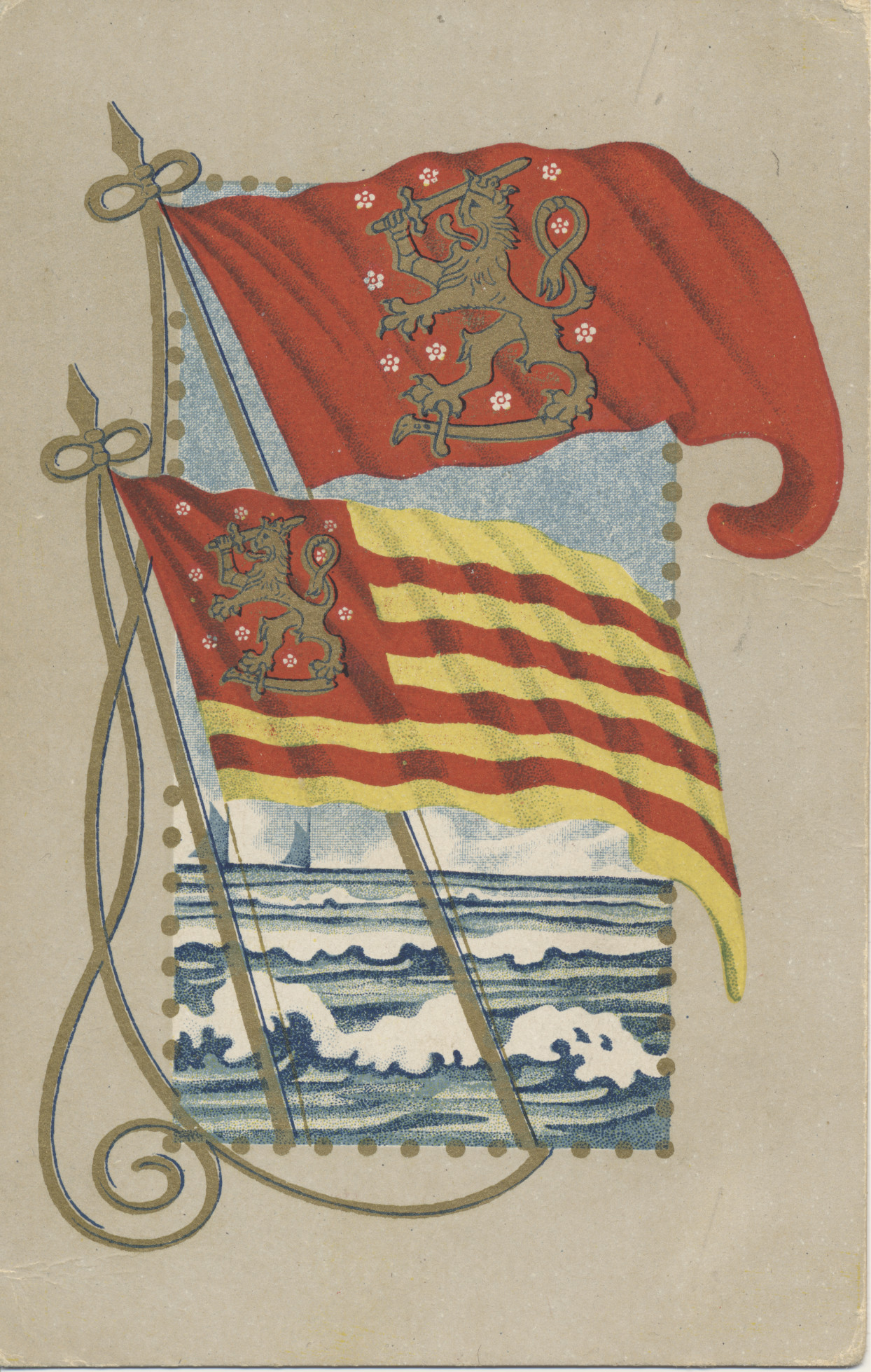
Striped flags, banners and pennants in red-and-yellow or blue-and-white were common as decorative elements since at least the 1870's. Since striped flags were seen more as festive ornaments than nationalist or separatist symbols, the authorities tended to tolerate them more readily, unlike, for example, the lion flag. While striped flags themselves were never proposed as the national flag of Finland, striped flags with the Finnish coat of arms in the canton were. These lion-and-stripes flags started appearing in the 1890's and became popular during the years of oppression. [1] While the number of stripes varied, nine was a typical choice, which stood for the historical nine provinces of Finland. Striped flags seem to have been more common in red-and-yellow than in blue-and-white, based on examples in museums and period photographs.

flag is associated with the US flag. [source]
Helsingfors Aftonblad wrote about the usage of one striped flag in 05.02.1895:
» On Tuesday, in honour of Johan Ludvig Runeberg's birthday, the flag of the Atlas Company's office on Alexander-street was flown in Finland's "newly discovered" national colours of red and yellow. The flag is divided into four red and five yellow stripes, corresponding to the number of provinces in Finland. The upper corner closest to the flagpole features a red field with eight stars and the golden Finnish lion with its swords and sabres. The number of stars also signifies the number of regions in the country. The flag was designed according to a drawing by businessman Mauritz Hallberg. » [2]


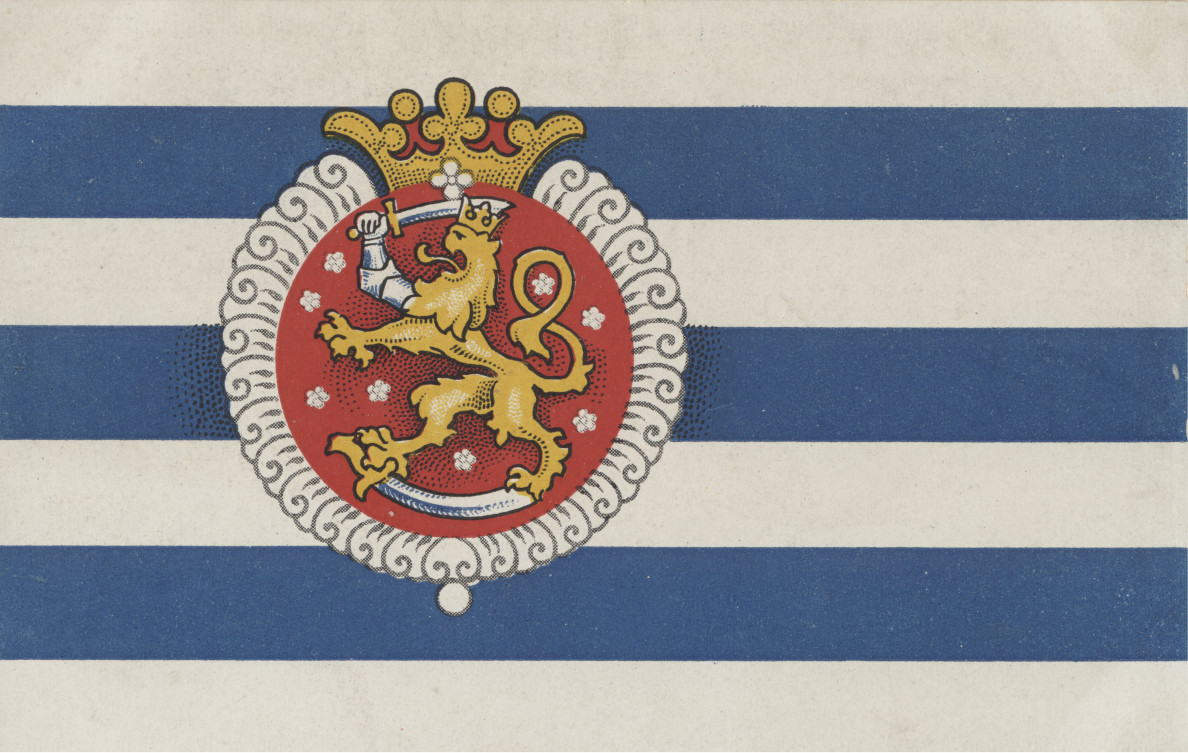
A writer using the pseudonym "von S." expressed his support for the blue and white striped flag in Turun Sanomat, 7th of November 1908. He identifies himself as a Young Finn and wants to combine the lion coat of arms with the Finnish blue-and-white colours. Additionally, he emphasizes that the flag represents the Finnish nation rather than the state itself, a common distinction among Finnish constitutionalists.
» We, the members of the Young Finns-party, have generally set our goal to follow the golden
middle path and be unifiers of all. It is appropriate for us to lead by example in this
matter as well. To achieve a common national flag, I would suggest combining all the flags I
have mentioned so that all parties come under one flag. Therefore, I propose a national flag
featuring narrow blue and white stripes, with a red field in the upper corner containing the
Finnish lion. I have had the opportunity to see such flags, and they look very striking and
splendid.
Furthermore, this would resolve one of the most persistent disputes in our public discourse.
To ensure its widespread adoption, let every Young Finn commit to obtaining such a flag, and
to doing so without delay. On our national days of remembrance, let each of us proudly hoist
our flag aloft, so that all may see it and declare: "There flies not the flag of a state,
but of the Finnish nation". As for "our colours" which we carry during public celebrations,
I endorse the proposal once put forward in this very newspaper, i.e., the colours of the
Finnish coat of arms. » [3]

Sources
- Kiljunen, Kimmo: Leijonasta siniristiin, p. 75-76. Into Kustannus, Latvia 2018.
- Helsingfors Aftonblad: En flagg i Finlands »nyupptäkta» nationalfärger. 05.02.1895. Available: digi.kansalliskirjasto.fi
- Von S.: Mikä on Suomen kansallislippu?. Turun Sanomat, 07.11.1908. Available: digi.kansalliskirjasto.fi
 Top
Top
![[a]](https://finna.fi/Record/siiri.urn:nbn:fi-vapriikkihttp%253A%252F%252Fmuseosiiri.tampere.fi%253A8080%252FVALOKUVA%252Fcontent%252FSIR_EXEC%252Fimages%252Fprimary%252F20100118%252F12637986592050.jpg?imgid=1https://finna.fi/Record/DownloadFile?id=siiri.urn:nbn:fi-vapriikkihttp%253A%252F%252Fmuseosiiri.tampere.fi%253A8080%252FVALOKUVA%252Fcontent%252FSIR_EXEC%252Fimages%252Fprimary%252F20100118%252F12637986592050.jpg&index=0&size=master&format=jpg&key=0&type=highresimg)
![[f]](https://finna.fi/Record/siiri.urn:nbn:fi-vapriikkihttp%253A%252F%252Fmuseosiiri.tampere.fi%253A8080%252FESINE%252Fcontent%252FSIR_EXEC%252Fimages%252Fprimary%252F20080707%252F12154288689940.jpg)
![[a]](https://siiri.tampere.fi/displayObject.do?uri=http://museosiiri.tampere.fi:8080/VALOKUVA/content/SIR_EXEC/images/primary/20090129/12332327519540.jpg)
![[a]](../muut/raitalippu.jpg)
![[c]](https://finna.fi/Record/siiri.urn:nbn:fi-vapriikkihttp%253A%252F%252Fmuseosiiri.tampere.fi%253A8080%252FESINE%252Fcontent%252FSIR_EXEC%252Fimages%252Fprimary%252F20040719%252F10902111759010.jpg?sid=5274941947&imgid=1)
![[e]](../muut/warrelics.webp)