Ekman, R. W., Haverinen, M: Emperor Alexander II opens the Diet of Finland in the Imperial Palace's Throne Room in 1863. [source]
In the 1860s, a public debate emerged in the Grand Duchy of Finland regarding the adoption of a flag.
Finland, once part of Sweden, was conquered by the Russian Empire during the Napoleonic Wars in 1808-09. Over
the following decades, Finland was granted extensive autonomy, including a national senate, constitution, and
even its own currency. This raised the question: why not a flag as well? As was common at the time, the primary
purpose of a flag was to be used at sea, and the purpose of a Finnish flag was to be the civil ensign of the
Finnish merchant fleet. During the Crimean War (1853-56) Finnish merchant ships suffered heavy losses at the
hands of British and French navies, who were ravaging Russian holdings in the Baltic Sea.
A decade later, the Polish Rebellion (1863-64) reignited fears that a broader
conflict could once again expose Finnish shipping to similar devastation.
These fears sparked the idea in Finland that the Grand Duchy should declare neutrality in any future war.
Such a declaration would naturally require a civil ensign distinct from that of Russia, which the Finnish ships would fly.
Finnish shipowners had already advocated for neutrality in 1859, and during the Polish Rebellion in 1863
these calls were brought forward once more.
The notion of Finnish neutrality gained further traction from the growing popularity of an idiosyncratic political theory
which argued that Finland had, after its separation from Sweden, developed into a separate state within the Russian Empire,
and existed in a state of union with Russia through a common ruler but not necessarily bound to share a common foreign policy.
The debate regarding the design and colours of the flag itself reflected Finland’s internal political and ideological
tensions. A dividing line emerged between the pro-Finnish Fennoman movement and the western-oriented liberals.
The Fennoman movement arose during the early 19th century and its goal was to elevate the status of the Finnish
language in culture, education and administration. In spite of Finland's incorporation into the Russian Empire,
the local Swedish-speaking elite continued to dominate the Duchy's governance and Swedish was the de facto language
of administration. The Fennoman movement was initially favoured by the Russian authorities, as it was perceived as a
means to diminish Swedish influence in the Duchy. Many Fennomans, in turn, expressed loyalty towards the emperor
in order to continue to elicit this support.
As early as the Crimean War in 1854, author Zacharias Topelius had began to promote blue and white as Finland's national
colours. Poetically they were grounded in Finland's nature - its blue waters and white winter - but an underlying political factor for Topelius was
also the association of the colours with other Russian maritime flags, primarily the St. Andrew's flag of the imperial navy
(blue saltire on white). Topelius was an outspoken loyalist of the imperial order and strongly advocated for loyalty
via his writings. He was also a central figure in developing Finnish culture and supported the advancment of Finnish
language rights. These colours would, thanks to Topelius, be accepted by the Fennomans at large and
various blue-and-white flags were flown by the movement all the way until independence in 1917. The most
prominent design was the so called Marstrand-flag flown by Topelius himself in 1862.
In contrast, the young-liberals who gathered around the newspaper Helsingfors Dagblad, favoured the colours of the Finnish coat of arms.
The so called Dagblad-flag featured a yellow cross, bordered by blue, on a red background. The flag had a strong Scandinavian
association since the coat of arms originated from when Finland was a part of Sweden and the cross likened it to other Nordic flags.
For the liberals, the flag represented Western ideals of constitutional liberalism in contrast to an eastern, unrestricted
form of imperial autocracy. The young-liberal camp thus formed a counterforce to the more loyalist wing of the Fennoman movement, and the
different flags symbolized this divide. A linguistic divide also played a role, since liberalism tended to be more popular
among Swedish-speaking Finns.
The public debate over the flag began in 1862 and continued until the Diet of 1863, when Tsar
Alexander II visited Helsinki, the capital of the Grand Duchy. The nobility wanted to present the Tsar with
a proposal for a civil ensign for Finland's merchant fleet. However, Field Marshal Nordenstam, the chairman
of the nobility, refused to discuss the matter, citing the absence of any reference to a flag in the Grand
Duchy's constitution. In spite of the failure to adopt an official flag, private citizens continued to fly
flags unofficially, and for the time being, Russian authorities largely turned a blind eye to this practice.
Most of the flags proposals during this time never saw any actual use in practice. The majority remained as
concepts, never materialising into real flags.
1. Fredrik Nylander and the Beginning of the Flag Debate
In 1862, by the decision of Emperor Alexander II, the so-called January Committee was convened, tasked
with preparing the matters to be decided at the ordinary Diet in 1863. The committee considered a variety of issues,
one significant topic being the expansion of economic freedom, which included discussions on the rights and liberties
of Finnish merchant ships in international trade. Inspired by this discussion, public reflection began on the need for
a Finnish civil ensign. The mayor of Savonlinna, Jakob Mölsä, raised the matter at the January Committee on the 20th of
February, but it was chiefly Oulu-based Fredrik Nylander who brought it to wider public attention through his articles
in Oulun Wiikko-Sanomat[30].
Fredrik Nylander was a physician and botanist from Oulu and he was also involved in financing the newspaper Oulun Wiikko-Sanomat.
In 1862, he published several opinion pieces in the newspaper arguing that Finland should have its own consuls abroad as well as a separate
civil ensign for Finnish ships. Nylander emphasised the significance of Finland’s merchant fleet compared to the rest of the empire.
At the same time he expressed support for the political theory according to which the Grand Duchy of Finland was a separate state
alongside Russia, sharing only a common ruler. This theory was put forth by professor Israel Hwasser in the 1830s, and it gained particular
popularity in the 1860's. Based on this theory he argued that Finland had the constitutional right to adopt a distinct civil ensign. [31].
On the 1st of March, 1862, Nylander wrote:
» The Grand Duchy of Finland is constitutionally distinct from the Russian Empire in its form of government,
administration, and governance, and, to our knowledge, no other bond exists save the common sovereign who
unites these states. The sole treaties in this regard are the solemn assurances given by our present and
late Grand Dukes since 1809, upon ascending the throne, to maintain and observe inviolate the religion,
fundamental laws, and privileges of Finland. The oaths of allegiance sworn to the Emperor of Russia,
our Grand Duke, are the Finnish people’s acknowledgment of their consent to this union. Evidently, the
relationship between Finland and Russia is of the same nature as, for example, that between Sweden and
Norway - or what is termed a real union founded on equality of rights and full political sovereignty
among the parties (unio realis jure æquali).
We possess our own laws, financial administration, military, and so forth - in short, all the hallmarks
of sovereignty. Would it, therefore, be unreasonable or unfounded to demand an external, public symbol
that would recognise and attest to our political status, such as a distinct civil ensign?
Certainly not; we have an indisputable right to this demand. » [31]
Nylander's state flag.
Nylander's civil ensign.
On the 12th of July, Nylander proposed a specific design for the civil ensign: a four-square red-and-white flag, with two red and two white
squares arranged in a cross. He also suggested that the Grand Duchy could simultaneously adopt a state flag featuring Finland’s
golden lion on a red background. Notably, Nylander depicted the Finnish coat of arms in the so-called Brenner style,
with the lion holding the curved sabre in its paw. This style was still common in the 1860s, whereas from 1886 onwards the
so-called Bomansson model, in which the lion tramples the sabre underfoot, became prevalent [10].
» We all know the coat of arms of Finland. It is a lion holding a vertical sword in one forepaw and a saber
in the other, standing on top of it, surrounded by roses, on a red background. The coat of arms of Finland
proper, now the Province of Turku and Pori, also had a red and partly silver-painted base. This would suggest
that the Finnish national flag ought to be red with the image of a Finnish lion in the centre and whatever else
it might have included.
The case for the the civil ensign is different, because decorations and pictures on
it are inappropriate and excessive; and probably partly for that reason many states have distinguished it from
their state and war flags. As such, Russia has the civil ensign of Holland, being distinguished by having the
colours in a different order. This flag was established by Peter the Great. Finland would therefore also be free
to choose on this point, but it seems more natural that the colours of the state should be used on this flag
as well, as has been done in many other kingdoms; but it is difficult to say exactly what they are.
The red colour is undoubtedly part of it, and silver also seems to shine in the Finnish coat of arms,
so we think that the Finnish flag of commerce should be red and silver, or white, and these colours placed on it
in such a way that two squares of different colours would be side-by-side, crossed. » [11]
The rest of the Finnish press initially received Nylander’s writings with cautious interest, but no other concrete proposals
were made in 1862. It was only at the beginning of the following year, as the Diet approached, that the discussion began to
intensify, reaching its peak in the summer of 1863. Zacharias Topelius had already, before Nylander, tried to promote blue
and white as Finland’s national colours and had even flown a blue-and-white flag at a sailing competition in Sweden on the 4th
of July, 1862. However, it was Nylander’s persistent
writings that truly set the discussion in motion.
2. Zacharias Topelius and the Origin of Blue & White
Flag of the Russian Navy.
Author Zacharias Topelius was the first to introduce the idea of blue and white as Finland’s national colours.
He addressed these colours for the first time in 1854, and their introduction was linked to the ongoing
Crimean War and the tense situation it created in Finland. British and French navies had entered the
Baltic Sea and forced the Russian navy into retreat, which threathened Finnish merchant ships, coastal towns
and fortifications. There were also fears that the war may widen to include Sweden, which could
result in a devastating land war in Finland.
Topelius' colours were based on the Russian Navy’s blue-and-white flag, the St. Andrew’s flag, which
featured a blue saltire on a white field. The choice
of colours was no coincidence, it was Topelius’s way of emphasising Finland’s loyalty to the Emperor
during the uncertainty caused by the war.
Topelius was not just a poet but also a public figure loyal to the Russian imperial authority.
He believed that Finland’s security and future depended on cooperation with the Emperor,
rather than any attempts to re-unite with Sweden. During the Crimean War, Topelius actively used
his writings to reinforce Finnish loyalty to the Emperor, fearing Swedish influence and the
destabilisation of Finland’s position should Russia suspect separatism and take countermeasures.
During the Crimean War Topelius published a fair number of writings related to the war,
and in this context he also began shaping the blue and white colours into symbols of Finnish identity.
In April 1854, he published the poem “To the Finnish Naval Equipage”, in which he praised
the Finnish marine infantry unit and the flag it carried; the flag of the Imperial Russian Navy.
In the poem he emphasized how the flag was 'ours' and carried Finnish duty and honour with it,
writing: “Wherever your flag reaches, that flag is ours as well” and “The honour of our flag is in safe hands with you”.
In doing so, he associated the flag’s blue and white colours with Finland. [1]
In May 1854, the first battle between Finns and the British forces occurred at the skirmish of Vitsand
in South-West Finland. The clash drew significant attention, as it was the first battle fought on Finnish
soil since the war of 1808-09. After the battle, Topelius published the poem “The First Drop of Blood”,
which praised the Finnish defenders and aimed to stir patriotic enthusiasm among Finns,
encouraging them to take up to arms. This poem drew much attention to Topelius due to its zealous fervour. [32]
Earlier that same year, in February, Topelius had also published the story “The Fortress of Finland’s Defence”
in the children’s magazine EOS. The story was intended for a young audience and sought to evoke patriotic feelings during the wartime period.
It also presented the Finnish flag and its blue-and-white colours even more explicitly. Topelius described a
snowball fight in which children fought as the 'good Christians' against 'evil Turks', in reference to the ongoing
Crimean War. When the Christians defended their snow fortress, they first raised a red scarf as a flag,
but the main character, General Mathias, dismissed it as unsuitable and quickly replaced it with a blue-and-white
flag. He emphasised that the blue-and-white flag represented Finland and that red was not an appropriate colour
for Finns. The justifications for the blue and white, Finland’s winter and waters, were the same ones
Topelius would later use in the national flag debate. [2]
Tuomas Tepora writes in his book "Sinun puolesta elää ja kuolla" ("To Live and Die for You", 2011) about the significance of the tale:
» During the Crimean War, concerns arose in Russia that the conservative elite in the Grand Duchy of Finland,
which was oriented towards Sweden, might exploit the wartime situation to pursue separatist goals. Topelius's
tale was the liberal camp's response to these suspicions. The story, in fact, introduced for the first time
blue and white as the colours of Finland, which later in the century became the colours of the Fennoman movement.
To the enlightened contemporaries, the symbolism of these colours left no room for interpretation: they were the
colours of the St. Andrew's flag and thus referred to the Russian navy. This was therefore a demonstration of
loyalty to the Emperor, and it contained an expectation of reciprocity for the emerging Finnish-speaking educated class. »
[3]
Some years later, in 1862, Topelius participated in a sailing competition in Marstrand, Sweden, along with his friends.
For the event, the group created a flag to represent Finland, which they hoisted on their boat. The flag was,
just like in Topelius' story, blue and white. Topelius wrote about the flag in a letter to his mother from Marstrand
on the 4th of July 1862:
"Friday, 4th July. Just recently, we received a letter via Helsinki from Carolina Borgström in Gamla Carleby,
and we were delighted to hear the first news of your and the children's safe arrival. There has been no letter
from you or Augusta. Perhaps it got lost? Emelie and the girls are currently making the first Finnish flag to
ever wave over the Atlantic. Blue and white, with the Finnish lion in a red field." [4]
Flag flown in Marstrand by Topelius et al.
Versions without the lion were more common.
Illustration from Topelius tale (1854), which includes a two-part blue-and-white flag, similar to the Marstrand flag in 1862. [2]
This flag later came to be known as the Marstrand flag, or more generally Topelius’s flag,
and while the same flag had already appeared in Topelius' children's story published in 1854,
now it was flown publicly for the first time as the flag of Finland. It is also the first
Finnish flag in blue-and-white.
When the discussion about a Finnish flag intensified in the press in 1863, Topelius began explicitly promoting the use of
blue and white in a Finnish flag. He took part in the public debate primarily through the newspaper Helsingfors Tidningar,
writing under the pseudonym Undecumque. Topelius had served as the paper’s editor-in-chief until 1860,
and Helsingfors Tidningar quickly positioned itself as an advocate of the blue and white colours.
Topelius also wrote a poem about the Finnish flag, which was published in Helsingfors Tidningar on the 15th of June, 1863.
In connection with its publication, he described in more detail the flag-raising at Marstrand:
» The reason for this flag poem was as follows. Last summer, Marstrand's numerous Finns formed a sailing club,
which sailed a respectable ship and appointed the oldest sailor in Marstrand, old man Fägersten, as helmsman
and pilot. Now all of Marstrand's sails were ready for the big race, and the blue and yellow Swedish flag
began to flutter grandly on all masts. Naturally, the Finnish boat should have a Finnish flag, but the question
was, what should it look like? What did the Finnish flag actually look like?
An 'extraordinary parliamentary session' pondered this question and unanimously decided that the colours of the
Finnish flag could only be white and blue. Decisions are swiftly made in such sessions. The idea received
immediate and proper approval from the highest authority, namely the young ladies of the sailing club,
who enthusiastically embraced the matter. It didn't take long before a splendid flag, white on the top half
and blue on the bottom half, was hoisted on the mast of the Finnish boat. To resolve any doubts about its
nationality, a crowned Finnish lion with all its accessories was embroidered in the top corner. »
[5]
Publicly, Topelius did not directly state that the blue and white colours originated from Russian naval flags,
instead he emphasized their connection to Finland’s nature and maritime traditions. It was precisely these poetic,
nature-based explanations that inspired Finnish-nationalist Fennomans to adopt the blue and white colours as their
colours. Topelius wrote a defence of the blue and white colours in the Helsingfors Tidningar newspaper on 9 June 1863:
» In the following proposal regarding the colours of the flag, let our understanding prevail:
The young nation, stepping onto the world stage like an unwritten page of future history,
could best depict its new position with the colour white. White is the attire of youth when they come
to the Lord's table to answer for their own deeds. The flag confirms Finland's maritime identity.
White is our country's colour during the six frosty months that enclose our ports - as mentioned, the Finnish
flag is a necessity through nature.
But alongside this, another colour must be included, symbolising the freedom of our lakes and ports when
all sails swell and glide out to sea, namely blue. Should we be blind to the clue that comes from Finland's map,
which is largely blue both inside and out? As a daughter of the sea, from which it has risen, and from which its
rise continues, Finland must use both colours of the northern seas in its flag, white and blue, the colours of
closing ice and open water. White and blue are also the colours of those countries with which our historical
memories are linked, but unlike red and yellow, they embody not dominance but freedom, friendliness, and traditional
significance.» [7]
Over the following decades, that Marstrand-flag became the principal flag flown by Finnish nationalis and the
Fennoman movement. It was used at various festivities celebrating Finnish culture and language, such as song
festivals, which were popular at the time.
Even during the period of Russification (1890–1917) the Fennomans continued to use blue and white, as these colours had by then shed
their association with Tsarist loyalty and come to symbolize Finnish nationalism instead.
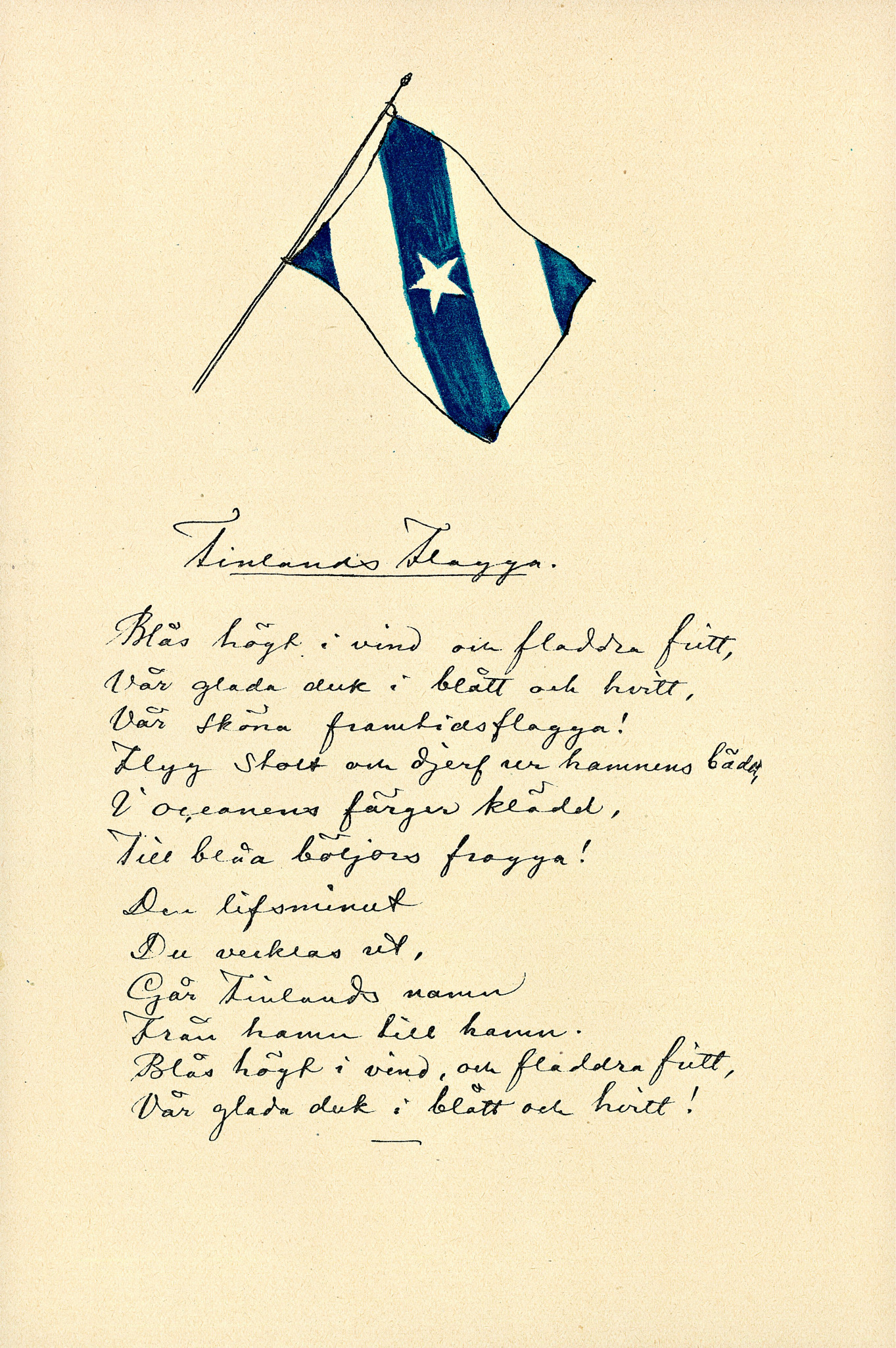
The Marstrand-flag was not, however, the only flag designed by Topelius. In fact, his main proposal for the
civil ensign of the Grand Duchy was a blue-and-white flag with blue diagonal stripes and a white
star in the middle. He developed this proposal early in 1863 and tried to find support for it both
in newspapers and by personally contacting shipowners across the country. Even though the flag
was much discussed during this time and was flown in Viborg alongside the Dagblad flag when the
emperor visited the city on his way to Helsinki, the flag never caught on. The flag was considered
too reminiscent of the Russian Navy’s St Andrew’s cross, and the diagonal stripes were thought likely to wear
quickly in the sea wind. Consequently, the proposal was soon forgotten, and in later years Topelius' flag was
understood to exclusively mean his Marstrand design.
In a letter to sea captain Böckelman from Uleåborg, Topelius tried to muster support for his diagonal flag and included a drawing of it:
» I would be interested to hear Captain's opinion on the attached project for the Finnish civil ensign with the
northern star in the centre. I know it has its drawbacks, such as the faster wearing of the diagonally cut fabric,
but among the many alternatives here, we have still considered this the most beautiful, and Finland's colours
are white and blue.» [6]
Drawing of the flag in Topelius' letter to Böckelman. [source]
After his design with slanted lines received some criticism for being prone to wear,
Topelius presented alternative designs in blue and white the 13th of June 1863. The main
goal for Topelius was that a blue and white flag of any kind would be adopted by the
Finns, while the exact form was secondary. He even proposed, in case it would be more
palatable for authorities, that Finnish ships would continue using the Russian civil ensign
with a Finnish flag only added into the canton.
» If a white flag with blue corners and a diagonally placed bar with a white northern star in the middle,
as previously proposed, is difficult to implement, this is by no means the only way to juxtapose these colours.
Either a white Latin cross can be placed on a blue background, or the upper half can be white and the lower
half blue, or alternatively, a white northern star alone on a blue flag. None of these combinations are in
use by other nations, and no sailor has difficulty distinguishing between these two colours in light wind,
whereas Dagblad's flag can easily be confused with the Swedish union flag. » [8]
3. Fredrika Runeberg's Variation on Topelius' Flag
In February 1863, Zacharias Topelius and his wife held a social gathering at their apartment
in Helsinki which included poet Johan Ludvig Runeberg and his wife Fredrika Runeberg.
J.L. Runeberg was a well known Fennoman poet and the author of the then
unnofficial (and later official) national anthem of Finland. The topic of
the Finnish flag was much discussed during the gathering and Topelius had
also read his poem for his blue-and-white flag. The topic had interested
Fredrika Runeberg to such a degree, that aftewards she sent a letter
to Topelius, proposing that the diagonal stripes ought to be changed
into horizontal instead.
» Dear Professor,
After we had settled down from our journey, my thoughts turned eagerly to the Finnish flag. Call it a
"women's scheme," "tailor's wisdom," or whatever you wish, but I must say I have my doubts about the
practicality of that beautiful flag. The edges will be diagonal, making it difficult to hem when sewing,
and the threads will pull at an angle. Additionally, the flag will be waving along the fabric's bias.
This makes it completely different from when it is along the straight grain. Moist winds might cause it
to bunch up. As soon as I got home, I had to try sewing a small flag, which confirmed my concerns.
(...)
I take the liberty of including my small flag to show how I envisioned it, though without the star, which is
unnecessary for this purpose. If the diagonal design is unsuitable, perhaps the same form with stripes along
the length of the flag would be beautiful with a star. Wasn't there a design like that? Three blue stripes,
two white stripes. » [9]
Topelius replied to Fredrika Runeberg in a letter on the 26th of March, agreeing with her points regarding the
diagonal cuts. Fredrika's flags were, however, never mentioned in Topelius' public writings and his Marstrand design
became more popular anyway.
» Your 'tailor’s concern' about the flag has been so much to the point that I have since heard the same remark made
from several other quarters. Emili [Topelius' wife] , to begin with, has reached the same conclusion with her models made from both shirting and flag cloth.
The same remark was also made by a group of sea captains and merchants in Oulu, to whom my brother-in-law Lindqvist showed the model.
However, when they considered the difficulty of the diagonal seams, which would be less durable and more easily worn,
one of them in turn observed that if Finland can afford to provide itself with a flag, the shipping companies can also afford
to pay for one once a year. I have now sent the model to Böckelman and requested his opinion. It may very well be that the blue stripe in the middle
should, as the Professorska suggests, run straight across the cloth; I also believe that the colours are the essential matter and their arrangement
of lesser importance, provided they are made as distinctive and beautiful as possible. Another question is whether the flag will be permitted
and have any practical significance – which Gabr. Tengström and others have their doubts over – but for the moment that is of less consequence, so long as
it gradually becomes a tradition. » [9]
One of the most popular and widely circulated designs during the 1860s debate was the so-called Dagbladsflaggan,
which featured a blue and yellow cross on a red field. An unnamed shipowner had proposed this flag to the newspaper
Helsingfors Dagblad, and when the newspaper began to support it in the public debate, it became known as the Dagblad flag.
According to Dagblad the colours stemmed from the Finnish coat of arms with its yellow lion on a red field. The blue colour was
said to represent the lion's swords while the cross stood for christianity.
Dagblad flag used to represent Finland on the cover of an Italian book on nordic poetry from 1881. [14]
Helsingfors Dagblad was a liberal newspaper that functioned as the main advocate for Finnish liberalism in the 1860's.
The paper's political program was formed by its editor-in-chief Edvard Bergh,
journalist Anders Herman Chydenius and captain Robert Lagerborg, who in anticipation of the diet in 1863, promoted a series
of liberal policies that ought to be presented to Tsar Alexander II. These included, among others, the establishment of
regular diets with legislative rights, freedom of trade, abolition of press censorship and, notably, granting the Grand
Duchy a status of neutrality in any future wars. According to Dagblad, Finnish neutrality would benefit not only Finland, but
Russia and Sweden as well by ensuring long lasting peace in the Baltic region. A separate flag would, consequently, be necessary
to adopt for Finnish merchant ships to fly on the seas.
In the Russian press, however, the call
for neutrality was interpreted as a indication of separatism, while the Swedish press saw it as proof of Finnish
dissatisfaction in Russian rule.
The radically constitutionalist liberal line of Dagblad functioned as a counterpart to the more loyalist view of Fennomans like Topelius.
While the Fennoman movement, including Topelius, largely embraced liberal ideals as well, they tied these values together with loyalty
to the Tsar, by whose grace these liberal rights had been granted for Finland and the Finnish language. The liberals who gathered
around the Dagblad were, in contrast, sometimes referred to as young-liberals, since they represented a more radical form
of liberalism that looked to challenge the establishment more than other groups would. The conservatives, at this time, consisted
of the bureucratic elite and civil servants, who weren't so much an organized political entity, but functioned as an anchor against the
rise of liberalism which was broadly embraced by the youth.
The Dagblad flag arose from these ideals of western liberalism and a constitutionalism which stood in contrast to
an eastern form of unchallenged imperial autocracy.
The Dagblad's constitutional liberalism was more popular among its Swedish-speaking population and, as a result, the
flag proposed by Dagblad was also more popular with Swedish-speakers. They appreciated the
Scandinavian nature of the flag's cross design which saw its colours derived from the Swedish-era coat of arms
of Finland. The flag did gain some support among the more moderate wing of the Fennomans who agreed with
the liberal policies of Dagblad, however, over the years the Dagblad flag became increasingly
associated with the Swedish factions in Finland. Although Finland ultimately did not receive its own civil ensign,
the Dagblad flag nevertheless remained in use and seems to have been initially more widely spread than the blue-and-white
flag of Topelius. In a letter from late 1863, for example, Fredrika Runeberg notes that the Dagblad
flag appeared to be surpassing the blue-and-white design in popularity. [33]
During the 1860s when yacht clubs were established all around Finland, the clubs of Airisto and Björneborg tried to petition the Emperor
for permission to use the Dagblad flag on their ships. The petitions were, however, rejected, as the Empire’s yacht
clubs had already been assigned an official blue-and-white cross-flag design.
[23][24]
» But may we be permitted to correct Mr. C. F. on one point. Mr. C. F. has overlooked the fact that the bright yellow Finnish
lion has a sword in its frame; and this sword is of steel and must therefore be blue. For although the story of the Finnish
lion contains many dates testifying to valour in battle, it does not, so far as we know, record any occasion on which it was
slain with a golden sword. The colours of the Finnish coat of arms are in fact red, yellow and blue. (...)
It is not easy to introduce a new flag that has both beautiful and distinctive features,
given the many existing flags. If the flag is to harmonise with the nation’s history and the country's
heraldic or poetic symbols, the task becomes even more challenging. However, we believe that the problem
can be solved with the flag that has been proposed here in Helsinki, which has been favoured by the many sailors
and shipowners we have consulted.
This flag would consist of a yellow cross with blue borders on a red background. As is well known,
the Swedish flag consists of a yellow cross on a blue background, the Danish flag of a white cross on
a red background, and the Norwegian flag of a blue cross with white borders on a red background.
Therefore, Finland’s flag can be easily distinguished from all other Scandinavian flags at first
glance. It would not lack Finland’s blue colour, long accepted, unlike the flag proposed by C.F.,
and it would not be difficult to distinguish in light winds or lose its regular shape due to wind,
as would happen with a flag featuring a blue diagonal band, the only possible form for a flag composed
of blue and white. Moreover, a white flag with a blue diagonal band would be hard to distinguish from
the Russian imperial flag, which has a blue St. Andrew’s cross on a white background.
It is of utmost importance to reach a consensus on adopting a common civil ensign for the whole country as
soon as possible. We believe that the proposed flag deserves full recognition. History and heraldry support
it, and it undoubtedly looks well fluttering in the wind. The fact that its background colour is red is more
than justified for anyone considering the country’s history thus far. And yellow is not the colour of ‘decay’
but of the ‘golden chalice,’ symbolising grain and gold: from the blood-fertilized field, we harvest the fruits
of our peaceful labour. Blue, the colour of steel, symbolises labour and loyalty to the homeland. Thus, it
rightly surrounds the gold.
This red-blue-yellow flag is not overly colourful but appears vibrant in the wind. It is unique:
a privilege earned through hard work. And it features the Lutheran cross, the symbol of our faith! » [15]
During the 1870's, the language strife between the Fennomans and the Swedish factions flared up, leading
to the founding of the Svecoman movement and the Swedish Party. The Svecomans advocated for a more aggressive form
of pro-Swedish policies and stood in opposition to the Fennomans. The liberals, on the other hand, tried to position themselves as a more
moderate voice in the strife, but failed to do so successfully. The liberal movement eventually merged with
the Svecomans and Helsingfors Dagblad ceased to exist in 1889. During the 1870's and 1880's, the Dagblad
flag remained in use with Swedish-speakers and the Svecoman movement, but only sporadically. By the 1890's the
flag was hardly seen anymore. During the Years of Oppression (1899-1917), when Finland was subjected to
Russification policies, the topic of Finland's flag and colours became a heated topic once more. At this stage the Svecomans
began flying a wide variety of red-and-yellow flags instead, dropping the heraldically inaccurate blue colour altogether.
The Dagblad flag made one more appearance after independence in 1917, when the Ship Officers' Union proposed it
as the civil ensign of Finland, but this proposal did not succeed.
5. Arno-flag by Otto Donner
In 1863, linguist Otto Donner published a pamphlet titled "Om Finlands Flagga"
under the pseudonym Arno. In it, he presented his own proposal for the Finnish
flag, which was based on Topelius's diagonal flag except the blue corners
were replaced with red ones. Donner believed that Topelius's flag too closely resembled
the Russian naval flag, so he added the red colours to represent Finland's historical
battles. Donner was also critical of the Dagbladet flag, considering
the blue colour as heraldically incorrect. Additionally, he thought the flag
resembled other Nordic flags too closely. Although Donner's proposal attracted
attention - partly because was published and printed as a booklet - it did not gain
broader support.
History supports it. For over fifty years, the Finnish merchant fleet has used
a flag with three colours: white, blue, and red. This has become established for us. Previously, we shared
a flag with Sweden, but at that time, we were merely a province. The blue colour can be seen as a reminder
of that era. These three colours, which Peter the Great brought from the Netherlands, are still used by the
Dutch and the French, and are therefore not exclusively Russian. Now adopted, they would signify that Finland
began its unique development as a separate state from 1808 onwards, which was not possible under Swedish rule.
The blue colour can also symbolise Finland’s blue lakes, and the white, its foaming waves. These colours are
dear to us since time immemorial; even today, conscript soldiers and guards wear them: blue and silver. Red,
as mentioned, represents the bloody struggles endured by the Finnish people in times past; the blood that
soaked into the snow during battles and flowed from the cheeks of heroes.
It cannot be mistaken for any other flag in the world. It is new and distinctive,
standing out from other flags both in the wind and when still. Additionally,
It conveys the image of a distinct nation. It is crucial that upon first seeing
the flag, both foreigners and we ourselves receive a representative impression of a new nation emerging in
history as a separate entity.
It is beautiful. And this is not merely a personal opinion. It is widely
acknowledged that the tricolours of France, the Netherlands, and Russia, which feature blue and red
supported by white, are among the most beautiful flags in existence. This flag follows in similar
pattern, but in a different manner. A flag with white is easily visible, fluttering like a cloud above the sails.
The red fields bordering the white give the appearance of being dipped in blood, undoubtedly evoking Sandels by Runeberg:
"Past the ranks, in its blood-red hue, a white steed now flew." » [20]
After the publication of Donner's booklet, a back-and-forth ensued between Donner and Dagbladet where they
both criticized each others' flags.
Dagblad mocked Arno's flag as ugly, childish-looking, and too Russian.
The paper also accused Donner of misrepresenting their flag by including an image of it in his booklet, where
the blue stripes were too narrow, making it easier to confuse the flag with the flag of Denmark (since yellow would be fade into white over time).
6. Hull Sailor Flag
Newspaper Åbo Underrättelser published a letter from a seaman in its edition of 21.02.1863, signed with the initials C.A.S.,
which describes two flags designed for Finland by seamen who spent Christmas in Hull, Great Britain.
» A Finnish captain, C. A. S., writes from Hull on 24th January:
» For the past six years, I have spent Christmas at sea; this time, I was fortunate to spend it in port. All of us, about 20 companions from Finland,
were invited on Christmas Eve to the ship S. from Oulu, hosted by Captain A. S., where everything was arranged in a patriotic manner. Lutfisk
was not missing, nor was rice porridge with milk. You may laugh at my childishness for mentioning such things, but you will soon hear that our conversation
also covered more serious matters. (...)
I have also received your letter from 28th December and presented to my companions what you mentioned regarding Dr N.'s [Fredrik Nylander’s] proposal for
Finland's own flag. You know how much we long for such a thing, so that we are no longer mistaken with poorly sailing Russians. But Mr N.’s flag,
although its silver field is beautiful, resembles the new English signal flag too much to serve as a national flag.
A. C. sends his regards and asks you to present in Åbo Underrättelser our proposal, which admittedly somewhat resembles John Bull’s flag,
but which all Finnish captains I have spoken with approve of:
Fields white, crosses red, with Finland's coat of arms in the centre.
Our voices may not carry far, but let us make them known nevertheless. My next destination is Havana or Matanzas, where A. C. set sail yesterday, and many
have already gone ahead of us, though freight rates are not particularly favourable at the moment. Something must be done, however, as sailing on the
Black Sea is no longer feasible these days.
Due to the negligence of Russian consuls, letters are often lost in Havana and Matanzas. Therefore, obtain my address from the shipping company B. »
This letter shows that interest in homeland affairs is strong even among those Finns who have spent years traversing the oceans. If only our newspapers
could reach even a few miles beyond Finland’s borders. For instance, one copy of Åbo Underrättelser always arrives in Hull, kept by Mr I.G. A Swede residing in
London, H. A. L., last year offered his friends copies of Helsingfors Tidningar. Our captains also complain that The Times and other respected British newspapers
write little or nothing about Finnish affairs. In the less respected newspapers, one may sometimes find more or less foolish reports, likely based on sailors' tales
and other similar hearsay. » [12]
7. Carl Forsman
In the issue of Finlands Almänna Tidning dated 1st June 1863, Carl Frederik Forsman, a secretary in the
Senate's Department of Justice, presented two flag proposals.
Forsman's 1st design, civil ensign.
Forsman's 1st design, state flag.
Forsman's 2nd design, civil ensign.
Forsman's 2nd design, state flag.
»The main components of Finland’s coat of arms are the golden lion and the blood-red field.
Therefore, Finland’s colours are gold and red. As is well known, in heraldry, gold can be replaced
with yellow and silver with white if gold or silver cannot be used for some reason. Thus, we can
use either gold and red or yellow and red. Gold, or yellow, is the primary colour and dominates
over red since the heraldic animal is yellow.(..)
Finland’s colours, gold and red, can be used in the
flag in various ways. The simplest would be to make the upper half of the flag yellow and the lower half red,
similar to how Lübeck's coat of arms colours were used in Lübeck’s flag. The flag can also incorporate the
Christian symbol of the cross, with the cross being yellow on a red background. The cross should not be a
St. Andrew’s cross but rather a simple Latin cross. The cross has often been used in flags; for instance,
the Swedish flag has a yellow cross on a blue background, the Danish flag has a white cross on a red background,
the Hanseatic flags have a red cross on a white background, and the Greek flags have a white cross on a light
blue background.
This simple flag would be Finland’s civil ensign. Finland’s state flag would
be based on the civil ensign but would also include Finland’s coat of arms in the centre,
as is customary with state flags. » [13]
8. Extra Fenniam
Pen name "Extra Fenniam" sent an opinion piece to Helsingfors Dagblad the 11th of September, 1863. He argued that while the colours of the Dagblad flag
were appropriate, their arrangement made it difficult to distinguish the flag from the Danish and Norwegian flags at sea. Instead, he argued, they
should be arranged by placing a yellow (or white) cross on a two-coloured background, which would make it stand out from all other cross flags.
Helsingfors Dagblad briefly comments in response, that the proposal does not change their mind, at least.
A similar design also appears on the cover of Franz Wick's sheet music.
Version 1, with a yellow cross.
Version 2, with a white one.
» From the not inconsiderable number of articles already seen in the newspapers regarding the choice of colours for a Finnish Civil Ensign and its construction in general,
it appears that the design recommended by Helsingfors Dagblad - a yellow cross with blue borders on a red field - has thus far been regarded as the most notable. It is
conceded that red, blue, and yellow may, on heraldic grounds, be considered to represent the colours of Finland; but the manner in which these are combined in the proposed
flag may be considered less successful, assuming the intention was to design not only a visually pleasing but also a functional flag, that is to say, one which would be easily
distinguishable from other similarly shaped flags, even at a distance and under unfavourable lighting. That a red flag with a yellow cross and blue borders would, in this latter
regard, fail to serve its purpose will doubtless be acknowledged by anyone who has observed how difficult it is - even with the aid of a good telescope - to distinguish,
at a great distance or when the flag is not fully unfurled, for example, the Danish flag from the Norwegian. Under certain conditions, the cross on these flags either
becomes invisible to the eye or blends to such a degree with the red field that one becomes uncertain of the colour and outline of the cross.
Since this same disadvantage undoubtedly applies also to the yellow-and-blue cross on a red field in the so-called Dagblad flag, the writer - in the event that the question
should lead to a practical outcome - has conceived that a Finnish Civil Ensign, to distinguish it from those of other states, could consist of a horizontally divided field,
the upper half red, the lower dark blue, with a yellow (or preferably white) rectangular cross running across the entire length and breadth of the flag. The width of the cross
should be approximately 1/5 of the total height of the flag. Whoever takes the trouble to design such a flag will, together with the writer, find that it is not only pleasing
to the eye and easily recognisable even at a great distance, but that it is also somewhat original, as it bears the cross that so many other states around the Baltic Sea does -
but does it so not on a single-coloured field, but rather on a two-coloured one, which for the strict defenders of heraldry may consider a reminder of the formerly divided Finland
now happily united into one. And with this, the flag is hereby most earnestly recommended to the favourable consideration of those concerned. » [19]
9. Helsingin Uutiset
The newspaper Helsingin Uutiset published an editorial on the 20th of July 1863 criticising the
flag by Dagblad and proposing three alternatives.
» Generally, we would not like such a matter to become a partisan issue, as the Scandinavian proposal from
Dagblad makes it. Various proposals can be made, and the Estates together with the Government should choose
from them. If it is desired to have yellow in our flag as a memory of the ancient Swedish rule, then three
stripes could be used: blue, yellow, and red. If a cross is deemed necessary (London, Genoa, and Sardinia,
as well as regions around the Baltic Sea, all bear a cross on their flags), why not a red cross with yellow
or green edges on a blue background? Regardless, we cannot support Dagblad's proposal. » [21]
10. White & Blue Cross Flag
In Helsingfors Tidningar on the 28th of July, 1863, a writer signing as "-k" proposed a flag featuring a white cross
on a blue background, with the Finnish coat of arms in the centre to distinguish it from the Greek flag.
White cross on blue.
» A broad, white Latin cross on a blue background may not be the most splendid and brilliant flag, but
it is national because it reflects our modest origins; it is practical as it presents the colours clearly
and distinctly; it is harmonious as one colour does not overpower another. We do not have any flag maps at
our disposal, but we remind you that even in Greece, flags feature a blue background with a white cross;
to distinguish our flag from theirs and give it a more beautiful and orderly appearance, nothing could be
more national, beautiful, and practical than placing our red coat of arms with the golden lion of Finland
in the centre of the white cross. The coat of arms in this case should be large enough that its corners
exceed the cross’s corners; this does not disrupt the harmony of the colours but rather makes the flag
more practical. » [22]
11. Union Flag
In Helsingfors Tidningar on the 24th of August, 1863, a writer signing as "-m" proposed a flag design featuring a white cross on a blue
background, with the Russian tricolor in the canton. The intention behind this "union emblem," as -m described it, was to improve the
chances of the civil ensign being accepted by the Russian authorities.
White & blue cross flag with a union emblem.
» In my view, shared by many others, there is no prospect that a flag of its own will be granted to Finland in any other manner than by including in it
some emblem indicating the country’s union with Russia. Regarding, for the time being, as a pleasant utopia that highly desirable neutrality,
without which a national flag cannot afford the slightest protection to Finnish merchant vessels when the Russian Empire is involved in war,
I wish to remark that such a union emblem could in no case be detrimental to the Finnish merchant fleet in any respect, whether the country
is at war or at peace, or even if, during Russia’s war, Finland were to enjoy neutrality.
The proposal for a flag stands: a blue field, with a broad white cross of straight angles; but the upper portion occupying the corner of the mast, is
to be divided into three parts - white, blue, and red - in the same manner as the Russian civil ensign, and thus forming the union emblem.
This flag is - at least in the correspondent’s opinion - exceptionally beautiful, moreover practical and suitable in purpose,
impossible to confuse with the flag of any other nation, consistent in idea with other union flags, and above all:
more likely than any other Finnish flag proposal so far presented to be approved wherever the flag question will
ultimately be decided. » [23]
12. Tapio
Tapio, a newspaper based in Kuopio, presented its own proposal the 8th of August 1863:
Tapio's flag as depicted in the newspaper.
[24]
In its proper dimensions as described.
» Among the various flags proposed for Finland's maritime flag, the one defended by Helsingfors Dagblad,
with a yellow upright cross with blue borders on a red background, was displayed at a special event here last
Tuesday evening. A large audience was present, but not many seemed to support it, with most criticising it as
too colourful, too red, or some other reason. Some defended a white cross on a blue background with the Finnish
coat of arms in the centre to distinguish it from the Greek war flag. However, in our view, adding the coat
of arms would complicate the flag-making process and thus increase their cost.
Since every newspaper and almost every individual who pretends to follow the times feels compelled to
come up with a new flag proposal, Tapio does not wish to be any worse than others and thus proposes a
Finnish flag consisting of four equal, slightly elongated sections, two placed side by side and two on top
of each other. Thus, the side next to the mast would have a white top and blue bottom, and the end would
have a red top and yellow bottom. The white section could also include the Finnish coat of arms if desired,
for example like this: » [24]
Tapio clarified the dimensions of its proposal on the 22nd of August 1863:
The local merchant ship owners were the first to fly this flag last Sunday, and it has been displayed
throughout the week alongside the Arno flag from the mast of the mentioned gentlemen's boat off
Vasikka-island. This one too is made of square pieces of cloth. Someone should make one from pieces about
one and a half or even twice as long as each cloth is wide, and then this flag would not be the ugliest.
Nor was Tapio's intention to create a particularly beautiful flag, as it is known that what is beautiful to
one is not necessarily beautiful to all; our intention was merely to create a unique flag that would resemble
no other, not Scandinavian, Slavic, or any other group's. » [25]
13. Countryman flag
An unknown pseudonym "Maamies" (Countryman) proposed the following flag in Helsingin Uutiset on the 5th of October 1863::
» The necessity of a distinctive civil ensign for Finland, its historical colours, form, etc., has been
debated in so many directions that there is not much left to discuss - I only say that the various ones
I have seen proposed have not deterred me from proposing an even different one, so I dare to suggest the
following: Colours to run diagonally, the top corner blue, the middle (or base) white, with a yellow star in the middle
of the base, and the bottom corner red. Blue, yellow, and red signify Finland's practical historical colours,
and white symbolises the appearance of snow, since our country is covered in snow during winter.
The star symbolises the North Star for us northerners! » [26]
14. Other Proposals
Other flags mentioned during the debate whose exact origins are unknown.
14.1. Flag from Viipuri
Emperor Alexander II visited Viipuri on his way to the Helsinki Diet in 1863. For the visit, the town organised
celebrations during which various flags proposed in the flag debate were flown. The newspaper Otawa
reported on a newly created three-striped red-yellow flag in Viipuri:
» Among the many ship flags here, there were also those proposed for the Finnish fleet in three types:
Dagblad's yellow-blue cross on a red fabric, Topelius's white-blue flag, and a newly invented one from Viipuri,
being red, yellow, and red, almost like the Spanish war flag, except without the Spanish coat of arms.
Undoubtedly, among the thousands of flags present this time, the beautiful and pleasing one was the neat
white-blue flag by Topelius. It is unfortunate that it is said to be difficult to distinguish at sea;
but then, Greeks and many others use blue-white flags, which can surely be distinguished from the waves
since they use them. The newly invented flag from Viipuri is undoubtedly ugly, but it has the advantage of
being visible from afar even in storms, indicating the colours of Finland's coat of arms.
Dagblad's flag was praised as colourful yet not beautiful. » [27]
14.2. Blue & Yellow Cross Flag
Writing under the pseudonym Trafikant (Merchant), an author submitted an opinion piece to several newspapers for publication in August 1863,
advocating for a blue-and-yellow cross on a white background as the flag of Finland. The writer offers no further detail on the flag’s origin,
mentioning only that they had seen such a design in some context.
» Since this is likely to be more beneficial than harmful to the discourse, the writer takes the liberty
to propose a mediation proposal between Helsingfors Tidningar and Dagbladet regarding the flag issue.
If the red background of the Dagbladet flag were replaced with white, we would have a very beautiful
flag. The writer has had the opportunity to see such a flag and must admit that it was more beautiful
than any existing national flag. Additionally, it has the advantage of being distinctive and cannot
be confused with the white Prussian or Russian St. Andrew's flag. The blue and white flag proposed
by H.T. resembles the Bavarian flag; the blue with a white cross resembles the Greek flag,
and the star pattern is common on the mastheads of all vessels in both Sweden and Finland.
Mr. Arno's flag is laughable and at best suitable as a candy-wrapper. »
[28]
Topelius mentioned in Helsingfors Tidningar on the 13th of June, 1863, a three-coloured flag propsoed in Åland, which was yellow, white, and blue.
Topelius does not elaborate on the flag’s design, but he uses the term “tricolore”, which typically refers to a three-striped flag.
However, he also used the same term to describe the Dagblad flag, so it is possible that the flag in question was the same cross flag
favoured by Trafikant. [8] This flag also appears on the cover of the sheet music for Franz Wick’s
Diet March.
14.3. Diet March sheet music
Franz Wick composed a march in honour of the 1863 Diet, and the cover of the sheet music featured illustrations of several flags proposed during the flag debate. It also included two pennants and the Russian tricolour. Notably, two of the flags depicted are not mentioned in any other sources: one with a yellow saltire on a red and blue field, and another with a white and yellow cross on blue. [29]
Sources:
Topelius, Zacharias: Till Finska Sjöekipagerne, den 28 April 1854, Helsingfors Tidningar 29.04.1854, p. 4. Available: digi.kansalliskirjasto.fi
Topelius, Zacharias: Fästningen Finlands värn. EOS. 1854, No 4. Library of Borgå Gymnasium. Available: in archive
Tepora, Tuomas: Sinun puolestas elää ja kuolla. Suomen liput, nationalismi ja veriuhrit 1917-1945. p.25. WSOY, Juva 2011.
Topelius, Zacharias: Korrespondens med föräldrarna, SLS, Helsinki 2018. Available: topelius.sls.fi
Nyberg, Paul: Konstnärsbrev : Z. Topelius brevväxling med C. J. L. Almquist, J. L. Runeberg, Fredrika Runeberg, Fredrik Cygnaeus, Fredrik Pacius, Conrad Greve, J. A. Josephson. Band 1. p. 73-77. Available: digi-kansalliskirjasto.fi
Tilgmann, F. & Bomansson, K. A. Coat of Arms of the Grand Ducht of Finland y. 1886. Available: dig.kansalliskirjasto.fi
Nylander, Fredrik: Suomen lipusta ja wäreistä. Oulun Wiikko-Sanomia, 12.07.1862. Available: digi.kansalliskirjasto.fi
Åbo Underrättelser No. 21: Wasa den 15 febr., p. 2. 21.02.1863. Available: digi.kansalliskirjasto.fi




 Top
Top
