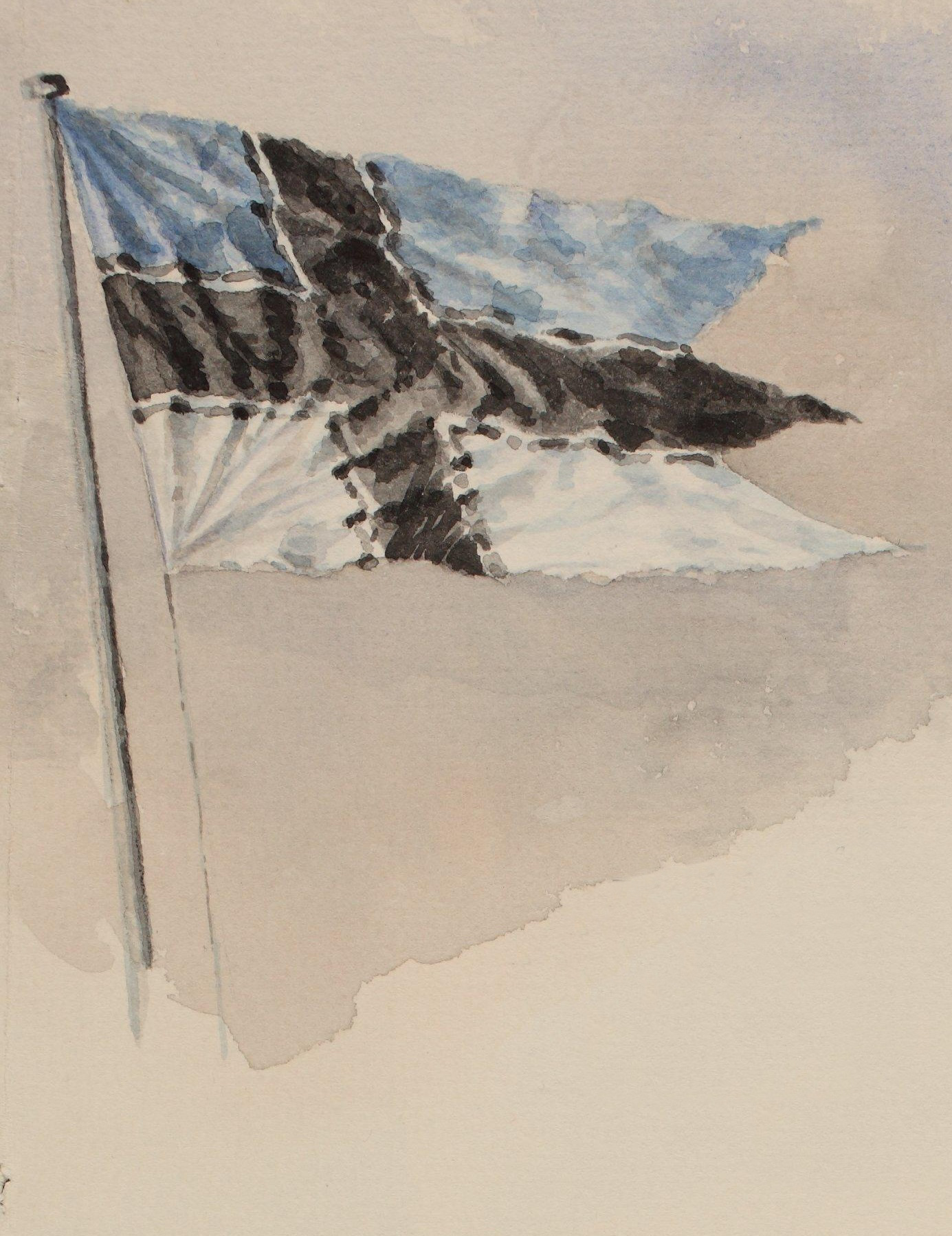
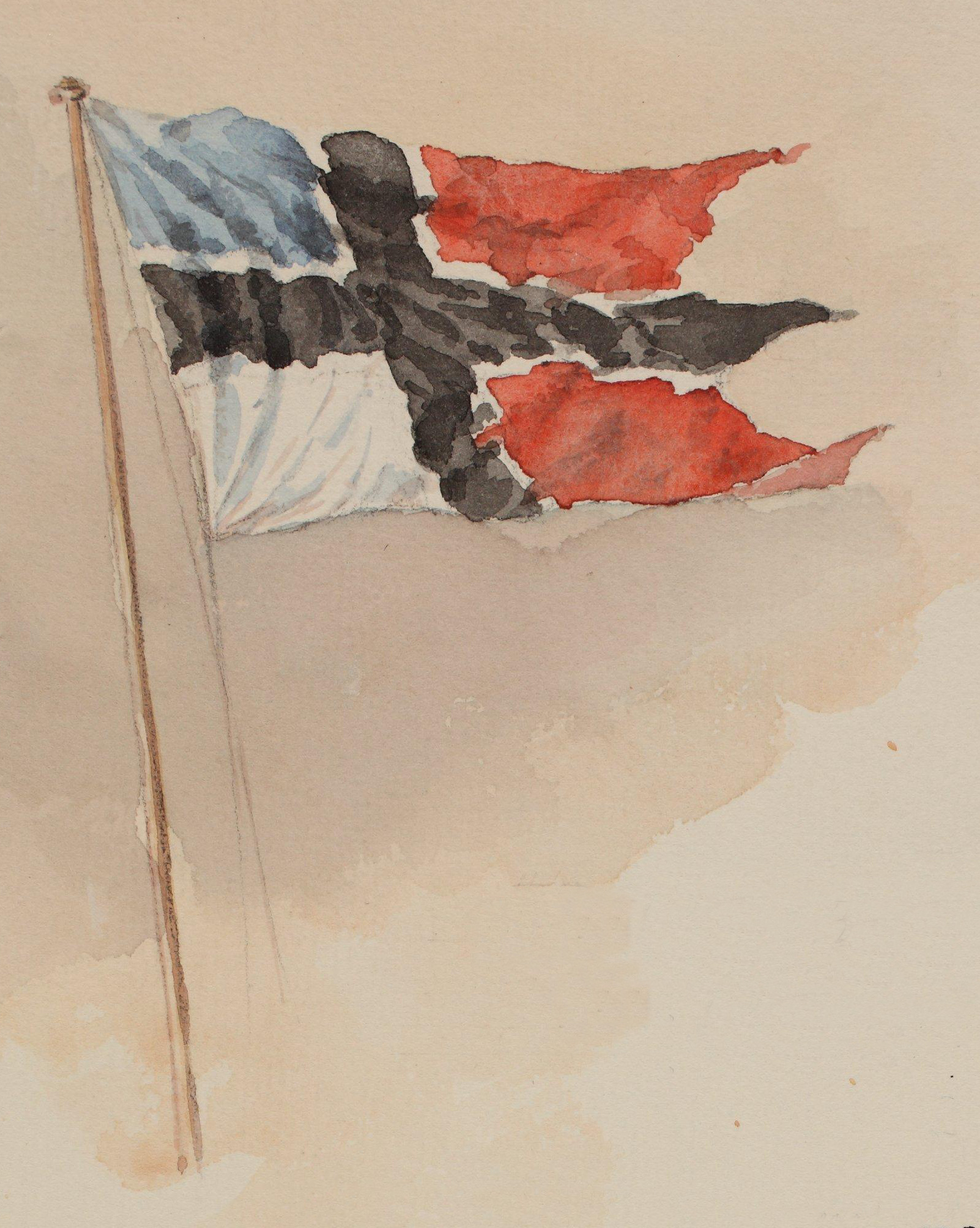
1. Estonians
1.1. Blue-black-white, from EÜS to independence
Before the collapse of the Russian Empire, the Baltics were divided into three governorates: Estland, Livland and Courland, each semi-autonomously
governed by Baltic German knighthoods. The predominantly Baltic German student population followed the tradition of
their counterparts in Germany by establishing corporations (or student unions) for students from each governorate, each adopting a tricolour flag.
The first to do so were students from Courland, who founded the corporation Curonia in 1808 and chose green, blue and white as their colours.
Students from Estland followed with green, violet and white, which symbolically were taken from the violet and white asters blooming at the time
of the corporation's September founding. The Livland corporation drew its colours from red and white roses, taking red, green and white as its own.
These tricolours were displayed on flags, worn on caps and carried on sashes.
Over time, through student festivities and growing public familiarity, the flags of Curonia, Estonia and Livonia became gradually associated
with each governorate as a whole, serving as unofficial regional flags. [1]


By the mid-to-late 19th century, Estonian nationalism began to take root and Estonian nationalists attempted to establish
their own student corporations, leading to the secret founding of the Estonian Students' Society (Eesti Üliõpilaste Selts, or EÜS)
in 1870. In 1881, the society attempted to
register as a student corporation under the name "Vironia," adopting blue, black, and white as their colours, but failed for
two reasons: the joint council of Baltic German corporation leaders was unwilling to admit a national student organization
into its ranks, and the Estonians struggled to gather the 30 members required to found a corporation. Although Vironia
failed to gain recognition, Estonian students were able to successfully register as an academic society at Tarty University
in 1883. The Estonian Students' Society (EÜS) adopted the colours already in use among its members. [2]
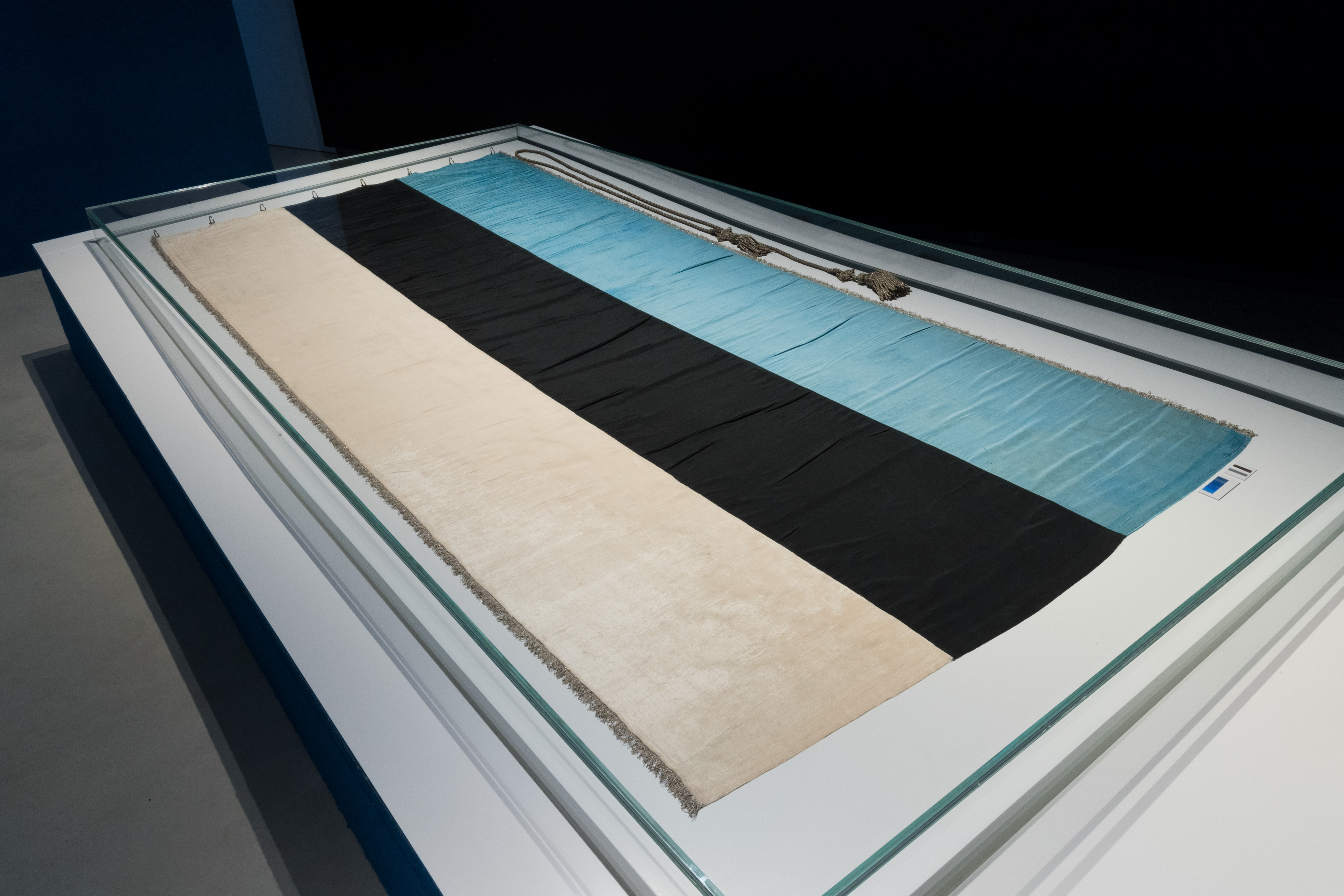
On the 4th of June, 1884, the first physical flag was sewn by Paula Hermann, assisted by Miina Hermann and Emilie Beermann.
The flag was consecrated at Otepää rectory by Pastor Rudolf Kallas. The dedication speeches already framed the flag not only
as a student flag but as a national symbol of the Estonian people. It was brought back to Tartu and kept in the EÜS library.
The original flag is still preserved at the Estonian National Museum in Tartu.
At first, the use of the colours remained within EÜS. But as the society attracted more alumni and became a hub of nationalist
intellectual life in Tartu, the tricolour gained wider recognition. The 1890s saw increasing use of the colours at cultural
events, particularly song festivals, which were central to the Estonian national awakening. By the end of the 19th century,
the tricolour was widely recognized across Estonia
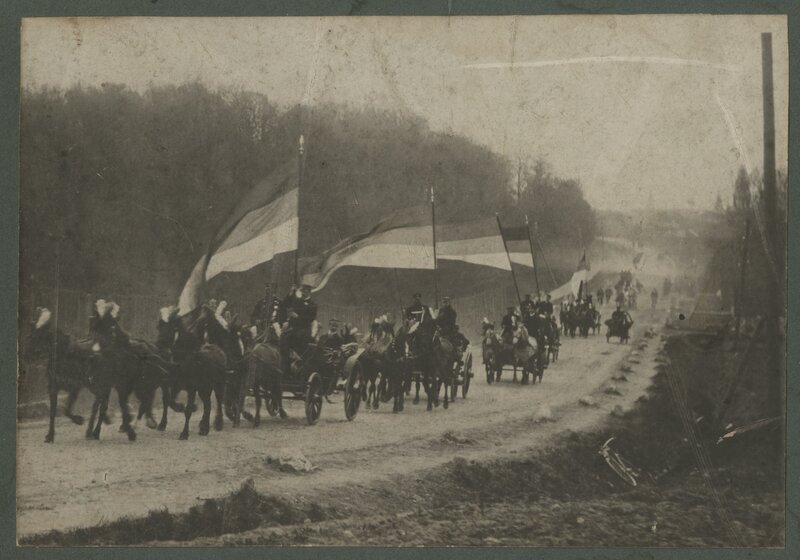
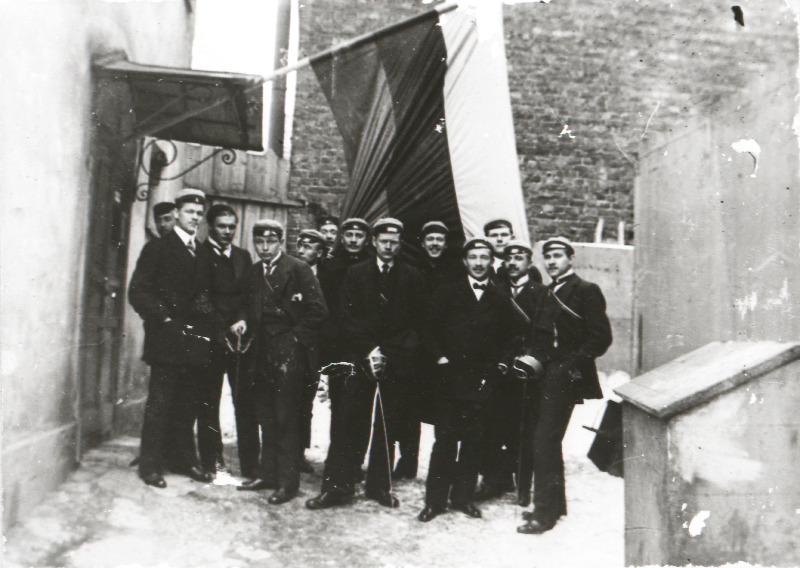
as the national colours. The blue-black-white took on a sharper political role during the 1905 Revolution. On November 1, 1905,
the EÜS flag led a demonstration in Tartu demanding national rights. The flag was attacked, and clashes ensued, but its presence
established the tricolour's role as a banner of nationalist political struggle. [1]

and future flag of Republic of Estonia.
When the Republic of Estonia proclaimed independence in February 1918, the declaration took place under blue-black-white flags
across the country. The moment was brief, however. Germany, still fighting on the Eastern Front, moved quickly to occupy Estonia,
cutting short the young republic's first steps. When the German occupation ended that November, the blue-black-white was raised
once more over Tall Hermann Tower in Tallinn. During the War of Independence
(1918–1920), Estonia fought against Bolshevik forces on the eastern front as well as remnants of the Baltic German Landeswehr in the south. Through
nearly two years of fighting, the national colours were used by Estonian units. Soldiers wore them on their uniforms, military units
carried blue-black-white flags into battle, and General Johan Laidoner, the commander-in-chief, later stated that Estonia had fought
and won its independence under these colours. [3]
With peace secured, the Riigikogu turned to the question of formally adopting the flag in law. Some proposed that the national and state
flags should be kept separate, while others suggested a cross flag to reflect Estonia's ties with the Nordic countries.
There were also practical concerns about whether blue and black could be sufficiently distinguished from one another at sea. In the end
, on the 27th of June 1922, the Riigikogu passed the National Flag Act, confirming the blue-black-white tricolour as
the official flag of Estonia, with equal colour bands and proportions of 7:11. The flag that had been carried through suppression,
revolution, occupation, and war officially became the national flag of the Republic of Estonia.
1.2. Blue-black-green, an early alternative
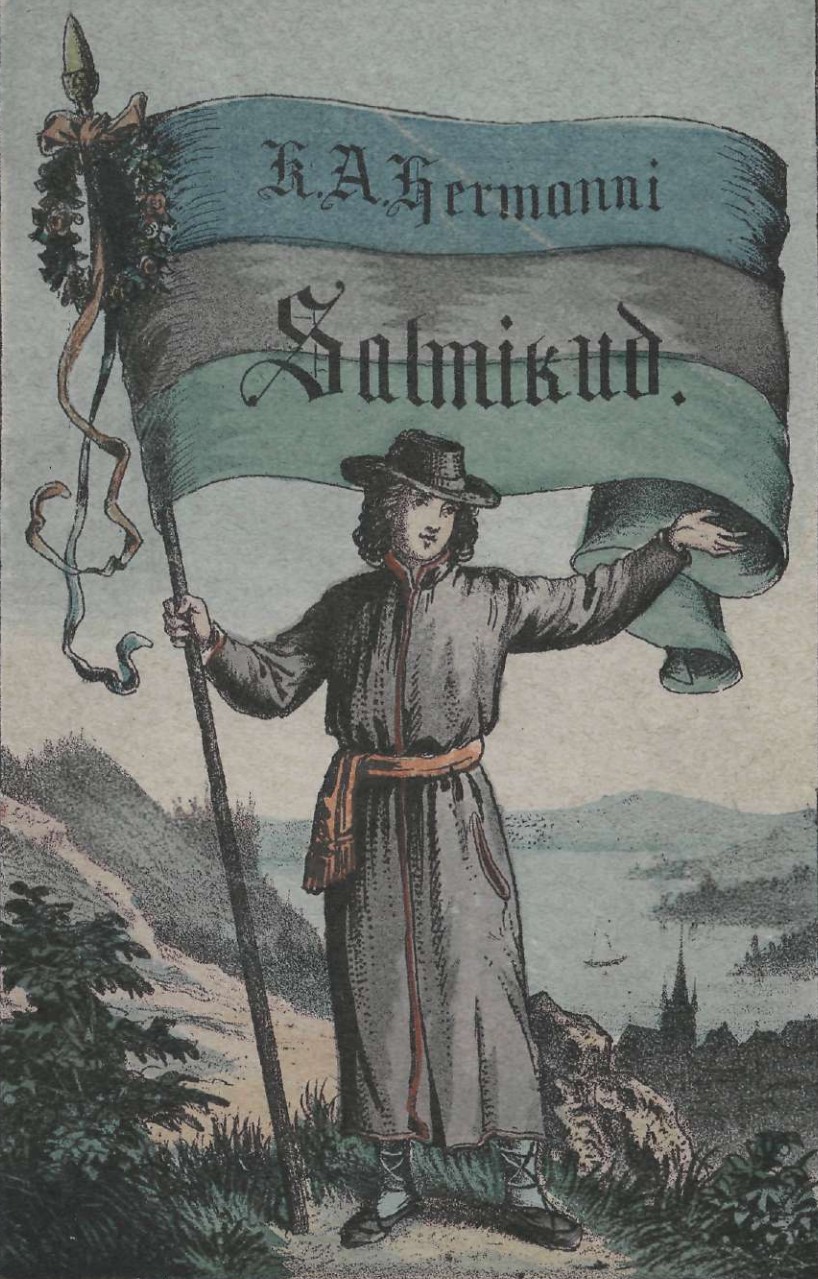
Another early 19th-century proposal for the Estonian national flag was the blue-black-green tricolour, or Sinimustroheline.
The earliest known public appearance of this tricolour took place at the Third General Song Festival in Tallinn on
the 13th of June 1880. Among the choirs performing that day was the Maardu-Ranna choir who flew a blue-black-green tricolour.
The flag has been atrributed to Johann Köler who played a significant role in the national awakening of Estonia. He is well
known for his painting depicting the rural life of Estonia, and the flag's symbolism contain similar themes. The blue
represented the sky, the black came from the coat of the Estonian farmer and green from fields and meadows. [4]
The flag and its colours were used and promoted as the flag and colours of Estonia and its people and thus represents an early
alternative to the blue-black-white flag. However, it would end up being replaced once EÜS chose its flag.

Priest and folklorist Matthias Johann Eisen, who was an early member of the EÜS, later recalled that blue-black-green
was seriously considered alongside blue-black-white during the debates of 1881. The colours also appeared in early
nationalist literary works.[5] Another notable EÜS member, Jaan Bergmann, wrote a poem about the flag (Eesti lipp)
in 1881 and gave each colour another meaning: blue for faith and the sky, black for the hard past borne with honour by
the Estonian people, and green for living hope and the renewal of spring.[6] When Bergmann's poem was
reprinted in 1901, the word 'green' had been replaced with 'white', reflecting the colour that had by then been widely recognised.[5]
It also appeared on the cover of Karl August Hermann's collection of poems called Salmikud from 1881. [7]
The flag was adopted in 1913 by the student corporation Rotalia, which still uses it to this day.
1.3. Other flag proposals, 1919–1922
When Estonia proclaimed independence in 1918, the blue-black-white tricolour had been raised across the country but had not
yet been confirmed in law, leaving the question of the flag officially open. In the public debate that followed,
numerous proposals were made. Common themes in the debate included whether the old blue-black-white tricolour should be
kept or whether its colours should be rearranged in some other way. Criticism was levied
against blue and black for blending into eachother and a number of alternative ways to use the colours were presented.
A big discussion was had around the cross flag and whether Estonia should adopt one in order to associate itself
with the Nordic countries. Alternative colour schemes were also considered.
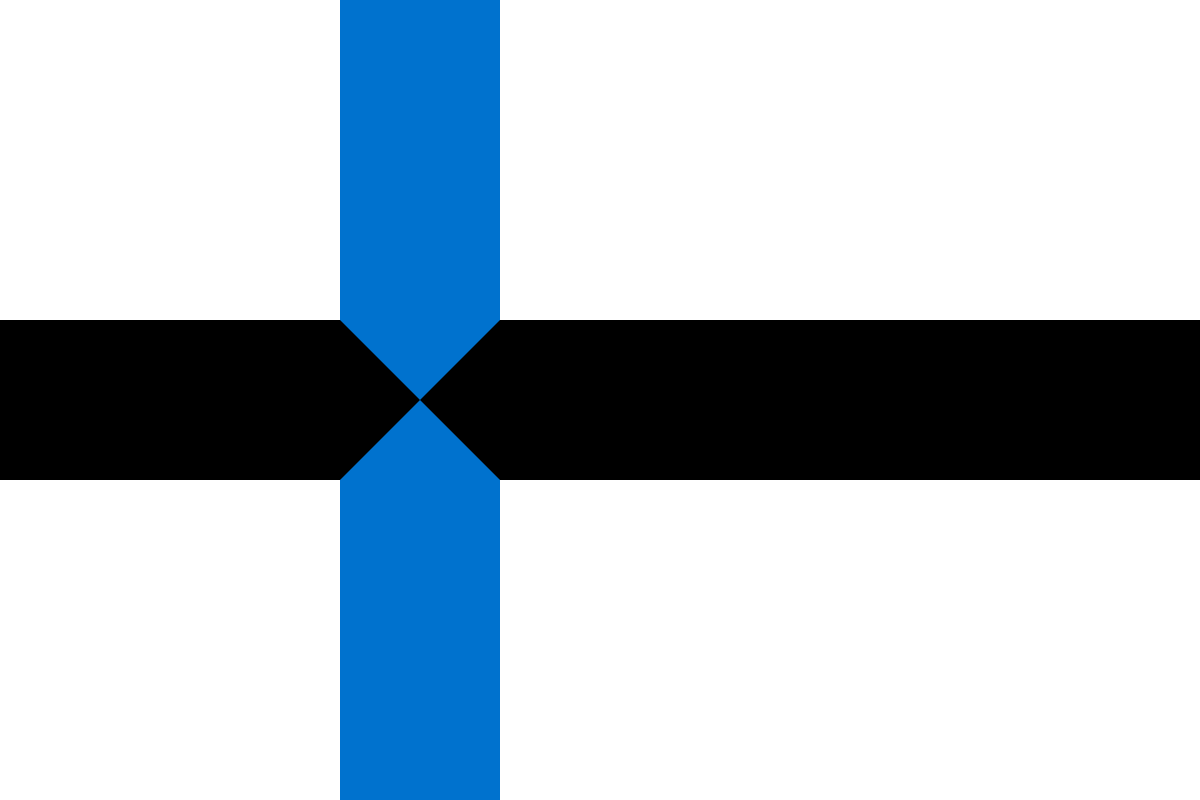
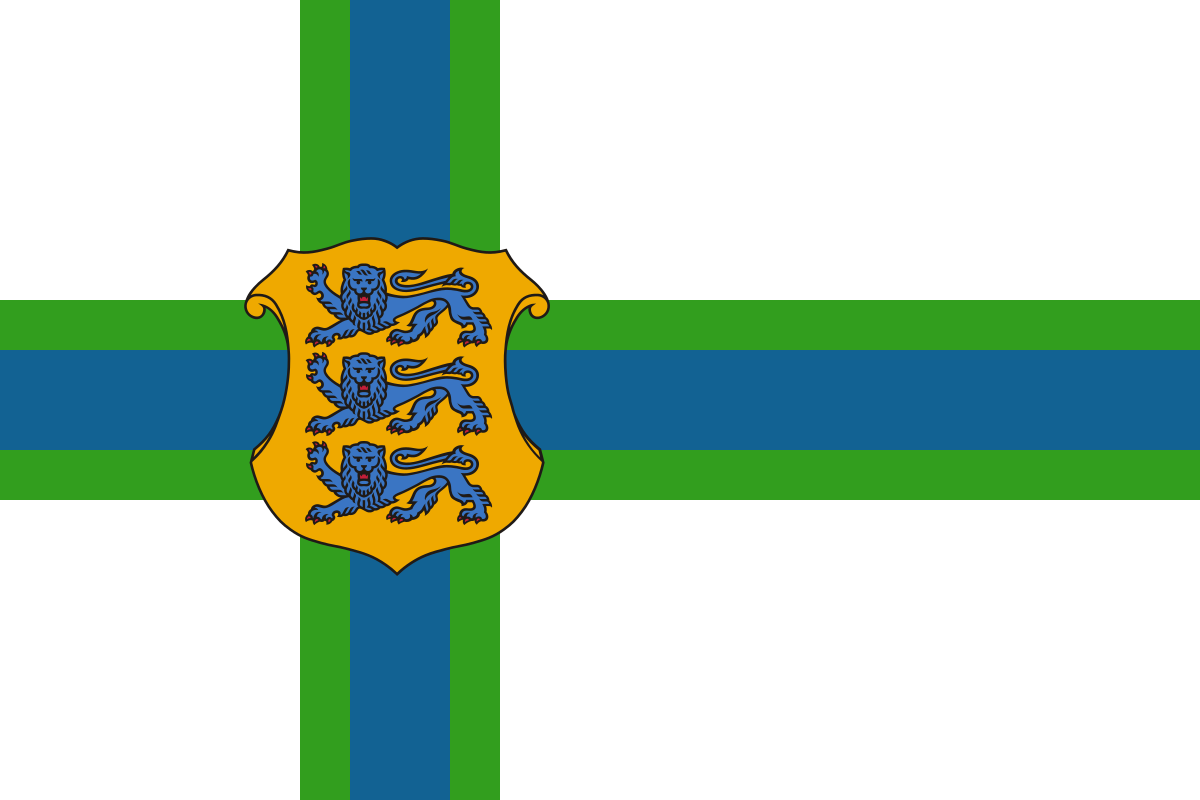
The earliest known cross flag proposal came from Estonian independence activists Aleksander Kesküla and Oskar Elevandi,
who in January 1919 described in a letter to Swedish politician Otto Järte a flag with a white ground, a blue vertical
stripe and a black horizontal stripe forming a cross.[8]
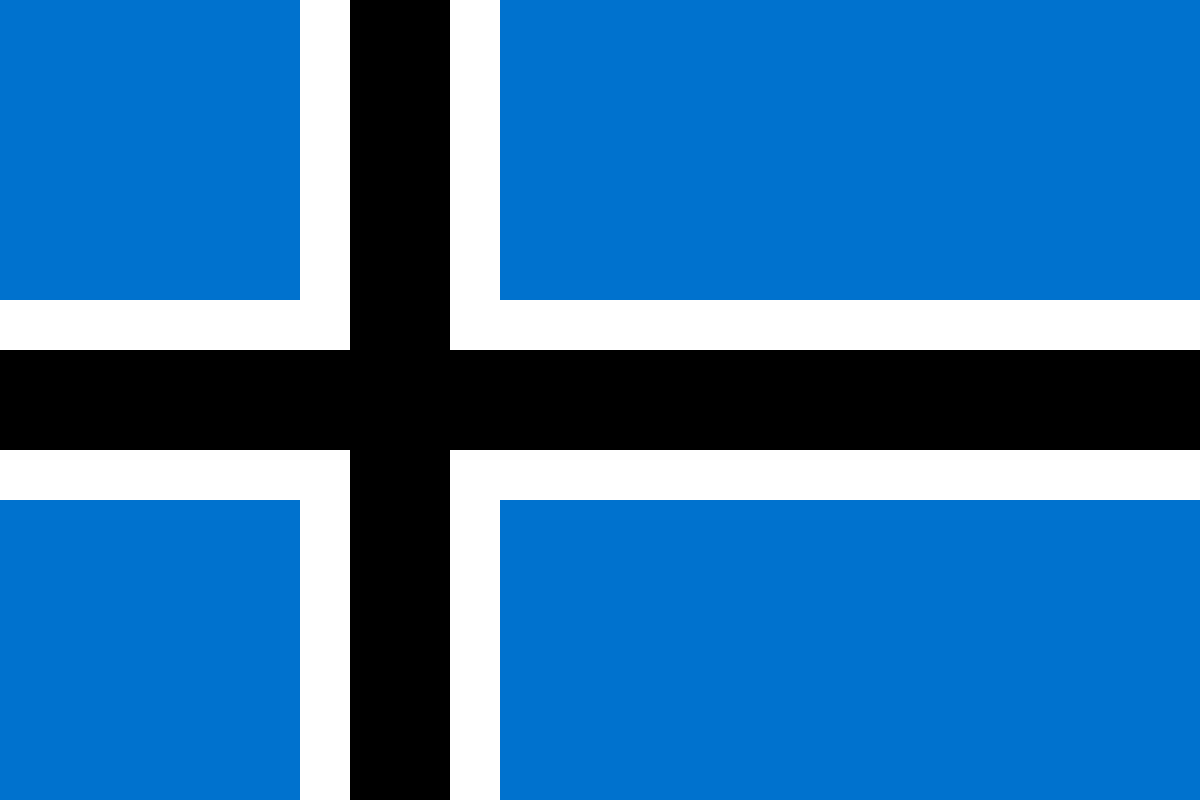
The public debate on the cross flag began on the 22nd of March 1919, when a writer using the pen name Studio criticised the tricolour in
the newspaper Tallinna Teataja, arguing that its black and blue stripes merged at distance and that it resembled Russian and German flags.
He did not call for abandoning the national colours, but proposed rearranging them: a black cross with white borders on a
blue ground, in keeping with the Scandinavian model. [9]
This cross flag design came up later many times in the 1919-22 period, including within the governments own debates. [10]
In May 1919, Jüri Wirula published an article in Päevaleht arguing that black had no place in the Estonian flag.
Instead he proposed a blue cross on white (in reference to Estonian kinship with Finland) and an Estonian coat of arms at
the centre to separate the two with possibly a green border on the cross. Wirula grounded his case in the Dannebrog legend, arguing that
Estonia's right and duty was to adopt the cross form. [11]
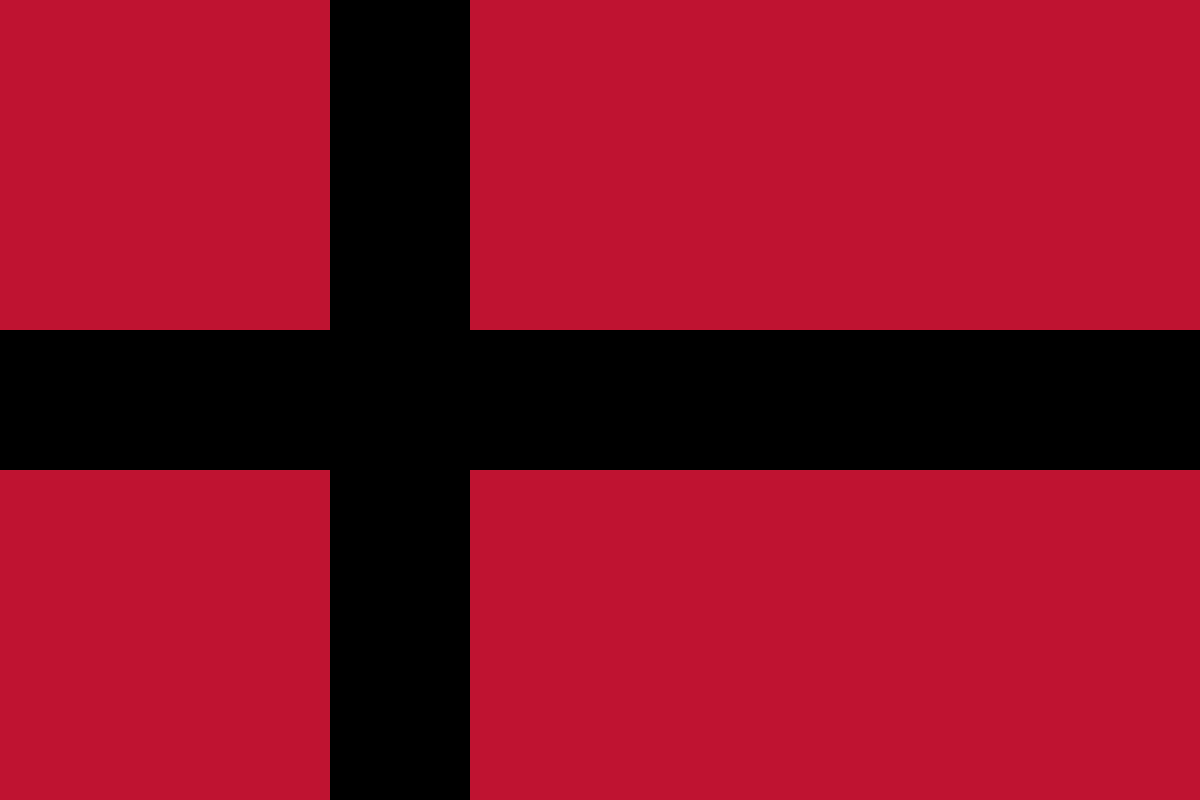
A schoolteacher named Johan Sapas proposed in the socialist newspaper Vaba Maa on the 25th of May 1919 that Estonia should
adopt a red flag with a black cross. He argued that red had deep historical roots in Estonia, pointing to the red Dannebrog which
according to legend had fallen from the sky at Tallinn during a medieval battle, and also connected the colour to the Russian
revolution and the liberation it had helped bring about. A red and black flag would moreover be far more visible at sea than
the existing tricolour. The proposal attracted little support and quietly faded from the debate. [12]
1919-1921.
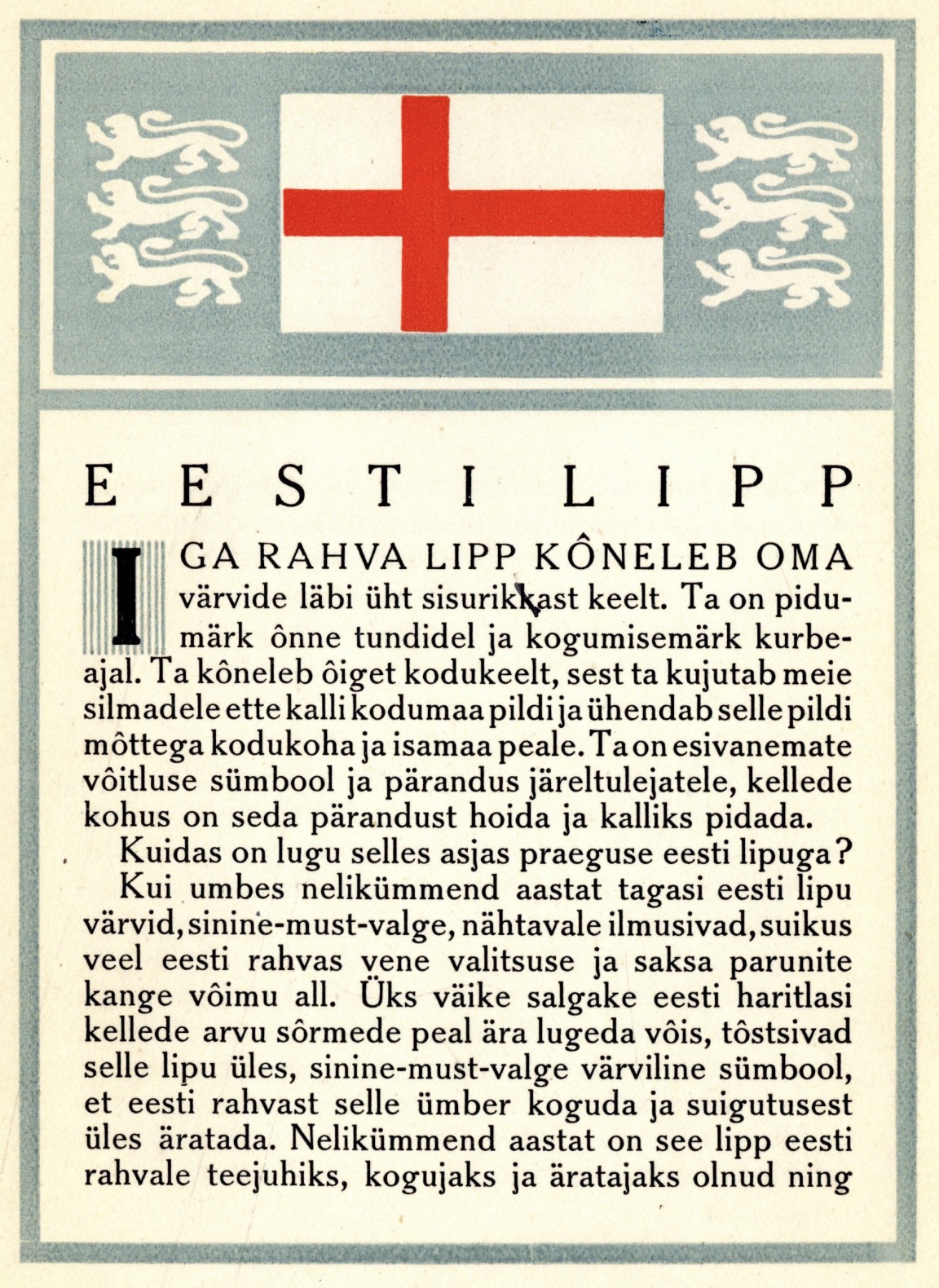
A red-and-white cross flag was proposed by Oskar Kangro, a Social Democrat compositor who had spent most
of 1908–1919 in exile in Sweden. Before returning to Estonia, Kangro printed at his own expense a high-quality coloured
brochure entitled Eesti lipp ('The Estonian Flag'), dated August 1919, in an edition of 200 copies, 120 of which he
sent directly to members of the Constituent Assembly. His proposal was a white flag with a red cross, following the Nordic
cross model. He argued that the existing blue-black-white flag was a relic of the era of foreign domination, created under
German cultural influence, and that its designers had replaced red (deemed a dangerous colour) with what he called
'petit-bourgeois blue'. An independent democratic Estonia, he maintained, required a new flag, and the red cross would
symbolise Estonia's struggle for freedom.[13]
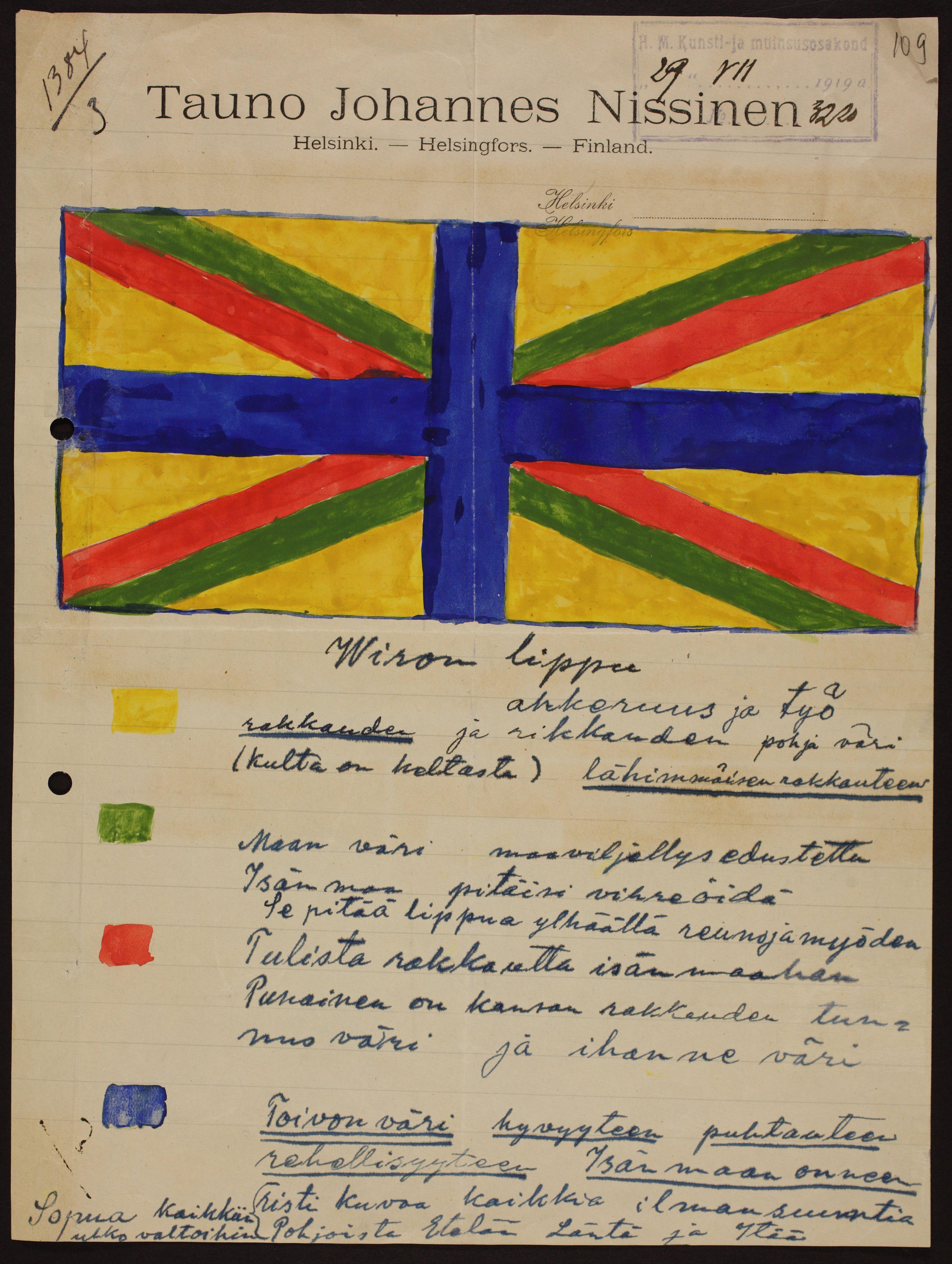
A more unusual proposal was presented by Finnish businessman Tauno Nissinen in 1919, with blue, yellow and green crosses
laid upon a yellow background. Yellow (or gold) stood for love of your countrymen, green for agriculture, red for
the fiery love of your homeland and blue for hope. The crosses represented directions on a compass and Estonias friendly
intentions to its neighbours. [14] An anonymous person drew in June 1919 four variations
on a cross flag, with swallowed tail versions being for the military. [15][16][17][18]


Writing in Postimees, a contributor known as "S." proposed a flag with a blue field on top and white at the bottom.
In the upper hoist corner would be a black square with a red star in it. He argued for the red star by saying that the
"five-pointed cross" held protective and evil-repelling significance in folk belief. If the red symbol proved too controversial,
S. offered alternatives using a white star or cross on the black square instead. [19]
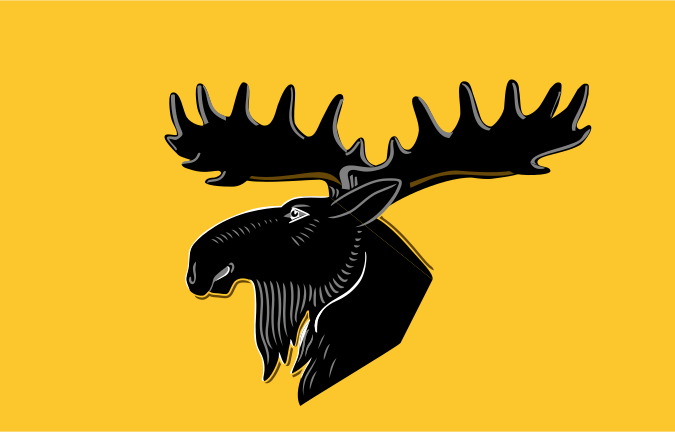
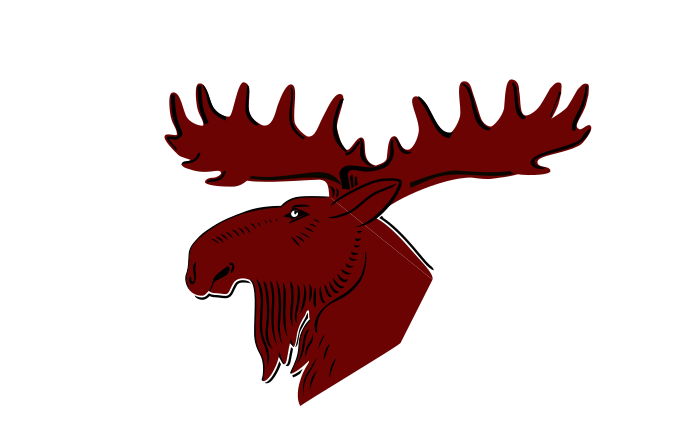
Georg Tofer, a wealthy Estonian businessman living in London, proposed two alternative designs for the Estonian national flag.
A golden flag bearing a black moose head or a white flag bearing a red moose head. He argued that white, gold and red were
the only suitable colours for a flag, as they were the most visible from a distance, unlike blue and green which blended too
easily into nature. The moose was chosen as the because Tofer saw it as a symbol of Estonian national character
(brave and steadfast) while its antlers with 18 branches symbolised the independence won in 1918. He also advocated for
the moose head to appear on the Estonian coat of arms. [10]

(Care, altered)
(Care, altered)
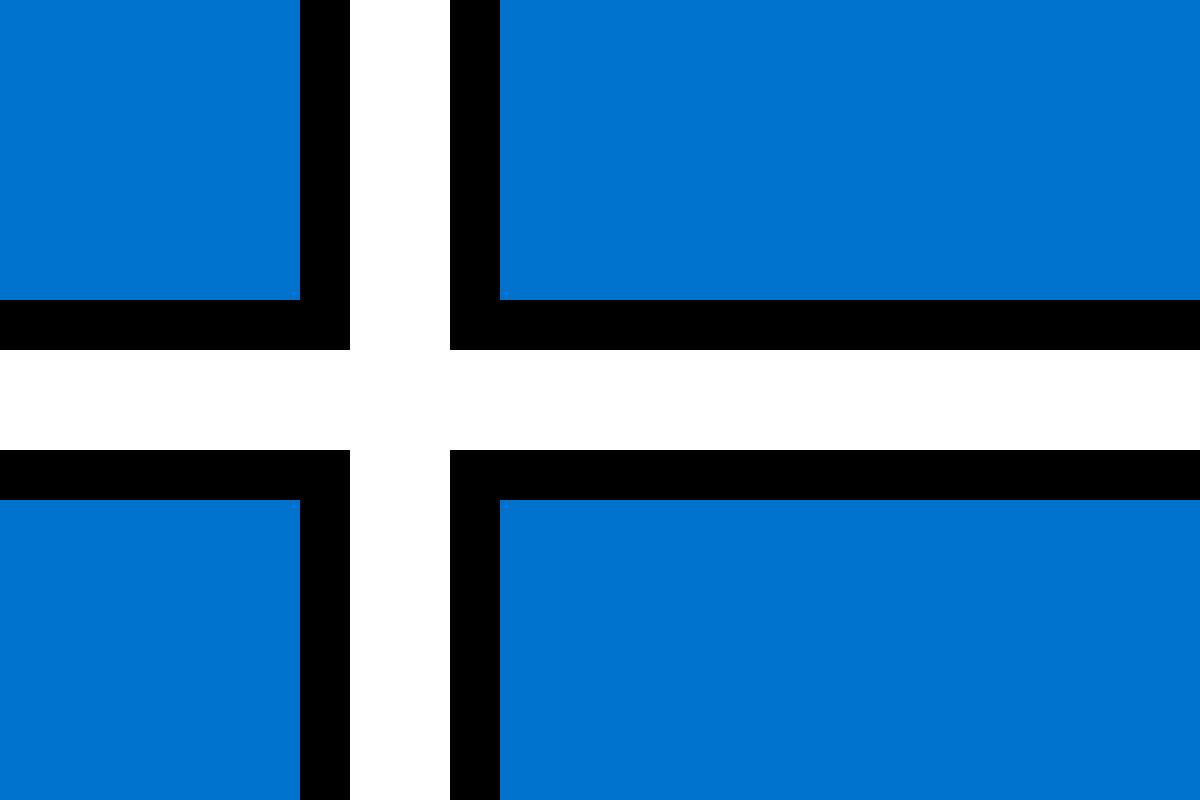
By 1921, the flag question was worked on within the government. The concept of adopting a separate state flag was considered, and several cross flag designs were suggested within the government. The national flag would remain the blue-black-white tricolour. One proposal for the state flag came from within the Ministry of Education in May of 1921, with a white cross, bordered by black, laid upon a blue field. [20] Similar designs had already floated around in the press since 1919. During the debate within the government and the parliament in 1922, a proposal was laid forth that would have rearranged the colours in the triband to blue-white-black. This was in response to the persistent criticisms laid against the original triband that the blue and black colours would blend into eachother at distance, making the flag hard to identify. [20] Eventually the issue would be resolved by choosing a blue that was light enough to distinguish from black.

committee, 1922.
government, 1922.
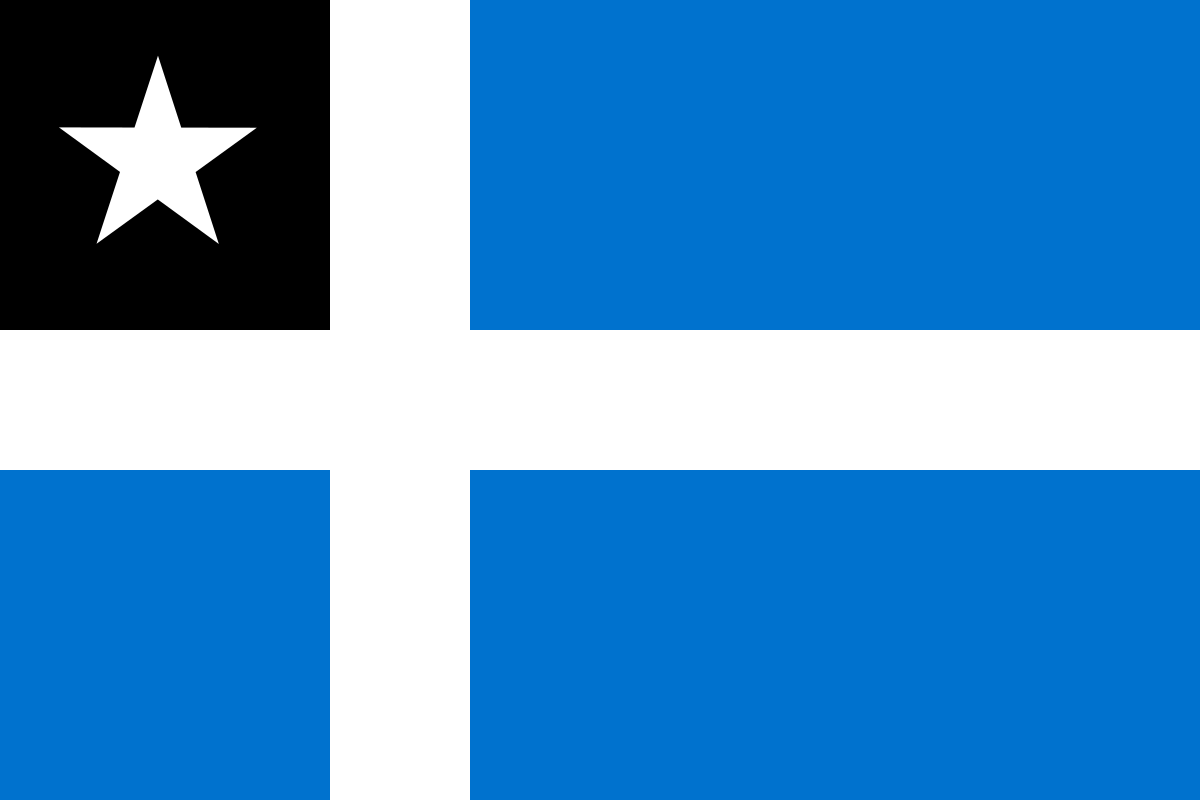
government, 1922.
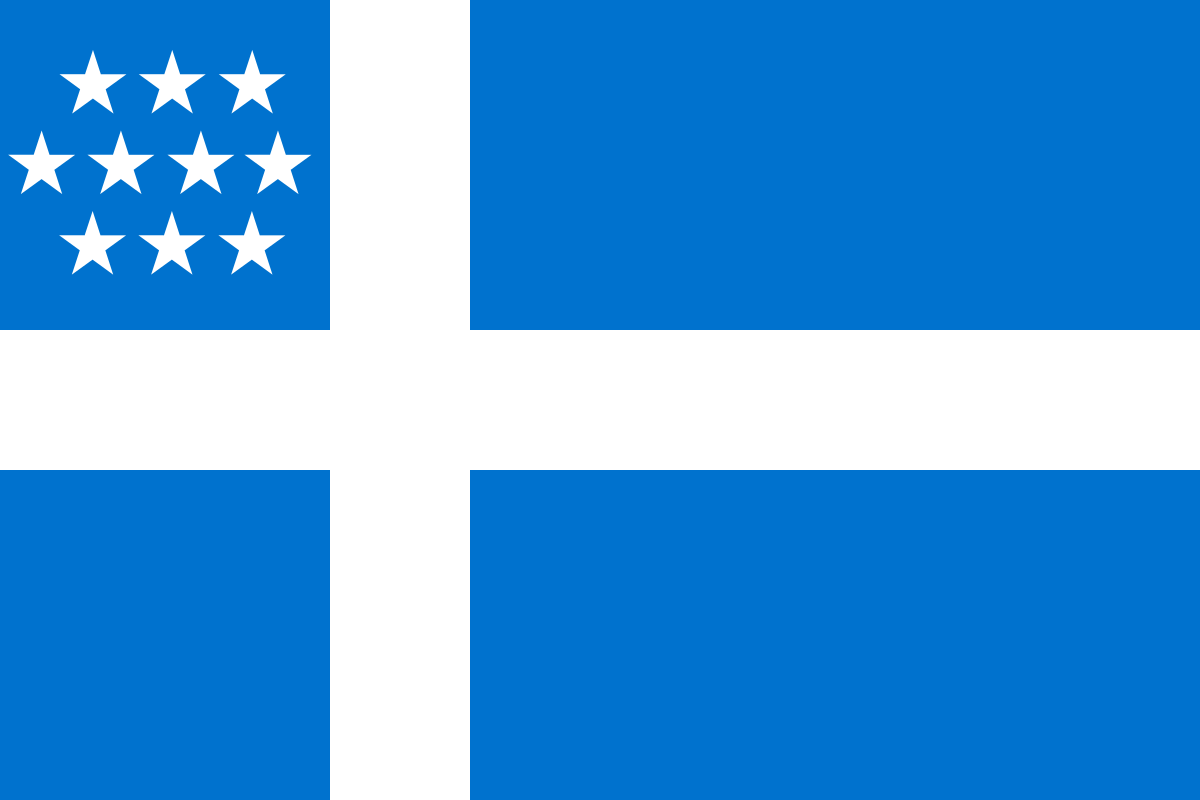
At its meeting of 20 January 1922, the government resolved to submit three variants of a state flag bill to the Riigikogu, in all three of which the blue-black-white was retained as the national flag. The first variant was a cornflower-blue ground with a white cross, the upper square at the flagpole being black with a single white five-pointed star representing the North Star. The second was a blue flag with white cross and ten stars in the canton for each Estonian county. The third option was the pre-independence green-violet-white tricolour used by Baltic Germans. All three variants were drawn up in proportions of 7:11.[21] None of these proposals prevailed as the Riigikogu passed the National Flag Act on 27 June 1922 confirming the blue-black-white tricolour without alteration.
1.4. The cross flag debate in the 21st century
The restoration of Estonian independence in 1991 saw the blue-black-white tricolour reinstated without serious challenge. Its emotional weight during the Soviet decades, when displaying it had been a punishable act, made any immediate suggestion of replacement politically unthinkable. Yet the idea of a Nordic cross flag has occasionally resurfaced since.
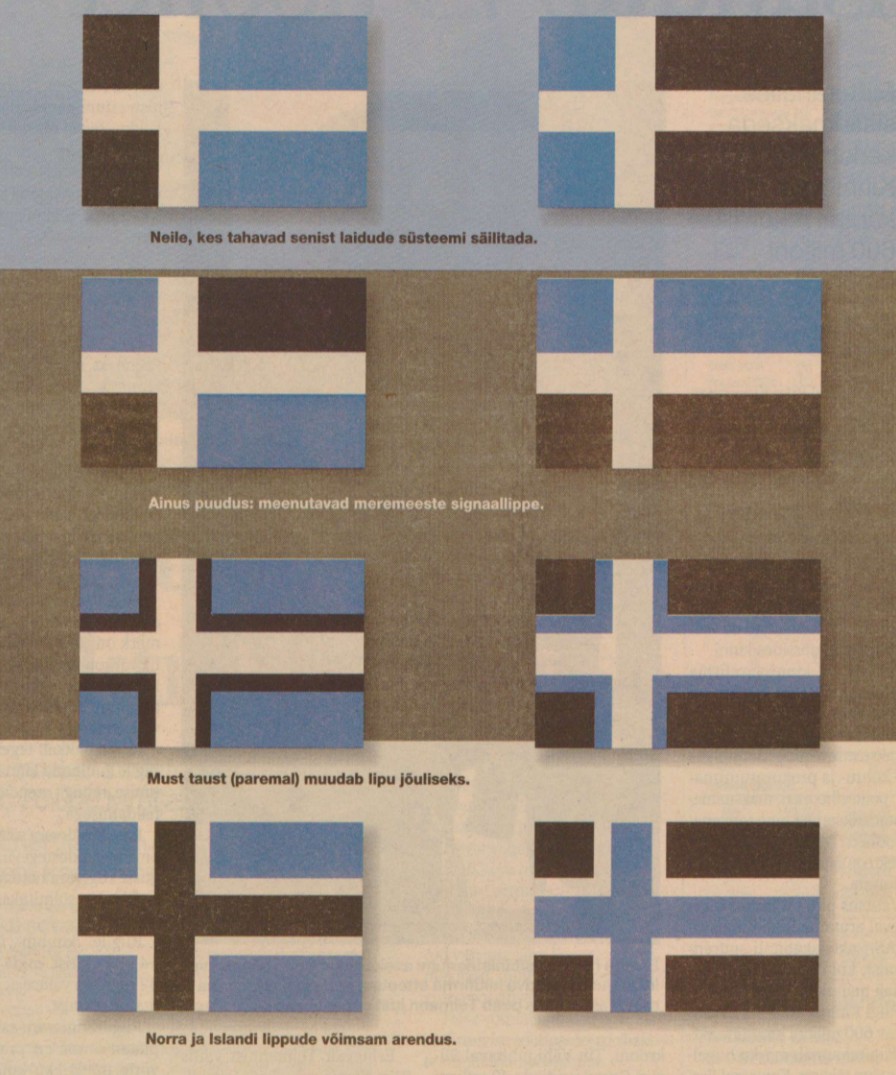
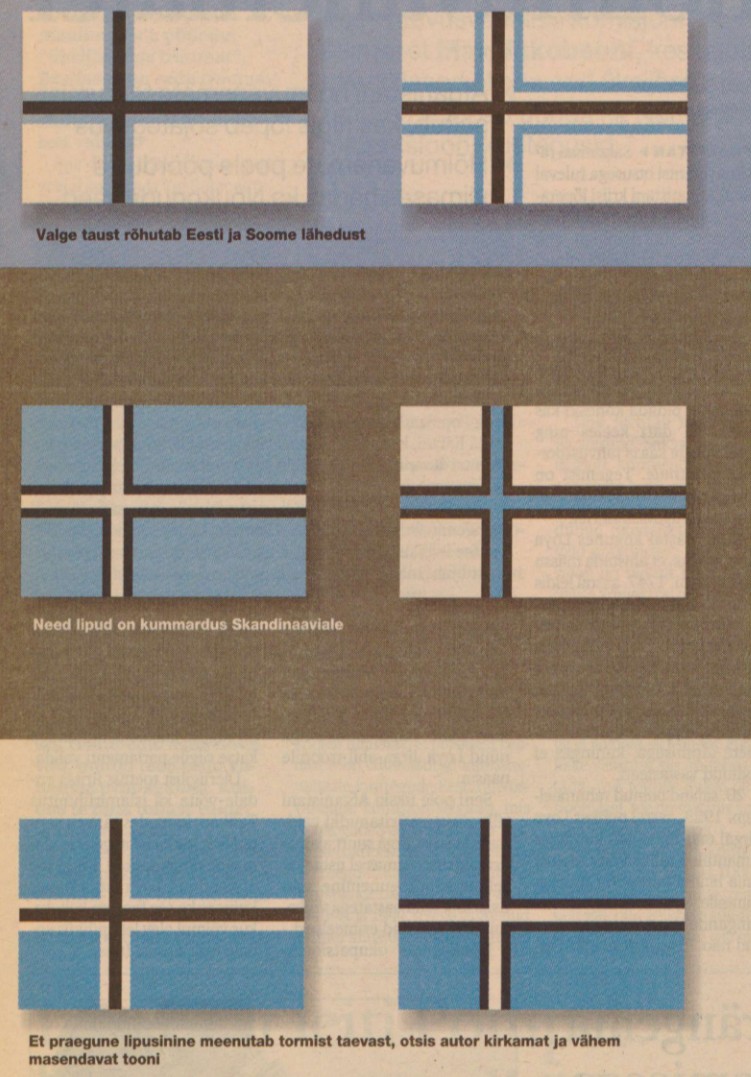
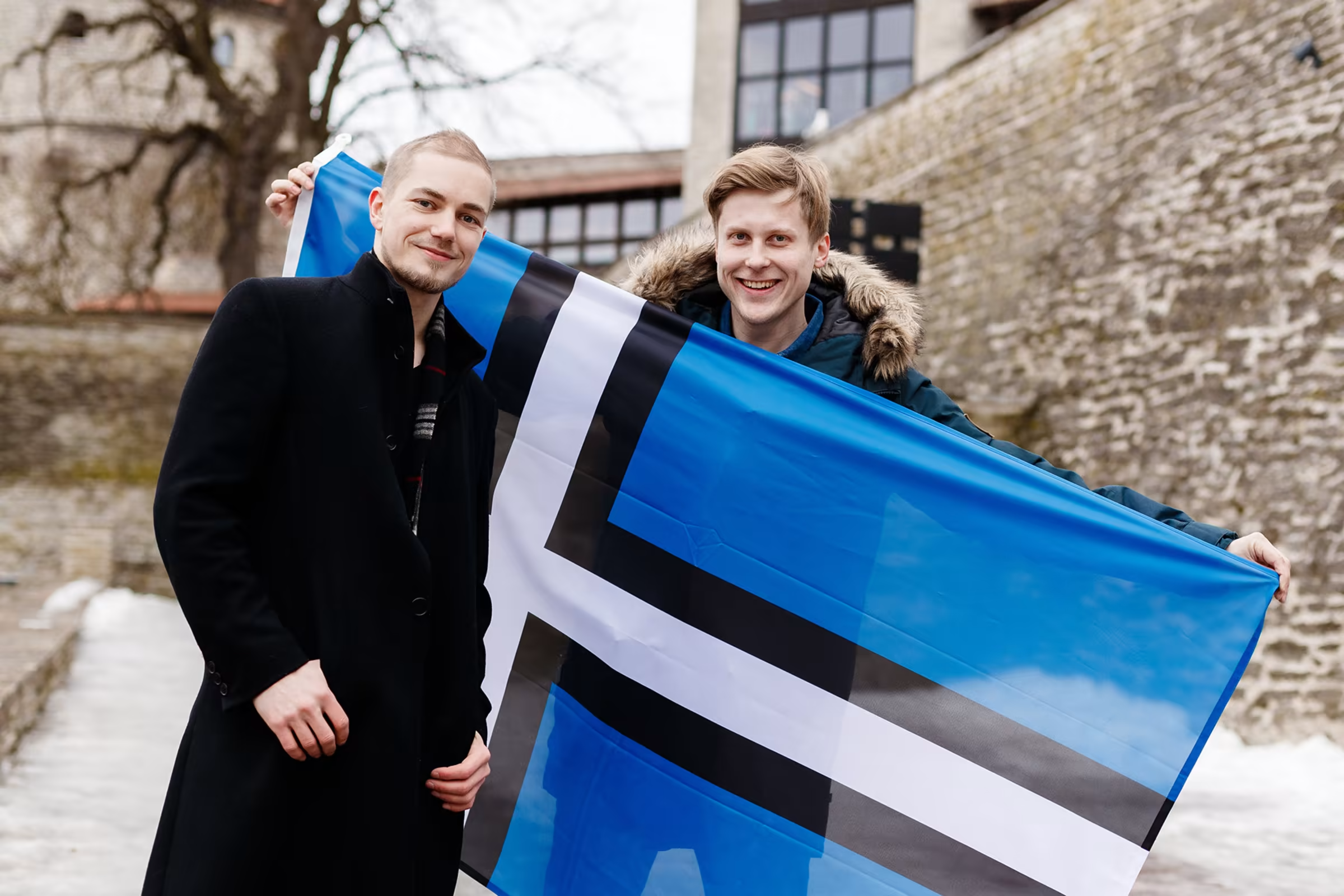
A debate on the cross flag was triggered when Eesti Päevaleht published a proposal by journalist Kaarel Tarand that Estonia adopt a Scandinavian-style cross flag in the national colours. [22] The proposal was linked to a broader national branding debate, in which the diplomat Eerik-Niiles Kross had separately suggested renaming the country Estland. During the debate, designers Arbo Tammiksaar and Marek Strandberg produced several cross flag variants that were published in Päevaleht. Tammiksaar favoured the cross flag for its modernity while Strandberg suggested adopting the cross flag for the state flag, while keeping the tricolour as a national flag. [23] In 2018 the television programme Pealtnägija revisited the question. Tarand restated his case in commercial terms, arguing that a Nordic cross was carried a strength in branding that was recognized worldwide. Two IT entrepreneurs, Peedu Tuisk and Jaan-Matti Saul, framed the argument in terms of Estonia's persistent Eastern European image in Western markets, arguing that a cross flag would visually anchor Estonia in the Nordic space. Neither proposed replacing the tricolour outright, suggesting instead a parallel symbol for use in contexts such as tourism.[24] Such unofficial use of the cross flag continues sporadically, but no serious attempt to replace the tricolour exists anymore.
1.5. Soviet Estonia
Under construction...
Sources
- Saare, Tiit: Eesti lipp, Eesti vapp , p. 24-35. Avita, 2005.
- Hiio, Toomas: 150 vuotta Virolaisten ylioppilaiden seuran perustamisesta . Elo 3/2020. Available: tuglas.fi
- Aun, Karl: The estonian flag - hundred years of the blue-black-white, p. 8-9. Flag Heritage Foundation. Massachussets, 2010.
- Põldmäe, Rudolf: Kaks laulupidu, page 222. A. Mesikäpp 1976.
- Eisen, Matthias Johann: Kuidas sündis Eesti lipp?. Postimees, 16.03.1934. Available: dea.digar.ee
- Eisen, Matthias Johann (koost.): Eesti luuletused. Schnakenburg, Tartu, 1881., pp. 29–30. Available: ester.ee
- Hermann, Karl August: K. A. Hermmann'i salmikud. Esimene kimbukene . Schnakenburg, 1881. Available: in archive
- Kuldkepp, Mart: Riigilipuks ristilipp: ühest rahvuslikust ambitsioonist aastatel 1919–1922. TUNA, no. 1 (2024), p. 32.
- Studio: Eesti lipu küsimus. Tallinna Teataja, 22.03.1919, p. 6. dea.digar.ee
- Kuldkepp, Mart: Riigilipuks ristilipp: ühest rahvuslikust ambitsioonist aastatel 1919–1922. TUNA, no. 1 (2024), p. 41-44.
- Wirula, J.: Eesti lipp. Päevaleht, 19.05.1919. Available: dea.digar.ee
- Sapas, Johan: Eesti lipu kohta. Vaba maa, page 2. 25.05.1919. Available: dea.digar.ee
- Kangro, Oscar: Eesti lipp. Stockholm, 1919. Available: Tartu Ülikooli Raamatukogu
- Nissinen, Tauno: Eesti Vabariigi vapi kavandeid 1921. a; s. 147. Available: Saaga ERA.1108.5.119:147
- Anonymous: Eesti Vabariigi vapi kavandeid 1921. a; ERA.1108.5.119, s. 183. Available: Saaga ERA.1108.5.119:183
- Anonymous: Eesti Vabariigi vapi kavandeid 1921. a; ERA.1108.5.119, s. 184. Available: Saaga ERA.1108.5.119:184
- Anonymous: Eesti Vabariigi vapi kavandeid 1921. a; ERA.1108.5.119, s. 185. Available: Saaga ERA.1108.5.119:185
- Anonymous: Eesti Vabariigi vapi kavandeid 1921. a; ERA.1108.5.119, s. 186. Available: Saaga ERA.1108.5.119:186
- S.: Ettepanetud Eesti lipu küsimuses, 11.04.1919. Postimees, p. 5. Available: dea.digar.ee
- Kuldkepp, Mart: Riigilipuks ristilipp: ühest rahvuslikust ambitsioonist aastatel 1919–1922. TUNA, no. 1 (2024), pp. 46-48.
- Protokollid nr. 1-32; ERA.31.2.10; 04.01.1922-13.04.1922. p. 114-116. Available: [114], [115] and [116].
- Tarand, Kaarel: Lippude vahetusel, 03.12.2001. Available: delfi.ee
- Kas Eesti lipul peaksid olema triibud või rist? Eesti Päevaleht, 6 December 2001. Available: DIGAR
- Raat, Geidi: Kas Eesti peaks votma kasutusele uue lipu?, 14 November 2018. ohtuleht.se
2. Ingrian Finns
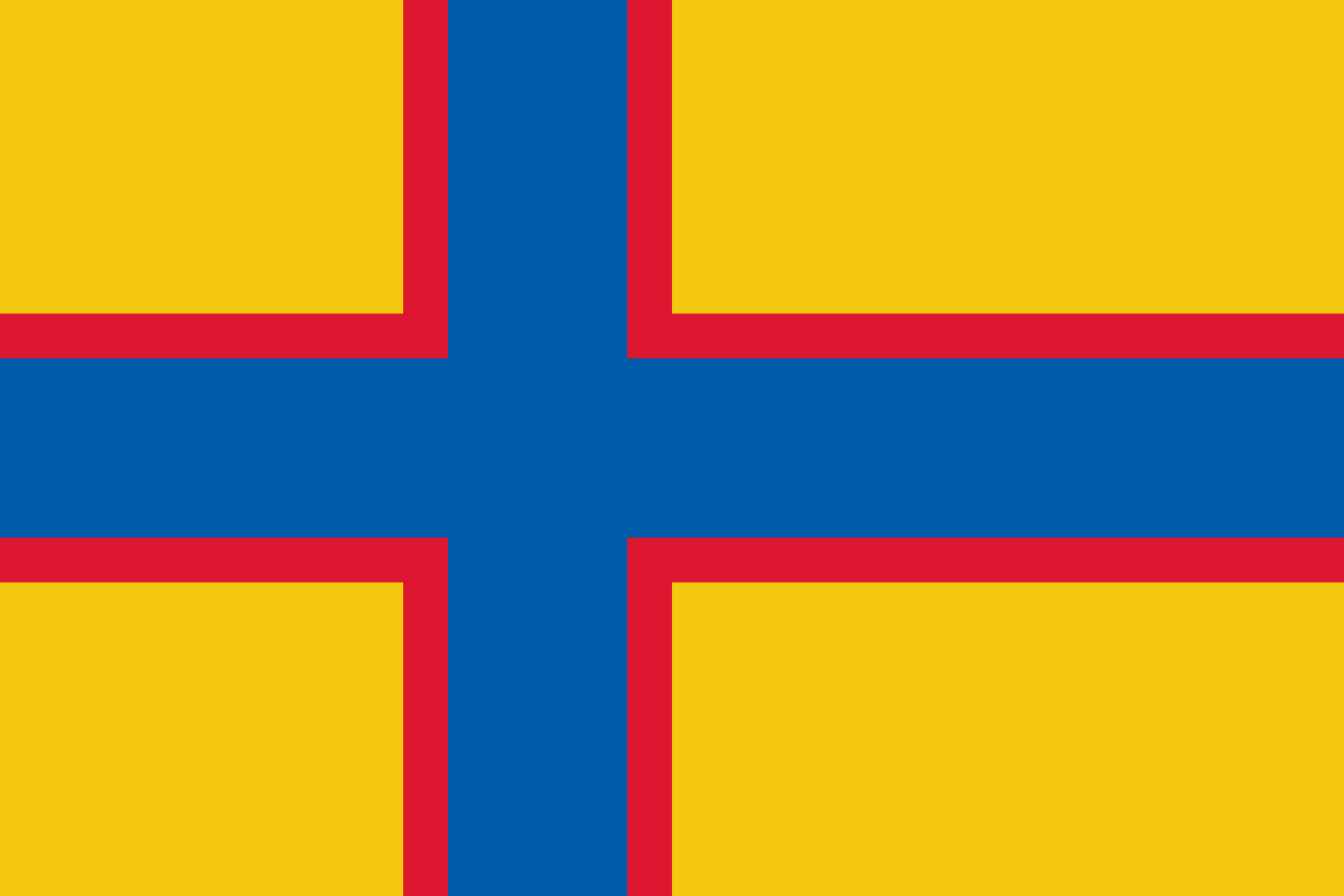
Ingrians are lutheran Finns who moved into the lands around river Neva after 1617 when Sweden conquered the area. They numbered up to some 140 000 before the collapse of the Russian Empire and following many decades or repressions and ethnic cleansing during the Soviet era, most Ingrians today live in Finland, with only a minority in Russia. The flag of the Ingrians was adopted in 1919 during the Ingrian liberation movement, and it was based on the Swedish-era coat of arms of Ingria from the 17th century.
When the Russian Empire fell and was replaced by a more liberal provisional government in february 1917,
the Ingrian national movement began to stir. Initially, the aim of the Ingrian movement was to establish
a self-governing region with an Ingrian majority. These aspirations, however, ran into both internal
difficulties and growing tensions with the Bolsheviks, who seized power in October. The Ingrians
subsequently turned to both Finland and Estonia in search of support. In western Ingria, Ingrian
volunteers joined the ranks of the Estonian army, while in northern Ingria along the Finnish border the Republic of North
Ingria took shape. Depending on circumstances, the goal was either independence, autonomy, or
the incorporation of parts of Ingria into Finland or Estonia. However, as the bolsheviks signed
peace with Finland and Estonia, these aspirations largely failed. Small portions of western Ingria
were ceded to Estonia, and Bolsheviks did promise national rights for Ingrians in Russia, but these
results were largely considered a bitter disappointment among Ingrians. Particularly when bolshevik
promises of minority rights were replaced with brutal repressions. [1]
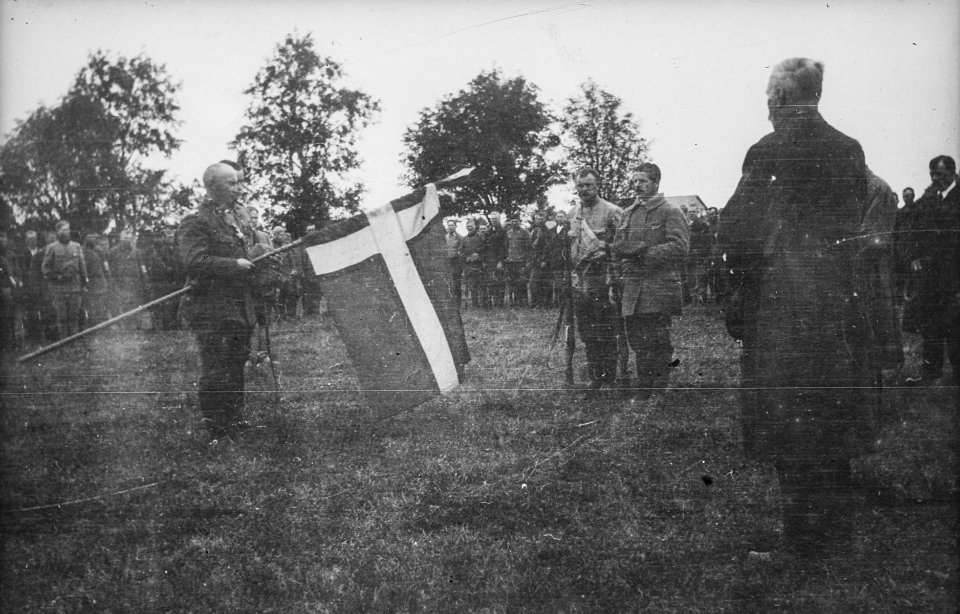
The early history of the Ingrian flag is partly obscure, but it is known with certainty that the
flag was in use in the Republic of North Ingria when it was consecrated on the 8th of September 1919.
Photographs from the consecration ceremony have survived. [2]
When Ingrian activists retreated to Finland following the peace treaties of 1920, they brought the
Ingrian flag with them on the 5th of December 1920. Once in Finland, the governing body of North Ingria
formally confirmed the Ingrian flag at its meeting on the 11th of March 1921:
[3]
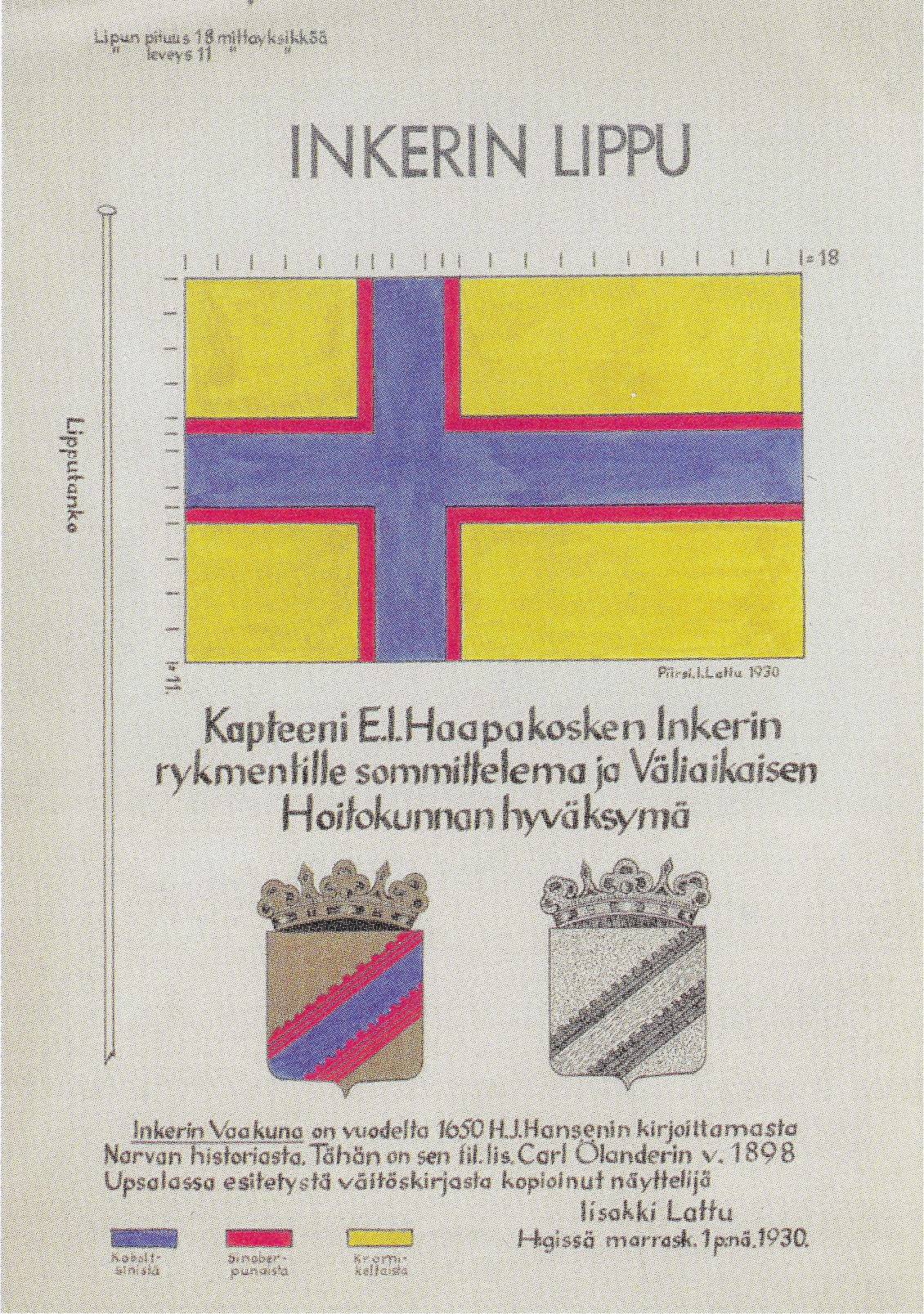
» The colour and dimensions of the Ingrian flag are hereby confirmed as following: background yellow; cross blue; border stripes of the cross brick red. Total height: 100 cm: 35 yellow, 5 red, 20 blue, 5 red, 35 yellow. Length 150 cm: 45 yellow, 5 red, 20 blue, 5 red, 75 yellow. Certified as a authentic extract by M. Kälviäinen and J. Tirranen. A drawing of the Ingrian flag with its proportions is appended to the same. »
In Finland, the Ingrians founded the Ingrian League in 1922 to advance their cause. Iisakki Lattu, an Ingrian primary school teacher and actor who had settled in Finland, submitted a drawing of the Ingrian flag and its coat of arms to the League in 1930, to which he appended his own account of the flag's history. According to Lattu, the flag had originally been designed by his son-in-law, Captain Ilmari Haapakoski, for the Ingrian Regiment fighting in western Ingria in 1919. In this drawing, the flag's proportions are given as 18:11 - the same as the Finnish flag — which differ from the dimensions recorded in the minutes of the Northern Ingrian governing body in 1921. [3] [4] Ingrian researcher Toivo Flink has, however, cast doubt on the reliability of Lattu's account and on the role he attributes to Haapakoski in designing the flag. [5]
Sources
- Martikainen, Tyyne: Ingermanländarnas rätt att ihågkommas, pp. 19–20. Institute of Migration. Turku, 2018.
- Laurla, Kari: Inkeri – Vaakuna ja lippu, p. 33. Collegium Heraldicum Fennicum ry / Airut, Helsinki, 1989.
- Flink, Toivo: Pois nöyrän panta, Inkerin liitto 1922–1944, pp. 90–91. Institute of Migration. Turku, 2012.
- Kiljunen, Kimmo: Leijonasta siniristiin, p. 136. Into, Helsinki, 2018.
- Flink, Toivo: Pois nöyrän panta, Inkerin liitto 1922–1944, pp. 92-94. Institute of Migration. Turku, 2012.
- Inkeriläisten sivistyssäätiön valokuva-arkisto. Kansio: Rykmentti. Kuva: 2353. Saatavilla: inkeriliitto.fi
3. East Karelia
East Karelia comprises the Orthodox regions of historical Karelia that now lie within modern Russia. The native Karelians of this area are regarded as a distinct, yet closely related, ethnic group to both Finns and Finnish Karelians. Following the collapse of the Russian Empire, the region became a battleground during the Russian Civil War, witnessing clashes between the Red and White Armies. It was later caught in further conflict between the Soviet Union and Finland during World War II, events that left deep and lasting impacts on both the land and its people.
3.1. Civil War and an Uprising, 1918-1922
In early 1918, as the civil war in Finland was nearing its end and the civil war in Russia continued
to rage, Finnish White Forces began organizing incursions into East Karelia. Their aim was to support a local movement against
the Russian Bolsheviks. These poorly organized excursions achieved little and often clashed with both Bolsheviks and troops from the Allied
Intervention in Northern Russia. As the central town of Uhtua was occupied by Finnish White Forces in 1918, Finnish painter
Jonas Heiska designed a flag for White Karelia, featuring white stars of the Plough on a blue background. [1] Though
this flag saw little use, it was the first specifically designed for the region.
During the Allied intervention in Northern Russia the British formed the Karelian Regiment by recruiting Finnish communists who had fled
to East Karelia after their defeat in the Finnish Civil War. The regiment was led by P. J. Woods, an
Irish officer of the British army, and carried an orange flag with a green clover leaf in the middle. The
flag was designed by Woods. The Karelian Regiment fought both Bolshevik forces and Finnish White troops. Although the Finnish Whites
were fighting the Bolsheviks, they were also aligned with Germany and were viewed with mistrust by the allies since World
War 1 was still ongoing in the west. The regiment remained active until late 1919, when it was disbanded following
the British withdrawal from Russia. [2]


At the end of 1919, after the withdrawal of the Allied troops from Northern Russia, the White Northern Army of
Russia collapsed rapidly in the face of the Red Army’s offensive. Soon afterwards, the Red Army also drove the Finnish
Whites back across the border and took control of most of East Karelia.
On 29 March 1920, representatives of the Provisional Government of Viena Karelia gathered for the first provincial assembly in Uhtua.
A total of 135 delegates had been elected from the municipalities of Viena and partly also from Northern Aunus. The
situation was uncertain, as there were still Red Army units in the area, but nevertheless the assembly dared to consider
state symbols for Karelia. During these meetings it was decided to establish a provisional government in Uhtua and to declare
the intention of seceding from Soviet Russia. In addition, they demanded a general referendum to be held once peace had
returned, in order to determine the future of Viena Karelia. The minutes also recorded that both a coat of arms
and a flag were discussed.
The minutes of the provincial assembly note that the coat of arms should depict a bear with a billhook in
its paws, and that the flag should be a two-coloured horizontal bicolour with the constellation of the Plough. The sources,
however, differ on what the background colours of the flag should be. According to the original minutes, the colours were
red and yellow, with red at the bottom and yellow at the top. In a copy preserved later in Finland,
it is stated instead that the majority supported red and green. It seems, however, that that the provisional government’s representative
Iivo Ranne took the red-and-green version of the flag to Finland, to Akseli Gallen-Kallela, and this became the basis for
Gallen-Kallela’s later designs. [3]


As a representative of the Provisional Government, merchant Iivo Ranne delivered the flag to the Finnish artist Gallen-Kallela. He was asked to design a flag and coat of arms for Karelia based on the design by the Provisional Government. Gallen-Kallela redesigned the flag and wrote to the government:
» Instead of the Plough, I have incorporated the northern lights into the state emblem and the flag through silver chevrons in the form of arches. There are 53 chevrons, representing the municipalities of Karelia. If this number happens to be incorrect, it can easily be adjusted by adding or removing chevrons. Additionally, as many negro states have stars and constellations on their flags and emblems, I wanted to avoid them. From a decorative standpoint, the arcs of the northern lights are much more splendid, heretofore unused in heraldry, and most natural for a northern nation and land. To prevent the bear's image (which, according to heraldic rules, should face right if the animal is depicted in profile) from becoming too similar to the coat of arms of Satakunta, I have placed broken chains under its feet. Since the bear's colour is black (as natural colours cannot be used), I have added the black colour to the flag. Furthermore, since green and red on the flag would over time form a very unpleasant and ugly hue due to the natural tendecy of the green colour to fade, the black intermediate colour improves the design. The combination of green, black, and red is highly distinctive for Finnic nations. It is true that the flag may appear somewhat sombre, but a national flag is not a trivial object; thus, in my opinion, seriousness is appropriate here, especially when it concerns the honourable people of Karelia. »
Gallen-Kallela also designed a state flag, a war flag, a customs flag, a pilot flag, and a postal flag. The customs flag features a traditional birch-bark rucksack (or »kontti» ), pilot flag two oars and the postal flag a birch-bark horn. The bear in the war flag is from the coat of arms for Karelia, also designed by Gallen-Kallela. Dimensions of the flag are horizontally 24,4 = 7,7 + 0,9 + 2,5 + 0,9 + 12,4 and vertically 15,7 = 5,7 + 0,9 + 2,5 + 0,9 + 5,7. [4]


The designs for the flag and the coat of arms was given to Iivo Ranne, who in turn were to
deliver them to the provisional government in Karelia. [5] However, in May of 1920 the Red Army decided to dissolve
the provisional government and consequently, they were never officially ratified. However, they became popular among Karelians and have remained in
unofficial use in both Finland and Russia to this day.
After the dissolution of the provisional government, dissatisfaction with Bolshevik rule grew among the Karelians. With support from Finnish volunteers,
they launched an uprising. Known as the "Forest Guerrillas," these fighters battled the Red Army, often carrying flags designed by
Gallen-Kallela. The uprising was ultimately suppressed in 1922. Between 1941 and 1944, Gallen-Kallela’s flag designs were flown during the Finnish
occupation of East Karelia in the Continuation War.
3.2. Soviet Karelia 1920-1990
Once the Red Army consolidated control over East Karelia, the area was turned into an autonomous republic within the Russian
SFSR. Initially the autonomous republic did not have its own flag and simply flew the flag of the Russian SFSR.
In early 1937 the constitution was amended and the automonous republic was given its own red flag with the name
of Soviet Russia and Karelian Autonomous Republic written in Russian, Karelian and Finnish on it. In late 1937 the Finnish
texts were removed after Finnish communists were purged from leadership. The ratio of the red banner is 2:1. [6]
After the Winter War in 1940, newly conquered land from Finland was moved under the control of the Karelian Autonomous
Republic which now was upgraded into the Karelo-Finnish SSR, a separate entity from the RSFSR. The new flag included the
name of the republic only in Finnish and Russian, not Karelian anymore. In 1953, shortly after the death of Joseph
Stalin, the flags of the republics were changed by removing any texts and separating them instead by colours and symbols.
Fields of green and blue were added into the Karelian flag to represent Karelian rivers, lakes and forests. [7] In
1956 Karelia was once again downgraded into an autonomous republic and moved under control of the RSFSR. The flag was
consequently changed into the flag of the RSFSR with KACCP and KASNT added under the hammer and sickle. In 1978
the text was slightly changed, but this flag continued in use until the collapse of the Soviet Union. [8]


The adoption of the 1953 flag was preceded by a draft in 1947 that was never put in use. It had a narrower green stripe and the blue field contained fir branches. In 1976 Finnish heraldic Kari Laurla submitted two proposals for the 1978 change of the flag. They contained a white field of fir branches, with and without a green wave-field. [8]


Between 1934 and 1935, a debate regarding the Karelian flag took place among Karelian refugees in Finland and Finnish promoters of the Karelian cause. In this context, criticism arose regarding the somberness of the colours in Akseli Gallen-Kallela's flag design. In issue 3/1934 of the magazine Karjalan Vapaus ('Freedom of Karelia'), the Karelian linguist Edvard Ahtia proposed that the national colours of Karelia should instead be white, blue, and gold. Ahtia drew connections between these colours and Karelian folk poetry, suggesting that they symbolised freedom, beauty, and goodness. Blue and white also appeared in the flags of the kindred nations of Finland and Estonia. Ahtia proposed that the preferred arrangement for these colours would be a white-edged blue cross on a yellow background. He was also of the opinion that the coat of arms designed by Gallen-Kallela could be replaced by one featuring a kantele instead of a bear. [9]

cover of the magazine Rahvahan sana, 1935.
The following year, Paavo Jukola (orig. Ivanoff), an activist originally from Olonets (Aunus) and secretary of the Suojärvi-based Karjalan Kansalaisseura -society, published a flag proposal in the society’s magazine, Rahvahan sana ('Voice of a nation'). Jukola based his proposal on Ahtia's colours: the flag featured a blue, gold-edged cross on a white background. The society had adopted the flag and a correspondingly coloured kantele coat of arms for its own use in May 1935, and they were now being proposed as symbols for the whole of Karelia. [10] However, the proposal for new symbols was criticised as unnecessary and for creating nothing but pointless division and neither Jukola's flag nor Ahtia's colours have been used since [11] .
3.3. Republic of Karelia 1991-
After the collapse of the Soviet Union, the Supreme Council of the Karelian ASSR decided to rename the region as
the Republic of Karelia and adopt new state symbols, including a flag, coat of arms, and anthem. In early 1992,
a public competition was launched to gather ideas, resulting in numerous comments and proposals. The selection committee reviewed 60 flag
designs, and on May 28, 1992, two were chosen as finalists: one by J. Nivin and another by V. Dobrynin. [12]
Nivin's proposal featured a green-white-blue tricolour with a red Finnic notched cross at the center. Green symbolizes faith in luck,
the nature and forests of Karelia; white symbolizes peace, the snowy winters of Karelia; and blue symbolizes greatness and beauty,
statehood, and prosperity. [13]
Dobrynin's proposal was based upon Gallen-Kallela's designs. He described his proposal:
» In the flag, there is a black cross with a red border on a green background, similar to the Scandinavian countries, to which Karelia geographically belongs. According to Gallen-Kallela, the colors of the flag and coat of arms reflect the peculiarities of the region's settlement history. Green represents the forest, red represents fire, and black represents the land. In the upper corner by the flagpole, there are 19 triangles representing the number of Karelia's districts and cities. » [14]


The debate in the Supreme Council dragged on into late 1992, with no unanimity over the flag nor the coat
of arms. Dobrynin's proposal was popular among Karelians, but it was also seen as problematic due to its associations with
Fenno-Karelian nationalism. During this period, A. Litvin, a university lecturer from Petrozavodsk, introduced another flag design. His proposal combined elements
of the Russian naval jack with a Scandinavian Latin cross, representing Karelia's role in the formation of the Russian navy
and Karelia's closeness to Scandinavia. [15]
In November 1992, the Supreme Council convened on the matter once again. This time the debate included more designs, including
a red-blue-green triband by Alexander Kinner and a proposal to re-adopt old flags of Soviet Karelia. Kinner's flag was the
most popular but failed to gather enough votes. Instead the decision was once again postponed to the 16th of February,
1993, when after more exhaustive discussions and voting rounds, Kinner's flag finally received enough votes to be passed into law. [16]

Sources
- Laurla, Kari: Itä-Karjalan tunnuksia , p. 40. Collegium Heraldicum Fennicum ry/Airut, Helsinki 1997
- Laurla, Kari: Itä-Karjalan tunnuksia , p. 34-37. Collegium Heraldicum Fennicum ry/Airut, Helsinki 1997
- Laurla, Kari: Itä-Karjalan tunnuksia , p. 41. Collegium Heraldicum Fennicum ry/Airut, Helsinki 1997
- Laurla, Kari: Itä-Karjalan tunnuksia , p. 42-43. Collegium Heraldicum Fennicum ry/Airut, Helsinki 1997
- Ranne, Iivo: Letter to Gallén-Kallela , 31.05.1920. Gallén-Kallela Museum, 9. Letters received, Paul - Samfundet Sverige-Finland (1880-1930): File 320. Available: The National Archives of Finland
- Laurla, Kari: Itä-Karjalan tunnuksia , p. 57. Collegium Heraldicum Fennicum ry/Airut, Helsinki 1997
- Laurla, Kari: Itä-Karjalan tunnuksia , p. 65-67. Collegium Heraldicum Fennicum ry/Airut, Helsinki 1997
- Laurla, Kari: Itä-Karjalan tunnuksia , p. 67-71. Collegium Heraldicum Fennicum ry/Airut, Helsinki 1997
- Ahtia, Edvard: Karjalan värit ja vaakuna . Karjalan vapaus, 3/1934, page 8. Available: digi.kansalliskirjasto.fi
- Jukola, Paavo: Karjalan lippu ja vaakuna . Rahvahan sana, 1935. Page 8. Karjalan kansalaisseura ry, Joensuu.
- Myös Karjalainen: Uusi “karjalainen” aikakausilehti , Veina-Aunus, 8-9/1935, page 118. Available: digi.kansalliskirjasto.fi
- Laurla, Kari: Itä-Karjalan tunnuksia , p. 73. Collegium Heraldicum Fennicum ry/Airut, Helsinki 1997
- Pashkov, Alexander: Karjalan vaakunat ja liput, p. 313. KARECO, Petrozavodsk 1994. Available: gerboved.ru or in archive.
- Pashkov, Alexander: Karjalan vaakunat ja liput, p. 316. KARECO, Petrozavodsk 1994. Available: gerboved.ru or in archive.
- Pashkov, Alexander: Karjalan vaakunat ja liput, p. 322. KARECO, Petrozavodsk 1994. Available: gerboved.ru or in archive.
- Pashkov, Alexander: Karjalan vaakunat ja liput, p. 328. KARECO, Petrozavodsk 1994. Available: gerboved.ru or in archive.
- Laurla, Kari: Itä-Karjalan tunnuksia , p. 40. Collegium Heraldicum Fennicum ry/Airut, Helsinki 1997
- Protocols nr. 1-32; Saaga ERA.31.2.10:150; 04.01.1922-13.04.1922. Saaga digital archive. Available: Saaga archive
4. Vepsians
The Vepsian national flag, designed by painter Vitaly Dobrynin in 1992, draws inspiration from the flag designed by Gallen-Kallela in 1920. The flag was first unveiled in June 1992 during the Vepsian Summer Festival held in Rybreka Village. Between 2000-2005, this flag served as the official flag of the Veps National Volost, a municipal autonomy for the North Vepses, until it was disbanded in 2005. [1]

Sources
- Heninen, Andrew: Vepsian national flag. Heninen.net. Available: heninen.net
5. Ludic Karelians
Ludic Karelians are a tiny threathened Finnic nation located in Olonets, who are either classified as a subgroup of Karelians or as a distinct language and people. In 1995 Ludic author and activist Miikul Pahamov designed a flag for Ludic Karelians based on Gallen-Kallelas design from 1920. The flag forms the basis for the flag of the Kuujärvi (Mihailovskoje) rural settlement. [1]

Sources
- Heninen, Andrew: Ludic Karelian national flag. Heninen.net. Available: heninen.net
6. Izhorians
Izhorians are an orthodox Finnic nation native to Ingria. Their flag is a two-colour triband in blue-yellow-blue. Traditional Izhorian embroidery is placed in the middle of the flag. The flag is probably designed by the ethnographic historian Olga Igorevna together with Vladimir Zernov sometime in the early 2000's. [1] An alternate version, where the red embroidery is replaced with a red Finnic notched cross, can be seen in an article written about Zernov in 2021. Zernov and Konkova are mentioned as the designers for this one too, but the flag is probably not in use. Perhaps a concept? ( image ). [2]


Sources
- Konkova, Olga Igorevna: Ижора : Очерки истории и культуры, p. 218-219. Kunstakamera, Russian Academy of Sciences 2009. Available: Presidential Library or in archive .
- Vitushkin, Dmitry: Аборигены Петербурга, крестьянские гербы и говорящие камни. Скамейка, 2021. Available: at dzen.ru or in archive.
7. Votians
Votians are another small Finnic nation native to Ingria. Their traditional homeland has been the lands along river Laukaa. The flag and coat of arms was designed in 2002 by author and poet Alexander Gurynov with help from the organizers of the Votian museum, Sergei and Tatiana Efimov, as well as heraldist Vladimir Zernov. The blue triangles symbolise Lake Peipus and the Gulf of Finland and the V-shaped white area represents the Votian lands wedged between these waters. The red cross on the white wedge represents remembrance of ancestors and continuity between generations. These crosses were a longstanding feature of Votian villages, where the whole community would gather around them during festivals to pray. [1]


Sources
- Konkova, Olga: Votes: Essays on History and Culture, p. 215-216. Peter the Great Museum of Anthropology and Ethnography (Kunstkamera), RAS, Saint Petersburg 2009
- Vatland.ru : Прогулка по музею. Available: at vatland.ru or in archive.
8. Livonians
Livonians are native to the coastal region of Latvia. Their numbers began to twindle already by the late 19th century which led to efforts supported by Finns and Estonians to awaken Livonian nationality in the 1920's. The Livonian Union was established in 1922 to promote the Livonian cause and one of its founders, Didrik Volganski, designed a flag for the Union. The Union and the Livonians faced repressions following the Soviet occupation of the Baltics and it wasn't until the 1980s that the Union and the flag were back in use. Historically Livonians have mainly been fishermen and their culture has been tied with their coastal environment. The green-white-blue tricolour represents the land, the white sandy shores and the sea. The outer dimensions of the flag are 2:1 and the horizontal stripes are 2:1:2. [1]

Sources
- Laurla, Kari: Latvian lippu ja vaakuna, p. 121. Collegium Heraldicum Fennicum ry/Airut, Helsinki 2002
9. Setos
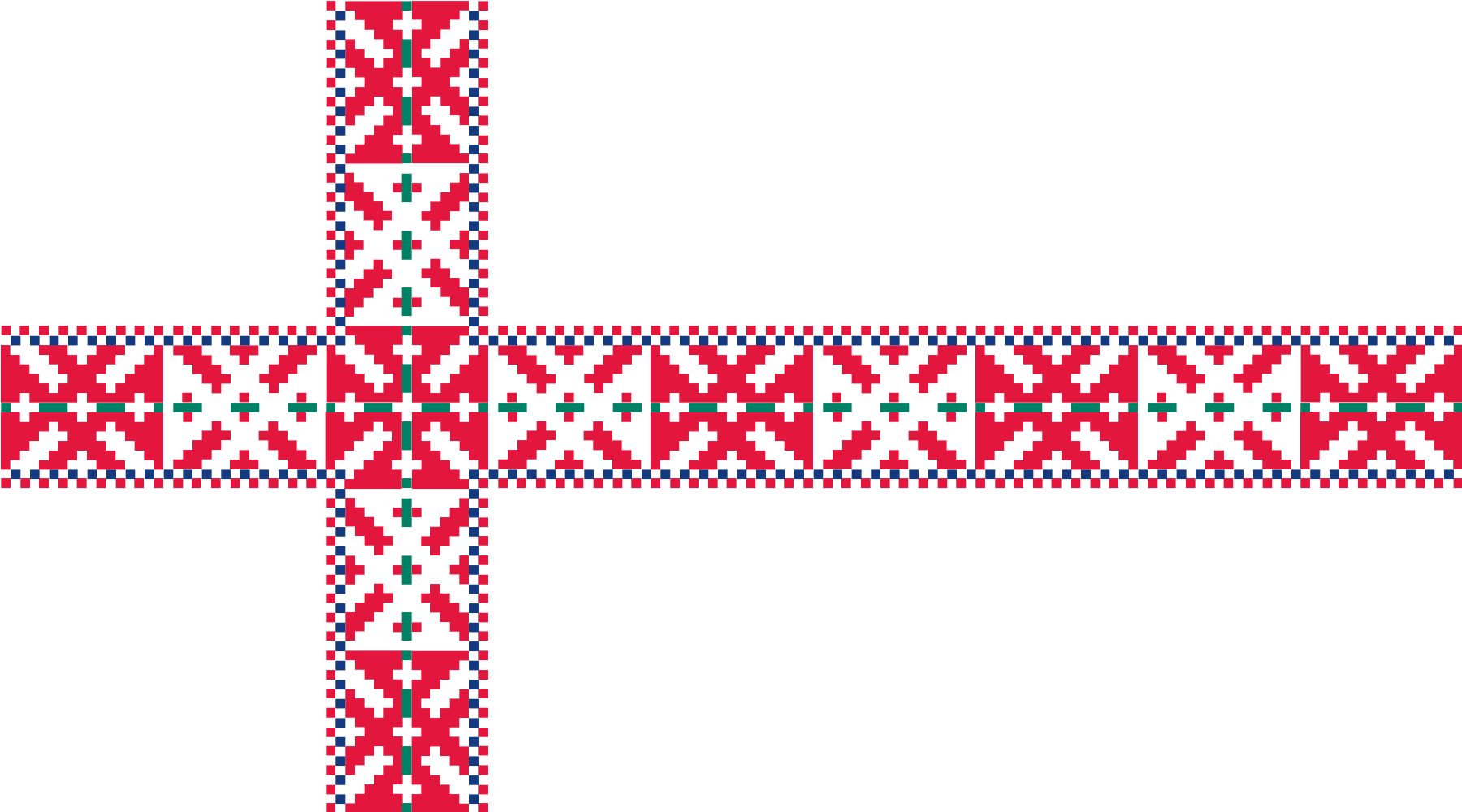
In 2003, a referendum was held among Setos where the current flag was chosen and on the 29th of November it was officially approved at the 7th Seto Congress in Obinitsa. In 2018, the newly established Setomaa parish adopted it as well. A red cross on a white background, the cross is based on traditional embroidered belts from Pangjavitsa and the ratio of the flag is 6:11. [1]
Sources
- Mäkeläinen, Tapio: Setomaan lippu . Setojen ystävät ry, 05.07.2024. Available: Setomaa.fi or in archive .
10. Võros
The Võro flag, a green flag with a white cross, was chosen in a public competition held in 2013 to represent the Võro language, its speakers, and their homeland in southeastern Estonia. The green background represents the forests of the Võroland. The notched cross is a traditional symbol among Finnic nations and is among Võro believed to protect from evil and bring good fortune. The white colours represents purity and honesty of the Võro people's spirit. It is also the colour of the traditional white linen shirt in Võro. The proportions are 7:11, the same as in the Estonian flag. [1]

Sources
- Võrokõisi lipp. Võro Selts VKKF, 2019. Available: voroselts.ee.
11. Sweden Finns
Sweden Finns are Finns living in Sweden, typically counted up to third generation, and they number around 700 000. In 2014 the Delegation of Sweden Finns decided upon an official flag for the minority. Between two finalists, the flag designed by Andreas Jonasson was chosen, which combines the flags of Finland and Sweden. [1] [2]


Sources
- Ojala, Tuomas: Ruotsinsuomalaisten lippu: kyllä vai ei? . Sveriges Radio, 13.12.2013. Available: sverigesradio.se
- Liekola, Heidi: Ruotsinsuomalaisten lippu on valittu. Sveriges Television, 31.03.2014. Available: svt.se
12. Torne Valley Finns
Torne Valley Finns include Finns living on both sides of the Finnish-Swedish border in the Torne River. This border was
originally created following the Finnish War of 1808-09 when the west side of the river became a part of the
Russian Empire. Finns who remained on the Swedish side of the border began to form their own dialect of Finnish
called Meänkieli and in the late 20th century efforts have been made to bolster their ethnic identity in Sweden.
The flag of the Torne Valley Finns was adopted the 15th of June 2007 to represent Finns of Torne Valley
on both sides of the border. The flag is a horizontal tricolour in yellow-white-blue with dimensions of 7:11. The colours
are derived from the flags of Sweden and Finland and was designed by Herbert Wirlöf. Yellow represents the sun, white
the open wintery fields and blue the summer sky. [1]

Sources
- Eejkestorm, Jaqueline: Tornedalingarnas dag den 15 juli . Länsstyrelsen Kronoborg, 15.06.2024. Available: lansstyrelsen.se
13. Kvens
Kvens are a Finnish minority that has lived in northern Norway since at least the early 1700s. Their flag was first adopted by the Kveenimaayhistys Society in 2009 after a competition featuring 20 different designs. In 2017, another major Kven organization, Ruijan Kvääniliitto, also approved the flag, which has since become the de facto symbol of the Kvens. The flag, designed by Bengt Johansson-Kyrö, features a blue background with a sunflower motif inspired by traditional Kven handicrafts. [1] [2]

Sources
- Kveen Suomi Liitto: Hvordan Kvenflagget kom til . Available: kvenfinn.no
- Larsen, Dan Robert: Endelig et felles flagg for kvenene . Norsk rikskringkasting, 18.05.2017. Available: nrk.no
14. Forest Finns

The Forest Finns were migrants from Finland's Savonia and Northern Tavastia regions. In the late 16th and early-to-mid-17th centuries, they
settled in the forested areas of Norway and Sweden and became known for their slash-and-burn agriculture. Over time, particularly by
the late 18th century, they were largely assimilated into the local Swedish and Norwegian cultures.
The flag of the Forest Finns, designed by Norwegian couple Frederic M. Lindboe and Bettina Gullhagen, was adopted on 29
December 2022. It emerged from a flag design competition held in the summer of 2021, which received hundreds of proposals.
At the center of the flag is a black rhombus, a traditional Forest Finn symbol for fertility, found on old
settlements. The green represents the slash-and-burn agriculture, red for fire and the holy Rowan tree, yellow for the St. John's
wort flower and black for soot. [1]

Svullrya, located in the Finnforests of Grue county, is the heart of Forest Finn culture. Every year, it hosts the Finnskogsdagene (Finn Forest Days) festival, during which the Republic of the Forest Finns humorously declares its independence and raises a flag to mark the occasion. The website of the Finnskogsdagene recounts the creation of the first flag with an explanation for its unusual dimensions:
» The well-known rally driver Per Engseth from Elverum was to visit the Republic of Finnskogen during the opening in
the summer of 1978 and the car was to be decorated in addition to making and fitting cow bumpers and
spoilers. The result of the decor was a flag. The proportions of the flag to be placed on the car
door were probably closer to a "normal" flag, but with the cross turned to the right and painted completely freehand.
The color choice was simple, it was the colors that were on the paint and varnish shelf in the workshop
at "Tanken". Erling Hagen, Oddvar Neby and Jorn Skaslien agreed that black Bengal varnish, green paint and masking tape was
an excellent color choice. This is the simple and true story of the republic's first flag, but as I said,
only painted on a car door.
The Republic of Finnskogen did not yet have a flag to hoist at the flagpole during the opening, and therefore
a government decision was made that the Republic of Finnskogen should have its own flag. The Republic was to separate
itself from the Kingdom of Norway and it was then quite natural to create its own special flag. The flag
was sewn by the seamstresses in FinnskogSom (Aud Vålberg, Martha Hansen, Inger Åransberg and Jenny Skaslien) following instructions from the
government.» [2]
Sources
- Bohmelin, IngMarie & Myhrvold, Jan: Her er det skogfinske flagget! . Norsk Skogsfinsk Musem, 2022. Available: skogfinskmuseum.no
- Finnskogdagene: Om republikken Finnskogen sitt flagg . Available: finnskogdagene.no .
 Top
Top

![[114]](https://www.ra.ee/dgs/browser.php?tid=68&iid=110700220973&img=era0031_002_0000010_00147_t.jpg&tbn=1&pgn=8&prc=30&ctr=0&dgr=0&lst=2&hash=40919bad1c73e394c3d1d6420c26ef3d)
![[115]](https://www.ra.ee/dgs/browser.php?tid=68&iid=110700220973&img=era0031_002_0000010_00148_t.jpg&tbn=1&pgn=8&prc=20&ctr=0&dgr=0&lst=2&hash=a75bdab0b3d2f14c1d0be9ae09d27e4c)
![[116]](https://www.ra.ee/dgs/browser.php?tid=68&iid=110700220973&img=era0031_002_0000010_00149_t.jpg&tbn=1&pgn=8&prc=20&ctr=0&dgr=0&lst=2&hash=45b677e3478c30f5227c813800db188c)

![[CoA]](https://commons.wikimedia.org/wiki/File:Coat_of_Arms_of_East_Karelia_(1920-1922).svg)

