In February 1917 the Imperial Rule in Russia collapsed during the February Revolution, which was celebrated throughout Finland.
Prior to independence, Finland had been under an intense policy of russification, and once Tsar Nicholas II was deposed,
Finns took to the streets with a wide variety of different Finnish flags in red-and-yellow and blue-and-white.
The red and yellow, drawn from Finland’s historic coat of arms, had been favoured by not just the Swedish-speaking population,
but also by the so called Constitutionalist movement, which advocated for resistance against russification policies.
In contrast, blue-and-white had been promoted by the Fennoman movement, which advocated for a Finnish-speaking Finland.
Finland's path to independence was complicated by internal disagreements in Finland and it wasn't until December 6th, after
the October Revolution in Russia, that Finland finally declared independence.
Public debate over Finland's flag began after the February Revolution and in December, with the declaration of independence,
the issue was advanced in the Senate and the Parliament. In the Senate, Finland’s executive body, the
Young Finnish Party - a part of the Constitutionalist movement during Russian rule - held significant influence and pushed
for the adoption of the lion flag. The Senate drafted a bill proposing this design as the state flag, while the civil ensign was
a cross flag. In the Parliament, however, the balance of power was tilted toward the blue-and-white faction. The Social Democratic Party (SDP),
the largest party, remained mostly indifferent to the flag debate, since their attention was mostly consumed by the looming
socialist revolution. This left the Agrarian League and the Finnish Party, both ardent supporters of blue and white, to dominate
the flag debate. The Senate's proposal was rejected and the parliament instead advocated for the temporary adoption
of a blue-and-white striped flag, with a public design competition over the final flag to follow. Before such a competition could be organized, however, the
country descended into civil war in early 1918.
As most of the leftist parliamentarians joined the revolutionaries, the parliament ceased to function for the duration of the war.
This left the Senate to rule alone, and the senate flew the lion flag as the unnofficial state flag of Finland.
However, the Civil War’s conclusion in May 1918, marked by the defeat of the Red Guards, reshaped the flag debate.
The victory of the White forces, combined with the now-toxic association of red with the defeated revolutionaries,
bolstered the position of the blue-and-white advocates. Even the Young Finns, facing mounting pressure, abandoned
their support for red and yellow. Only the Swedish People’s Party continued to champion the traditional heraldic colours.
Ultimately Finland ended up adopting the Blue Cross Flag in May 1918. By combining the colours of the Finnish nationalist
Fennoman movement with a Nordic cross flag, the parliament attempted to find a comprompise that would unite the Finnish and Swedish
factions in Finnish politics. As an additional concession to the Swedish-speaking minority, the state and war flags would also feature
the red-and-yellow coat of arms at the center of the cross, while the civil ensign remained a simple blue cross on white.
And thus, after more than half a century of debate, Finland’s flag question was finally resolved
The lion flag had become one of the major flag designs used before independence during the years of oppression. It was particularly favoured by the Swedish-speaking population of Finland, but was also popular among many Finns, especially those who favoured a more active form of resistance against the Russian rule (i.e. the Constitutionalists). In the capital the flag was raised on top of major buildings around the Senate Square following the collapse of the Russian Empire, and when the Finnish senate began the process of adopting a flag for the newly declared independent Finland, the lion flag was the favourite.
While Finland's declaration of independence was still being drafted, the Senate decided on the 4th of December 1917 to establish a flag committee to prepare a proposal for Finland's new flag. [36] The committee comprised of Councillor of Commerce Lars Krogius, architect Eliel Saarinen, and Dr. U.T. Sirelius. For the state flag, the committee proposed a red lion flag, and for the civil ensign, a simpler red and yellow cross flag. To ensure the civil ensign could be distinguished from Denmark's flag at sea in case the yellow cross would fade into white over time, the committee added nine white roses to the upper inner corner. The idea for the roses appears to have come from the Shipmasters' Association of Helsinki.


The committee justified its proposal as follows:
» In drafting this proposal, we have considered it our duty to apply the heraldic colours found in the Finnish lion emblem: red, yellow, and white. However, this colour combination has posed difficulties in ensuring sufficient distinction from both the Danish national and merchant flags, as well as from the international signal flag representing the letter R. At the same time, we have deemed it desirable and natural for the Finnish flag to be brought as closely in line as possible with the flags of the other Nordic countries. However, for practical reasons, we have chosen to eliminate the swallow-tailed form. In accordance with this, we have found it necessary to introduce into the upper hoist quarter of the merchant flag the nine white roses present in the Finnish coat of arms, which should make the flag easily distinguishable from the Danish civil ensign. To further differentiate the civil ensign from the naval and pilot flags, we have replaced the roses in the corresponding quarter with the lion. » [1]
The flag issue quickly gained attention in the press after the committee submitted its proposal to the Senate. A lively debate ensued during which a wide variety of flag designs were proposed to the committee, the senate, the parliament and in the press. These desings are presented in more detail in chapters 4-6 on this page.
On the 21st of December 1917, the Senate reviewed the flag committee’s proposal. The Senate supported the committee’s suggestion insofar as it approved the lion flag, only
Senator Louhivuori held a differing view, arguing that the civil and state ensigns should be one and the same. The design of the civil ensign became a matter of bigger disagreement.
Louhivuori proposed that the civil ensign should feature a blue cross on a white background, with Finland’s golden-yellow coat of arms in the upper canton. Senator Pehkonen suggested
modifying the committee’s flag by changing the background behind the roses to blue. Senator Frey, in turn, proposed a flag with a yellow cross on a red background, bordered by two
stripes: the inner stripe blue and the outer stripe white. The Senate debated the merchant flag designs proposed by the committee, Louhivuori, Pehkonen, and Frey, ultimately deciding in
favour of Frey’s flag. [3]
On the 4th of January, the Senate resolved to submit a proposal to Parliament for Finland’s flag. The draft law specified the proportions of both flags as 26:17.
The dimensions of the civil ensign were defined horizontally as 8 × 0.35 × 0.4 × 2.5 × 0.4 × 0.35 × 14, with the height of the red rectangles set at 6.5 units.
[4]

The Senate argued their proposal:
» When the matter was discussed in the Senate, it was concluded that it would be proposed to the Parliament for approval: that the aforementioned so-called Lion Flag proposed by the committee be designated as the special State Flag of Finland, for which the government will provide detailed instructions on usage; that for the maritime and civil ensign, a cross flag with a gold-yellow vertical cross bordered by a blue and white stripe on a red background. These flags, thus formed, are distinct from the flags of other countries, combining harmoniously the heraldic colors beloved by the Finnish people. » [4]


On 24 January 1918, Parliament reviewed the Senate’s proposal in the Foreign Affairs Committee.
The committee failed to reach a consensus on the Senate’s proposal or on what the flag’s design
should be in general. Many members supported blue and white as the national colours. However, the
majority of the committee proposed that a public competition be organised for the design of new
flags and that well-known artists be invited to participate. Additionally, until a new flag was
chosen, a temporary flag should be used, featuring a blue upper half and a white lower half.
The committee’s report concluded:
» In addition to the flag samples submitted by the Senate, the Committee has also received
several other proposals and drafts. However, the committee is of the opinion that this matter,
which is one of great importance to our country and vigorously discussed among various groups
of citizens, has not yet been sufficiently prepared. An independent Republic of Finland should
receive an original national flag that corresponds as well as possible to its dignity. In the
Committee’s view, this aim would be best achieved by arranging a competition for the design
of the Finnish flag.
(...)
Organising such a competition will undoubtedly delay the resolution of the flag question to
some extent. However, as it has been pointed out, especially by those in the maritime sector,
that a swift decision on this issue is essential in order to avoid unpredictable inconveniences
and damages, the Committee has considered it necessary to arrange the matter on a temporary basis.
This could be done by stipulating that, until a law on the Finnish flag is enacted, Finland shall
use a blue-and-white flag composed of two rectangular pieces of cloth of equal size, the upper one
blue, the lower one white. The length of the flag shall be 26 units and the width 17 units. As the
parliament will undoubtedly be able to make its final decision on the matter by the 1st of May,
the use of the blue-and-white flag should be restricted to the period up to that date. »
[5]

However, the committee's temporary flag was never widely used, and the competition was not organized. The socialists initiated a revolution in the following days, and the flag debate in the parliament came to a halt. The parliament became inoperable once the largest party, the SDP, had joined the revolutionaries. Once the Civil War began and the Red Guard seized control of the capital, the Senate relocated to Vaasa for the remainder of the war. With the flag issue deadlocked in Parliament, the Senate decided to issue an order concerning the use of temporary flags. On the 15th of February 1918, the Senate decreed that the Lion Flag was to be used temporarily as the civil ensign until Parliament could decide the matter in more detail:
» The Board of Trade and Industry hereby notifies, for information and compliance, that the Senate has today decreed that the Lion Flag, proposed as the national flag, shall be used as Finland’s civil ensign until Parliament has resolved the question of Finland’s flag. » [32]
However, a couple of weeks later, on 27 February 1918, the Senate revoked its previous order regarding the flag and decided instead that the civil ensign should be that designed by Senator Frey and proposed by the Senate to Parliament:
» The Senate of Finland, upon presentation by the Chancellery of the Financial Department, has, revoking its decision of
15th February 1918, issued the following regulations concerning Finland’s temporary maritime and merchant flag:
From the date of publication of this decision, Finnish merchant vessels shall use as a temporary maritime and merchant
flag a plain red flag, coloured carmine-vermilion, the width of which shall be 17 units and the length 26 units, and which
shall bear a golden-yellow cross bordered by two stripes, the inner blue and the outer white, dividing the flag into four
rectangles, each 6.5 units wide; those nearest the staff shall be 8 units long and the outer ones 14 units long. The width
of the yellow cross stripe shall be 2.5 units, the blue 0.4, and the white 0.35 units. » [6]
Despite the Senate’s decree, Frey’s flag never came into widespread use. Instead, the Senate flew the Lion Flag during the war, even though it had not been legally confirmed. After Helsinki was recaptured, the flag was flown when the chairman of the senate, P. E. Svinhufvud, symbolically took possession of the Viapori Fortress and renamed it Suomenlinna (The Fortress of Finland). During the victory parade, the Commander-in-Chief, C. G. E. Mannerheim, proclaimed:
“The army’s goal has been achieved. Our country is free. From the fells of Lapland and the outermost skerries of Åland to River Siestarjoki, the Lion Flag waves.” [37]
Although the Vaasa Senate flew the Lion Flag, the blue-and-white colours were already popular among the White troops, many of whom came from the Finnish countryside. As the war progressed, blue-and-white imagery became ever more strongly associated with the White Army, the Civil Guards, and the German-trained Jaegers. These colours now became linked with an idea of a Finnish national front, that perceived itself to be fighting against a foreign backed socialist threat looking to destroy the Finnish nation. Even though originally in the 1850s and 1860s the blue-and-white colours had risen from loyalty to the emperor - and even though during the Years of Oppression they had been associated with the Old Finns’ policy of compliance - for the common ranks of the white army they still represented the Finnish-speaking population above everything. And now that a new independent Finnish nation-state was being created, naturally the colours of a Finnish flag would be those colours which the average Finn had flown since the 1860's. The red-and-yellow lion flag, in turn, represented for them an old-fashioned and elitist form of power, which didn't represent the common Finnish folk. After the war, in the victory parades, both flags were still displayed side by side, but in the post-war debate the blue and white gained further strength through their association with the Civil Guards.
After the Civil War, the parliament once again took up the question of the Finnish flag.
The senates’s proposal for the Finnish flag, presented before the war, was transferred
from the Foreign Affairs Committee to the Constitutional Law Committee, which included
all the same members except for the socialist representatives (who were either dead, jailed or in exile).
The commitee was chaired by K. J. Ståhlberg and convened to discuss the flag on the 17th of May, the day
after the victory parade. During the first meeting, it quickly became clear that the lion flag was
no longer a viable option.
The Finnish Party (Old Finns) and the Agrarian League supported the blue-and-white since many years, but
now even the Young Finns, who had been staunch supportes of red-and-yellow since before independence,
shifted their stance. The blue-and-white colours were justified not only by the old arguments - that they
were widely accepted by the common folk - but now they also found support from their new association
with the victorious Civil Guards and a White anti-communist Finland. The lion flag and the red-and-yellow colours,
on the other hand, were now utterly unacceptable to the blue-and-white supporters. These colours were not only
accused of being distant and foreign for the commoners, but after the war their visual association with the red banners
of the socialist revolution also made them impossible. The capital had been recently liberated from under the red flag
and it would be incomprehensible to raise such a similar looking flag back into the flagpoles.
The representatives of the Swedish People's Party (SFP) still attempted to defend the historical tradition
of the lion flag and its colours, but by now they were hopelessly outnumbered.
A blue cross on a white background quickly emerged as the most popular option. While the colours of the flag
were now destined to become the fennoman blue-and-white, it was widely agreed that Finland should adopt the Nordic
cross flag style. A white cross on blue was also considered, but this version was deemed too similar to the Swedish
flag and the unnofficial Icelandic flag, and as such a blue cross on white was the logical solution.
Efforts were also made to reach a compromise with the Swedish representatives by trying to figure out a way
to incorporate the red-and-yellow colours into the blue cross flag. Various proposals were made, such as A.O. Wuorimaa
(Agrarian league) who proposed adding them in the form of heraldic stars or roses in the canton. Tekla Hultin (Young Finns)
proposed adding the Finnish lion into the canton. Lauri Ingman (Old Finns) suggested red-and-yellow bars into the canton whereas
Santeri Alkio (Agrarian League) supported adding the Finnish lion in the middle of the cross.
Ståhlberg (Young Finns) was critical of colouring the upper corner and proposed that the red-and-yellow colours could be added
as narrow stripes around the blue cross instead.
Eventually, Ingman proposed the following: the committee would agree on a blue cross on white as the basis of the flag, with red and yellow incorporated
into the upper corner in a yet-to-be-determined manner, with the final details decided upon later. The committee voted 14–2 in favour of this proposal
and assigned Ingman and secretary A. F. Puukko the task of drafting the design. Their draft featured a narrow blue cross with red and yellow triangles
in the upper corner. This version was then presented to artist Akseli Gallén-Kallela, who was tasked with finalising the design for the committee’s consideration.
[26]
Akseli Gallén-Kallela the head of the drawing department at the General Staff at the time, and he was asked to finalise the flag based on the committees draft.
His subordinates included artists Eero Snellman and Bruno Tuukkanen, who were responsible for designing uniforms, medals, and flags for the defence forces.
However, Gallén-Kallela opposed the committee’s flag design and refused to take on the task. Like many other artists, he supported the
red-yellow colours and had designed two flag drafts featuring yellow and red double crosses on a white background. If the colours had to be blue and white,
he would have preferred a white cross on a blue background.
Eero Snellman later recalled:
» Around the time of Pentecost, Gallén-Kallela was assigned the task of designing the proportions of the national flag. The secretary of the Parliament's Constitutional Law Committee, Dr Puukko, arrived at our office one morning before the holidays, carrying a draft flag proposal based on Parliament's principle decision - a blue cross on a white background. The draft featured a relatively narrow blue cross, akin to Scandinavian flags. Due to the country's linguistic balance and the need for impartiality, the upper canton of the flagpole side was divided diagonally into red and yellow triangles. The proposal was dreadful and provoked an outright fit of rage from Gallén-Kallela, who remarked that the flag resembled the Cross of St Andrew. The task of creating a new flag proposal now fell to Gallén-Kallela. However, he left for the countryside and, as an opponent of the blue-white flag, likely had little enthusiasm for designing it.« [25]


However, the Constitutional Law Committee had already made its decision regarding the blue cross flag and had scheduled a meeting on 22 May to finalise the matter. On the morning of the meeting, the committee secretary, A. F. Puukko, visited Gallén-Kallela’s office to inform him that if he was unwilling to design the flag, the committee members would proceed to do so themselves. However, by then, the artist was no longer in the city at all.
When Gallén-Kallela declined to design the flag, his subordinates Eero Snellman and Bruno Tuukkanen were given the task instead. Snellman and Tuukkanen agreed with Gallén-Kallela that the committee's vision was not a good one. They felt that the cross was too narrow, the chosen blue colour too pale, and the upper corner in red & yellow unsatisfactory. Instead, they decided to propose that the civil ensign be a plain blue cross on white, while the state- and war flags would have the colours of red and yellow placed in the middle of the cross in the form of the Coat of Arms.
» On the first working day after Pentecost when Dr. Puukko arrived to collect the flag draft, Gallén-Kallela was nowhere to be found. Therefore, Tuukkanen and I hurriedly began designing flag proposals ourselves. The committee was scheduled to meet that same day at 12 noon, during which the flag issue had to be resolved, and if no alternative was ready, potentially in line with Parliament's dreadful suggestion. We experimented with the blue cross in different sizes and shapes. Ultimately, we settled on simple proportions of 3:4:5:10 starting from the flagpole. To accommodate the colour demands of the Swedes, I had a fortunate idea to propose the approval of three flags: a state flag, a military flag, and a civil ensign. The first two would feature the red-and-yellow coat of arms, then still with a crown, placed in the centre of the blue cross. » [25]


The Constitutional Law Committee reviewed Snellman’s and Tuukkanen’s drafts in its meeting on 22 May, and the majority of representatives considered them to be highly successful. However, Swedish representatives Wrede and Estlander continued to oppose the blue and white colours and announced that they would submit a dissenting opinion. As an attachment to the dissent, Estlander also presented his own proposal for the civil ensign, in which blue and white fields would be added to the upper corner of a red and yellow cross flag.

However, the committee’s clear majority supported Snellman’s and Tuukkanen’s drafts and voted in their favour. The committee then prepared a proposal for parliament, where the flag law would be discussed next. The committee's reasoning was as follows:
» The Committee has been unable to agree with the proposal in the Government's bill, which suggests that the basic colours of the Finnish
flag should be the colours of Finland's coat of arms: red and yellow. In many parts of the country, white and blue have long been considered
national colours. The colour blue also holds deep historical significance in Finland. It is the main colour in several provincial coats of arms,
and in some, it appears alongside white. Under the banner of white, red tyranny was recently overthrown, and Finland's independence was secured.
For this reason, the Committee has decided to propose white and blue as the primary colours of the Finnish flag.
The Government's bill proposes a cross flag as the design for Finland's maritime and commercial flag. The Committee supports this design,
particularly because it is used by all other Nordic countries. Regarding the choice of colours for the cross and the background, it is important
to note that a flag with a blue background and a white cross could easily be mistaken for the Swedish flag from a distance. As is well known,
the Swedish flag features a yellow cross on a blue background. Additionally, the unofficial Icelandic flag is blue with a white cross. Therefore,
the Committee, considering that a dark cross on a white background is more visible at sea, believes that Finland's flag should feature a sea-blue
cross on a white background.
During the Committee's discussions, it was suggested that the colours of Finland's coat of arms, whose inclusion as the main colours of the flag has
also been advocated, should still be represented on the flag in some form. Acknowledging this viewpoint, the Committee has decided to propose that
the state flag should include the coat of arms of Finland in the centre of the cross. Since coats of arms or similar symbols are generally not used
on commercial flags for practical reasons, the maritime and commercial flag would be the state flag without the coat of arms emblem. »
[8]
The committee's proposal was approved by the Parliament on the 28th of May, 1918, and the bill was passed by the Senate on the 29th of May 1918. Below is an unnofficial translation. [33]
The state flag of Finland is a rectangular cloth with a deep blue (ultramarine) cross on a white field.
The cross divides the flag into four rectangular areas of equal height. The coat of arms of Finland is in the centre of the cross.
It is the responsibility of the Government to issue more detailed regulations on the use of the state flag.
The proportions of the flag are as follows: the total height is 11 units, the total length is 18 units; the width of the cross is 3 units; the length of the inner sections is 5 units, and the outer sections 10 units.
The merchant and maritime flag is the state flag without the coat of arms.
This flag shall be used by Finnish merchant vessels to indicate their nationality, in accordance with the applicable maritime regulations, whether sailing or in port.
Pilot, customs, and postal flags shall be the merchant and maritime flag, supplemented with such marks as the Government shall specify in more detail.
The war flag is the state flag with three tongues. The total length of this flag is 19 units. The length of the outer sections, excluding the tongues, is 6 units. The outer edges of the tongues shall not form an angle with the top or bottom edge of the flag.
Pursuant to regulations issued by the Commander-in-Chief of the Defence Forces, a special mark may be added to the flag to indicate command, but otherwise no marks or letters shall be added to the flag.
The war flag shall be used:
a) on vessels and buildings of the navy;
b) on state fortifications;
c) on barracks, camps, and training grounds of military units, as well as on vessels belonging to military units when commanded by a military officer; and
d) on buildings used by headquarters, military units, or military educational institutions.
Standard flags shall be manufactured by the Government and stored in a dark room designated by the Government.
The coat of arms of Finland received its precise form in November 1919 based on drawings by Eric Ehrström. At this stage, the
coat of arms still had a crown on top of the lion, as it traditionally had always had. However, when Finland's form of government
became established as a republic, it was deemed inappropriate to include a royal crown on the state symbol, and so it was removed the 12th of February, 1920. [39]
At the same time, the shape of the shield in the flag's coat of arms was changed into a square, so that it would fit in the centre of
the cross (excluding the lower point of the shield). In November 1920, a further decree restricted the use of the state flag to state
authorities only. Private individuals were to use only the civil ensign. [34]
In 1925, the Finnish Government issued a decree (200/25) specifying that standard colour samples of the Finnish flag were to be produced.
These samples, made from wool and cotton fabric, were to be packaged in paper and metal containers. The regional state administrative
agencies and certain ministries were responsible for storing these samples and providing them to businesses and citizens as a reference
for flag production, as needed.


In 1957, the Government appointed a Heraldic Committee to prepare proposals for supplementing heraldic legislation.
In this context, the committee noted that the standard colours approved in 1925 were no longer sufficiently precise, as flags had begun to be manufactured
not only from traditional wool and cotton but also from synthetic fabrics. In addition, textile dyeing techniques had developed considerably,
rendering the 1925 colour standards outdated. For this reason, the committee considered that the colours of the Finnish flag should be respecified
using modern methods. However, the committee’s proposal did not lead to immediate action. [38]
In 1967, the Heraldic Committee raised the issue of the flag’s colours once again. On this basis, the Government appointed, on 16 February 1967,
a separate Flag Committee whose task was to carry out a broader revision of the legislation concerning the Finnish flag and to prepare uniform guidelines
for its use, including those concerning colours.
With regard to the colours, the committee proposed that their definition should be based on a modern and internationally accepted optical measurement method.
In the study of the old standard colours, it was found that the blue of the flag had changed over the years and that the flags on sale were often
lighter than originally intended in 1918. Bruno Tuukkanen, one of the original designers of the flag in 1918, also confirmed this to the committee.
The committee furthermore proposed a separate Act concerning the Coat of Arms of Finland, which had not previously existed.
As the coat of arms also appeared on the state and military flags, the committee considered it appropriate to address the legislation on the coat of arms in the same context.
The coat of arms designed by Eric Ehrström in 1919 was simplified into a model drawn by Olof Eriksson. At the same time,
the small tongue at the bottom of the shield on the state flag was removed, making the shield a complete rectangle. [38]
The committee also recommended reversing Finland’s flag hierarchy. Previously, under the 1918 Act, the state flag had been the primary flag, from which the civil ensign
(without the coat of arms) and the war flag (with a swallowtail) were derived. In 1978, the committee proposed renaming the civil ensign into a national flag and
making it the primary flag. The state flag, in turn, was derived from it by adding the coat of arms. The war flag was renamed the swallow-tailed state flag,
indicating that it was a derivation of the state flag, since the defence forces were a part of the state. The purpose of this change was to better align the definition
of the flags with the democratic values of Finland; the primary flag was the flag that represented the people, rather than the state. [38]
The committee’s proposed Act on the Flag was approved by Parliament in 1978 and entered into force on 1 June 1978. However, the committee’s proposal for a new colour specification
was not incorporated into the law itself; instead, the Act merely states that the Government shall issue more detailed provisions concerning the colours of the Finnish flag.


In 1984, the Heraldic Board of the National Archives once again brought up the fact that the shade of blue had still not been respecified. The Ministry of the Interior finally initiated, in 1988, a process in which VTT (Technical Research Centre of Finland) measured various shades of blue in order to find the most suitable one. In 1992, the Heraldic Board selected a new blue from among twelve test-dyed fabric samples — the one that best corresponded to the original 1918 shade. After comparison, the choice narrowed to Pantone colours 294 C, 301 C and 287 U, of which 294 C proved to be the closest match. The corresponding shades for red and yellow were 186 C and 123 C respectively. The colours were also defined in the NCS and CIE colour systems. The Government confirmed its decision on the colours of the Finnish flag (827/1993) in 1993. This decision darkened the shade of blue in commonly used flags, bringing it closer to the original. [31]
The flag of Finland has a blue cross on a white field. The flag is either the national flag or the state flag.
The national flag is rectangular, and its proportions are:
height 11 and length 18 units;
width of the crossbar 3 units;
and
height of the fields 4 units, length of the hoist-side fields 5 units, and length of the outer fields 10 units.
The state flag is either rectangular or swallow-tailed. It bears the coat of arms of Finland in the square formed by the crossbars. The square has a yellow border, the width of which is 1/40 of the width of the cross.
The proportions of the rectangular state flag are the same as those of the national flag.
The swallow-tailed state flag is one unit longer than the rectangular state flag, so that the length of its outer fields is 6 units and the length of the tongues is 5 units. The middle tongue is isosceles, with the crossbar as its base. The outer edges of the outer tongues do not form an angle with the top or bottom edge of the flag.
Everyone has the right to fly the national flag.
The national flag, with the exceptions provided in Section 5, is the nationality mark of a Finnish vessel. However, on a pleasure craft, an approved special flag may be used instead of the national flag, as separately provided by regulation.
The rectangular state flag is used by Parliament, ministries, central government agencies subordinate to the ministries and agencies comparable thereto, the Supreme Court, the Supreme Administrative Court, the Courts of Appeal, the Licensing and Supervision Authority, the Vitality Centre, Finland’s diplomatic or equivalent missions abroad and consular posts headed by career consuls, the Bank of Finland, the Finnish Centre for Pensions, the Academy of Finland, public universities, the Border Guard, and state vessels. (27.6.2025/578)
By regulation, it may be provided which other state agencies, institutions, and authorities not mentioned in subsection 1 shall use the rectangular state flag. However, the Ministry of the Interior shall determine the right of the police to use the rectangular state flag.
The swallow-tailed state flag is used by the headquarters, units, institutions, and vessels of the Defence Forces.
The President of the Republic uses a swallow-tailed state flag with a blue and yellow Cross of Liberty in the hoist-side upper field.
In cases other than those provided for in this Act, no additional emblems may be placed on the Finnish flag.
However, the swallow-tailed state flag with a special emblem designated by the President of the Republic in the hoist-side upper field may be used as the command flag of the Minister of Defence and the Commander of the Defence Forces, and as the naval command flag on warships.
The Government shall issue more detailed provisions on the colours of the Finnish flag.
Anyone who publicly desecrates the Finnish flag or uses it disrespectfully, or without authorisation removes a Finnish flag displayed in a public place, shall be sentenced for defaming the Finnish flag to a fine. (21.4.1995/588)
Anyone who unlawfully uses the flag of the President of the Republic or another state flag, or uses a Finnish flag to which additional emblems have been added in violation of Section 6, or sells as a Finnish flag a flag that clearly deviates in colour or proportions from the flag prescribed by this Act or regulations issued under it, shall be sentenced for violation of the regulations on the Finnish flag to a fine.
More detailed provisions on the implementation and application of this Act and on flying the Finnish flag shall be issued by regulation.
This Act enters into force on 1 June 1978. It repeals the Act on the Flag of Finland of 29 May 1918.
However, a flag of an association or other community that has additional emblems in violation of Section 6, subsection 1, and was taken into use before the entry into force of this Act, may be used until the end of 1980.
Seafarers and ship officers' associations actively participated in the discussion about the Finnish flag, particularly regarding the civil ensign. Since shipowners were the primary users of the civil ensign, their views held significant importance. A popular design proposal was a red and yellow cross flag, partly due to the large number of Swedish-speaking individuals among the seafarers. The discussion also emphasised practical considerations: the flag needed to be easily producible at sea, as flags wore out quickly. Additionally, there was concern that a worn-out red and yellow cross flag might too closely resemble the Danish flag, so many proposals sought to add extra elements, such as stars or additional colours around the cross. These issues were also addressed in the flag committee and the senate, indicating that the views of seafarers were carefully considered.
In a meeting on the 6th of December, the Shipmaster's Association of Helsinki decided to present the Senate a design for a civil ensign with a yellow cross on red, with nine stars or roses added in the upper corner. Stars and roses are common symbols in Finnish heraldry with the number relating to the number of the Finnish historical provinces. This proposal was presented to the Senate and on the 8th of December the flag committee of the Senate decided to endorse the version with roses.
» It was decided to immediately submit a petition to the Senate of Finland for the adoption of a distinct civil ensign for Finland and, regarding the appearance of the flag, to unconditionally endorse the proposal presented herein. According to this proposal, the flag would feature a yellow upright cross on a red background, with well-balanced proportions, along with nine white, clearly visible stars or roses in the upper field closest to the flagpole. Sea captains George Stenius and Victor Sundman were entrusted with presenting this wish of the association orally to the Senate. » [27]

The board of the Finnish Ship's Officers' Union, a nationwide organization with local branches, criticized the decision by Helsinki shipmasters and the flag committee for including overly complicated elements in the canton. The union argued that these additions made it challenging to produce flags on board at sea. Instead, they proposed that the yellow cross should be bordered by blue, which would help avoid confusion with the Danish flag. This design was essentially the same as the so-called Dagblad flag from the 1863 flag debate. The Dagblad flag had been somewhat popular among seafarers at the time, which might explain its re-emergence in the union's proposal. Unlike the original Dagblad flag, which typically featured a centered cross, the new proposal adopted a more conventional Nordic cross style. The board sent a letter outlining their flag proposal to both the Senate and the maritime inspector, Gustaf Wrede, including an image of the suggested


» The Helsinki Ship Officers' Association discussed the flag issue in its meeting on the 6th of this month and concluded that
the civil ensign should feature a yellow cross on a red background, with the upper hoist quarter decorated with nine white stars.
This proposal was also supported by the committee appointed by the Senate for this matter, though the stars were replaced with roses.
For our part, we cannot agree with this proposal concerning the stars (roses). We consider them unnecessary and likely to make the flag's manufacture
significantly more difficult, especially at sea, where it is often crucial to produce a new flag quickly.
Furthermore, in calm weather or when the flag is wrapped around the pole, it would be impossible to distinguish it from the Danish civil ensign at a distance.
Additionally, the flag - and above all the civil ensign, which represents our nation in foreign lands and at sea - must symbolise the nation's political unity.
While it may be appropriate for the United States to include as many stars on its flag as there are states in the union, given that those states enjoy a certain degree of political autonomy,
it seems unjustified for us to include as many stars as we have provinces, particularly since our provinces now hold primarily historical significance.
A civil ensign like the one proposed by the Helsinki Ship Officers' Association has been discussed in maritime circles elsewhere, including in Turku,
but for the reasons mentioned above, it has not been deemed suitable. Instead, a flag featuring a yellow cross with a narrow blue border on a red background -
similar in design to the Norwegian civil ensign - has garnered great interest. This flag would also align with those of the Scandinavian countries -
which many would prefer - and the blue border would make it easily distinguishable from the Danish flag.
There are also supporters of a flag with a yellow cross on a red background, but as yellow fades over time, it could be confused with the Danish flag.
For this latter reason, we would prefer to support the flag with the narrow blue border. We present an illustration of it here. » [9]
Within the Ship Officers' Union, many other flag designs were also proposed, as mentioned in the 1/1918 issue of the Finnish Maritime Journal.


» The flag issue was discussed on the 14th of December at a meeting of the members of the Finnish Ship Officers' Union residing in Åland, where it was
decided to express the wish that Finland, as a republic, should have only one flag, consisting of a yellow cross on a red background, with a
narrow red cross inside the yellow cross. At the meeting of the Viipuri local branch of the Finnish Ship Officers' Union on the 20th of December, the
proposal of the local Ship Officers' Association for a civil ensign was unanimously approved, according to which the flag would have a white
background with a blue cross and nine blue stars in the upper hoist canton.
A sea captain from Koivisto proposed a national and civil
ensign featuring five blue and four white horizontal stripes, arranged so that both outermost stripes were blue. In the upper hoist canton,
there would be eight yellow stars on a red background. A member from Kuopio believed that the best solution to the flag issue would be a flag
with a blue cross on a yellow background.
Other proposals were also made, such as a red cross on a yellow background and a white cross
on a blue background, etc. At the extraordinary general meeting of the Finnish Ship Officers' Union on the 29th of December, the majority of those present
supported the proposal for a civil ensign drafted by the so-called flag committee. »
[10]
The Shipmasters Association of Vaasa came up with an alternate version of the flag proposed by Helsinki Shipmasters, where the background of the stars was changed to blue. The flag was publically demonstrated in Vaasa, after which the local newspaper criticized the heraldic nature of the flag, suggesting that its colours should be inverted so that it would have a white cross on blue, with white stars on red in the canton.


"In recent days, the proposed flag of the Vaasa Shipmasters' Association has been flown atop the Vaasa Town Hall as a sample. Its primary colour is red with a yellow cross. The upper hoist quarter is blue, featuring nine white stars symbolising Finland’s provinces. However, one could rightly argue that, in Finland’s coat of arms, these nine stars appear on a red background, making white stars on a blue background heraldically incorrect. Therefore, if one does not wish to adopt a flag that might be mistaken for the Danish flag, it would be more appropriate to make the upper hoist quarter red with white stars, while the rest of the flag remains blue – a colour overwhelmingly favoured by our nation's population and long regarded as our national colour. The cross would then be white, ensuring that the flag would not be mistaken for the Swedish flag. This change would also remove one colour from the flag, better meeting the general requirements for a civil ensign." [11]
A seafarer with the pseudonym "Sjöfararen" proposed the following civil ensign in Hufvudstadsbladet on 24 May 1918:

» Two models proposed for the civil ensign, presented by the flag committee and the Senate, can hardly be considered successful
from a practical point of view. Experience has shown that the white roses and blue and white stripes do not stand out clearly from
a distance in many cases. Therefore, it can be safely stated that these two flag models can easily be confused with the Danish flag,
the Dannebrog.
A simple cross flag, on the other hand, could be as follows, combining red and yellow and blue and white: a yellow cross bordered
by red stripes, so that the two fields on the hoist side are blue and the outer fields are white. The dimensions along the upper
edge: blue 8, red 1, yellow 3, red 1, white 14; along the hoist: blue 6, red 1, yellow 3, red 1, blue 6.
The cooler blue and white colours gain life and unity from the more vibrant cross, and the red border clearly separates the yellow
from the white. Moreover, it prevents — as the cross of the German navy's flag shows — the white from disappearing in foggy weather.
The manufacture of the flag would require the same amount of work as the manufacture of the Norwegian flag. This would be an
advantage for seafarers. »
[24]
The artistic community was also actively involved in the discussion and often supported the red and yellow colours. When Parliament was considering the Senate's bill on the flag, the Foreign Affairs Committee proposed holding a competition for the design of the civil ensign, in which artists would be invited to participate. Had the competition taken place, the outcome would likely have been a red and yellow flag. However, the competition was cancelled due to the outbreak of the civil war.
In January 1918, the Finnish Artists' Association formed its own flag committee to address the flag issue. The painter Heikki Tandefelt was appointed as chairman, and the committee decided to propose a variation of the Senate's flag committee's design as the civil ensign, where the white roses would be replaced with white borders around the yellow cross. As an alternative, the association's committee also considered a plain red and yellow Nordic cross flag. Tandefelt presented the proposal in the Työmies newspaper on the 16th of January 1918.
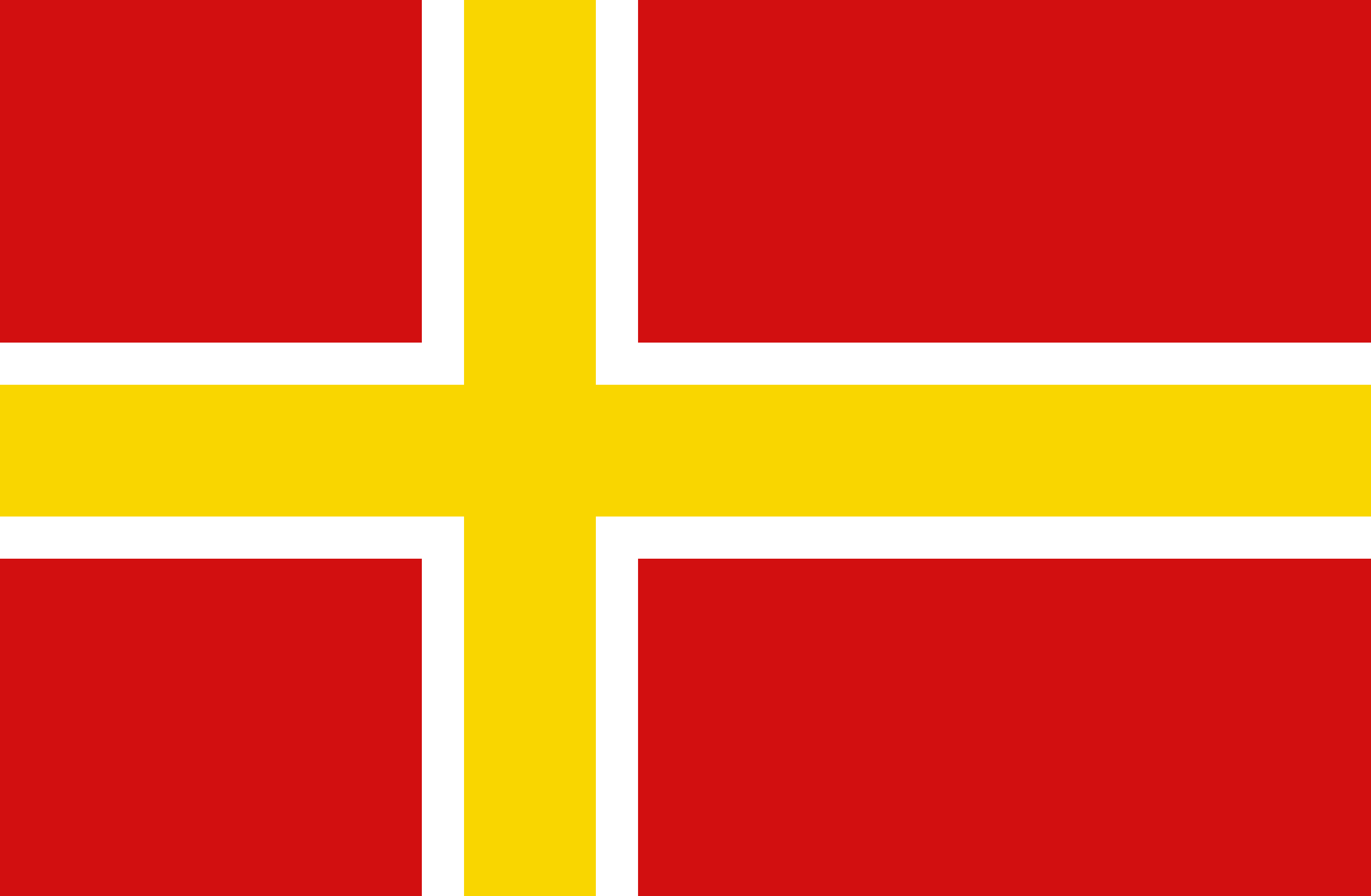
» Regarding the blue and white flag, the undersigned has not encountered a single artist - architect, painter, sculptor, or decorative artist - who has supported it.
Blue and white is the poorest and coldest of all conceivable colour combinations, a fact already noted by Goethe, the first theorist of colour harmony.
The blue, white, red and yellow compromise flag proposed by the government has been widely regarded as highly unsuccessful. It is not beautiful. It is gaudy
like a child's flag and flashy like a circus advertisement. It is generally impossible to harmoniously combine the flag colours blue, white, red, and yellow.
However, the red and yellow Nordic cross flag proposed by the state's flag committee, featuring heraldic roses in the upper inner field, has gained numerous
supporters among artists. Only the roses included in the design have provoked objections.
For this reason, the Artists' Association's flag committee has advocated for a flag in which the white colour of the heraldic roses is refined into a narrow
border around the yellow cross. In this way, white appears advantageously as an intermediary colour between red and yellow. This arrangement is also heraldically
correct. However, since it can be justifiably argued that white borders, when viewed from a great distance, increase the resemblance of the Finnish flag to the
Danish flag, it has also been considered that they could be omitted. In this case, we would have a simple Nordic cross flag displaying the primary colours of
our coat of arms. »
[12]
Ornamo, the Finnish Association of Decorative Artists, also supported the red and yellow colours. However, the association proposed modifying the Senate's bill regarding the civil ensign by replacing the blue stripe with a red one.
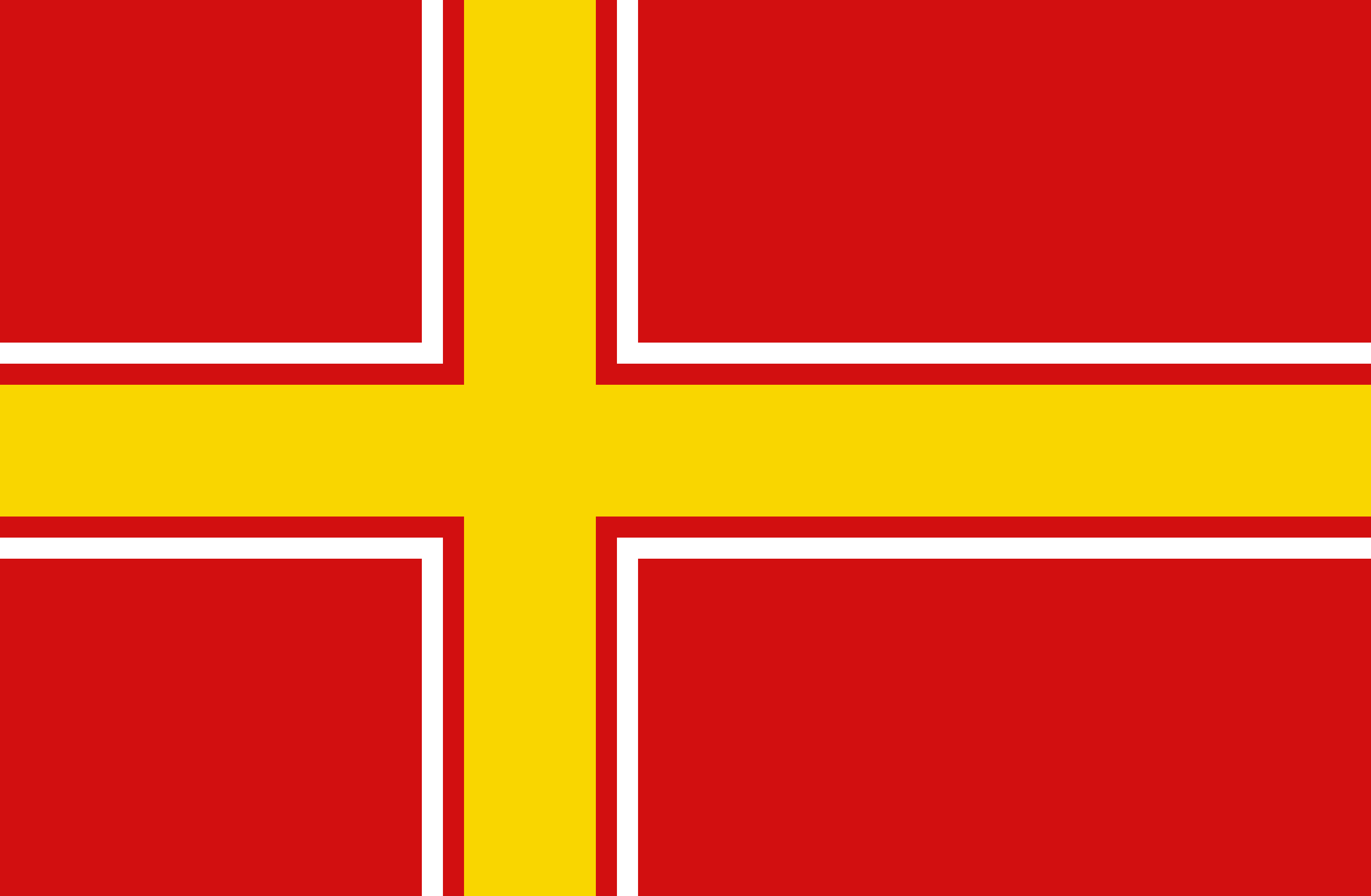
» Considering the aesthetic and colour harmony values of the flag as perhaps the most important aspects, the Finnish Association of Decorative
Artists dares to request that Parliament, in adopting a flag for the Republic of Finland, support the flag approved on the basis of the association's resolutions of 13 January.
The Finnish Association of Decorative Artists unanimously rejected certain colour combinations as unsuccessful and instead supported a cross-design
flag composed of the colours of the national coat of arms. The flag committee's proposal was not supported, as the roses included were deemed aesthetically
unsuccessful, unnecessary, and disruptive to the beautiful simplicity of the flag.
Instead, the Finnish Association of Decorative Artists supports the Senate's proposal for a red-based yellow cross flag with blue and white stripes.
However, the association firmly proposed that the fourth colour, blue, be removed as it was deemed detrimental. The use of four colours in a flag was
condemned as heraldically unsuccessful and aesthetically unacceptable. By allowing the red base to shine instead of blue, an exceptionally beautiful
flag would be achieved, meeting the highest aesthetic standards. Moreover, there would be no concern that this flag would be confused with the Danish flag.
The Finnish Association of Decorative Artists, therefore, requests that the Parliament of Finland adopt the Senate's proposal for the civil ensign with
the aforementioned modification. Based on its reasoning, the association supports the adoption of a red-based yellow cross flag, with a red and white stripe
surrounding the cross, as the national flag of the Republic of Finland. The maritime flag would be derived from the civil ensign by shaping the end into a
Scandinavian-style swallowtail. The postal flag would feature a white post horn depicted in the upper left red quadrant. » [13]
Designers Arttu Brummer-Korvenkontio and Toivo Vikstedt submitted their views on the flag issue to the Senate as early as the 8th of January, before Ornamo and the Artists' Association presented their proposals. At the time, Brummer-Korvenkontio was serving as Ornamo's secretary, while Vikstedt was the superintendent of the Artists' Association. In their letter, they mentioned four different flag versions, including those ultimately supported by Ornamo and the Artists' Association. This suggests that they likely participated in shaping both the association's and the society's proposals. For the state flag, they supported the lion flag.
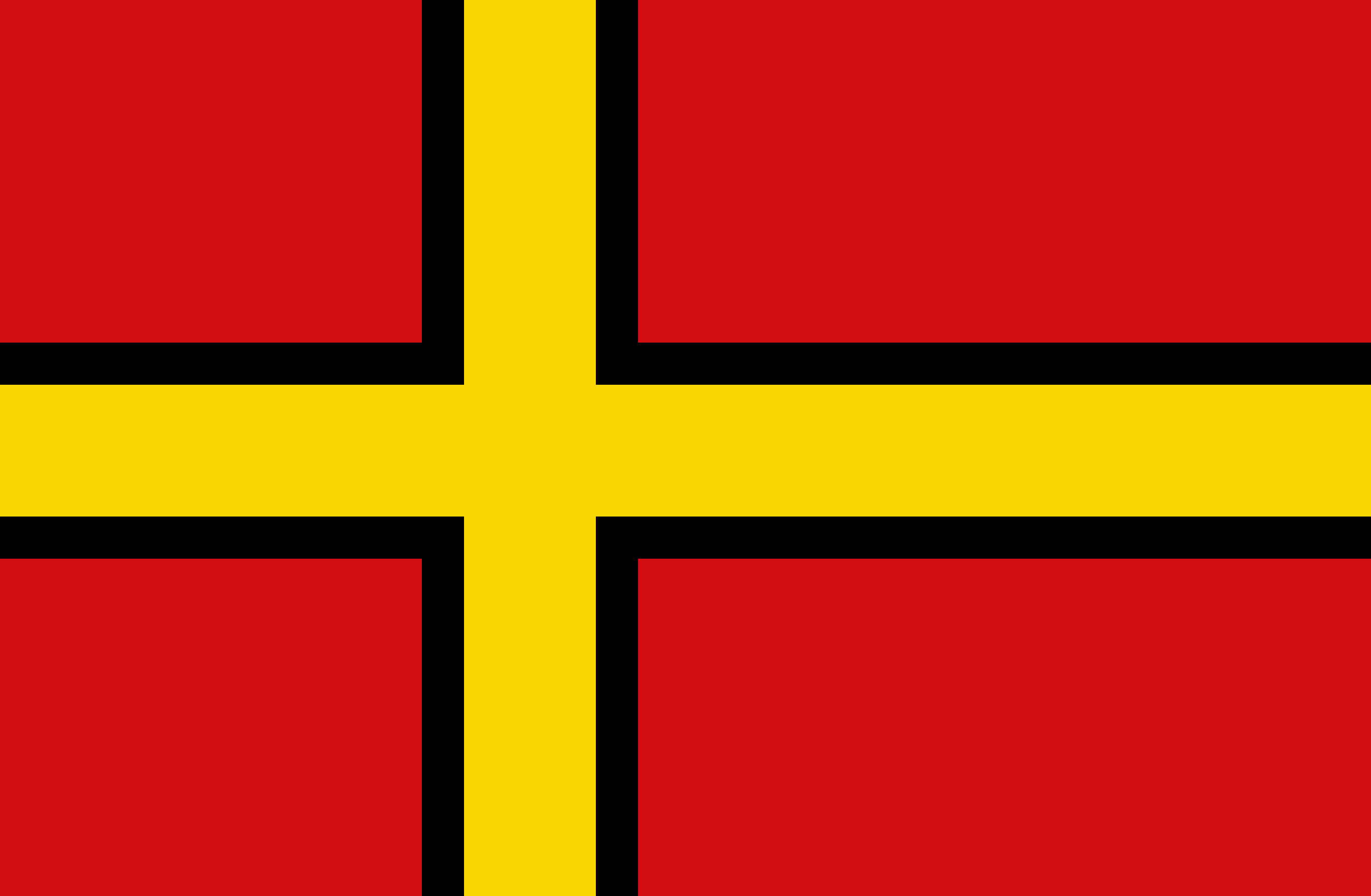

» Supported by artists, decorative artists Arttu Brummer-Korvenkontio and Toivo Vikstedt submitted three different flag proposals to the Senate on the 8th day of this month. In two of them, a yellow cross is depicted on a red background, bordered in one version by a black stripe and in another by a white stripe. The latter version also includes an alternative with a red base, a yellow cross, and a surrounding red and white stripe. The maritime flag derived from these civil ensigns is shaped into a Scandinavian-style swallowtail. The postal flag features a white post horn in the upper left field. The third flag proposal is divided into three vertical colour sections, in the style of the French tricolour: red, white, and yellow from the flagpole outward. The maritime flag features the Finnish coat of arms in the centre of the white section, while the postal flag displays a red post horn. All proposals share a common national or state flag, namely a yellow lion surrounded by white roses on a red background. » [14]
At the same time as the flag was being debated in Parliament, a lively discussion on the matter was also taking place in the press. Flag proposals were again being offered by private individuals, newspapers, and various societies.
While designing an updated blue-cross flag in 1919, one of Eric Ehrström's rejected sketches was as follows: [15]

State archaeologist Dr Hjalmar Appelgren-Kivalo participated in the public flag debate in March 1917, proposing that the Finnish flag should feature a white cross on a blue background with the lion coat of arms at the centre of the cross.
» Our flag, with its colours and symbols, should unite all historical and national traditions while also representing Finland’s political independence. I therefore propose a white upright cross on a blue background, with Finland’s red and gold coat of arms at the centre of the cross. » [16]

Appelgren-Kivalo was a member of the Finnish Society, which, towards the end of 1917, became concerned that Finland was moving towards adopting the lion flag as proposed by the flag committee. The Finnish Society, being one of the oldest Finnish nationalist organisations, supported the blue-and-white colours. In a meeting on 11 December 1917, the society decided to support Appelgren-Kivalo’s flag proposal and submitted a memorandum to the flag committee:
» It cannot be denied that red and gold have to some extent come into use in flags, mainly in cities and their surroundings, and that red,
as elsewhere, has been and will be used as a colour of opposition. However, the Finnish people, especially in rural areas, do not consider
them national colours. They continue to celebrate under the protection of the blue-and-white flag, as they have always done. It would therefore
be a grave mistake to remove these old national colours, cherished by the majority of the people, now that Finland has declared itself an
independent state. Our national history has been shaped under their protection, and our great national figures have endowed them with national significance.
However, this does not mean that the colours of the coat of arms should be absent from the flag. They should not, however, be used separately from the
coat of arms itself. We believe that the flag of an independent Finland should, as much as possible, incorporate all the key political and cultural
symbols from our history while also representing our political independence. As a suitable flag, we therefore propose, for example, the design created
by State Archaeologist Dr Hjalmar Appelgren-Kivalo: a white upright cross on a blue background, with Finland’s coat of arms at the centre of the cross,
whose primary colours are red and gold. In this form, we believe our flag would be a fully representative symbol of Finland’s political and cultural
aspirations. [17]
» The proposal of the Finnish Society is a compromise proposal: it recommends Z. Topelius's summer lake and winter snow blue and white, with the latter forming the cross and the former the background; the coat of arms of Finland would be placed in the centre of the cross. Such a flag can be criticised for having too many different colours, for not being based on a solid heraldic foundation, and for the unusual placement of the entire coat of arms on the flag. The Finnish people have the power to make their flag whatever they want, but by deviating from the facts on which other countries' flags are based, they put themselves in an exceptional position. » [2]
Master of Laws Kaarlo Kauko Järvinen and his wife, artist Laila Järvinen, sent a letter to the parliament in January 1918 regarding their own flag proposal. The parliament, at the time, was in the process of debating the senate's flag proposals. Kauko Järvinen was working as a clerk in the senate within the same special committee which was responsible for overseeing the work of the flag committee, meaning he most likely was well aware of the flag adoption process.

» For the trade and civil ensign of the Republic of Finland, we propose a blue-background white-cross flag according to the attached model, with a yellow-bordered red diagonal cross in the upper left corner. As a compromise solution, we believe that this could be accepted, as it meets both aesthetic and practical requirements and represents the relative numbers of supporters of different colours in our country. The dimensions are: the total length of the flag is 26 units, the width is 17 units, the length of the smaller rectangles is 8 units, the length of the larger rectangles is 15 units, the width is 7 units, the width of the large cross is 3 units, the total width of the small cross is 1.5 units, of which the red part is 0.3 units and the yellow parts are 0.6 units. » [18]
J. Penger proposed a white-blue-yellow flag for the national and civil ensign. The war flag would be a lion flag with the national flag added to the upper corner. [19]

The then Maritime Inspector, Baron Gustaf Oskar Axel Wrede, proposed two different red and yellow cross flags for the
state and civil ensign.[19]
The Parliament's archive contains Wrede's business card
with the civil ensign drawn on it. [20]


Railway Engineer Hugo Nyberg from Joensuu sent a letter to Uuno Sirelius, who was working on the flag commitee, on the 9th of December 1917 He proposed a red and yellow cross flag with a star in the middle of the cross. The dimensions of the flag are 13:8, the width of the cross is one-twelfth of the length of the flag, and the red fields on the hoist side are squares. The civil ensign would be the state flag surrounded by a white field. The postal flag would have a post horn in an appropriate place, and the customs flag would have Mercury's staffs. [19]


Researcher and non-fiction writer Vilho Setälä supported the blue and white colours but proposed replacing the cross with a Kalevala-inspired swastika. The blue-cross flag reminded him too much of the imperial-era yacht club flags.

» The Constitutional Law Committee has, as we have reported, proposed a flag with a wide blue cross on a white
background and the coat of arms of Finland in the centre. This proposal by the Constitutional Law Committee has
been criticised in a letter sent to us, which points out that the flag in this form strongly resembles the flag of
Russian yacht clubs, which is similar to the proposal but has the coat of arms of the city or province in the upper
corner. The writer, Mr Vilho Setälä, proposes a flag with a blue swastika on a white background, a symbol that we
have already seen on Finnish aircraft and locomotives. The theme would be completely original and domestic. This idea,
which the writer had already come up with earlier, is worth considering before the matter is finally decided. There is
no longer any dispute about the colours — blue and white. »
[21]
Painter Jonas Heiskan's proposal aimed to combine the red and yellow and blue and white colours. Inspired by Vilho Setälä's proposal, he also used a swastika in his flag.

» If we want a happy solution to the question that all citizens can agree on, it is already fairly clear that,
first of all, as far as the colours are concerned, all two-colour proposals must be compromised without exception.
Therefore, neither exclusively red and yellow nor exclusively blue and white can be Finland's new flag. Anyone who
stubbornly insists on one of these colour combinations will not gain unanimous support, no matter what group or
“flag committee" they speak for. Such stubbornness and narrow-mindedness in colour choice is “understanding only
half and opposing only half".
But before we go into more detail about the colours, we need to clarify the flag's ideological core, the allegorical
composition that gives it its form. What should it be? A warlike lion with a sword as the central idea? One writer has
put forward a rather successful idea in this regard, in my opinion, by suggesting that the overly complex and
difficult-to-draw lion figure in our flag be replaced by an old Kalevala-style decorative motif: the swastika.
Adopting this idea, which in my understanding points in the right direction in terms of form if not colour composition,
I dare to propose the final design for our flag as depicted in the title of our article. In the centre, there would be
the aforementioned, equally simple and charming ancient sacred ornament, which was certainly used by the smith Ilmarinen
himself for decorative purposes when forging the lid of the Sampo. » [22]
In May 1918, Tampereen Sanomat was highly critical of the blue-cross flag and proposed a lion flag with a white background. The civil ensign would be the Senate's Frey flag proposed earlier in the year.


» The flag question has been written about a lot lately, but only from one side. The admirers of Topelius's colours have tried
in various ways to use the hypnosis of the moment created by the catchphrases and symbols of the War of Independence to turn the
aversion to the “reds" into an aversion to the colour red and the sympathy for the whites into support and approval for the blue
and white colour combination. The result has been a blindness that is no less than the blindness of the hypnotised socialist
masses. Under the influence of the moment's delusion, an attempt is being made to bring the flag question to a conclusion that
will be a scandal that is difficult to correct. The Constitutional Law Committee proposes for our flag the flag of Russian yacht
clubs and various other Russian institutions: a white flag with a vertical blue cross. Similar proposals have previously died a
natural death for the very reason mentioned. It is hardly possible to imagine that Finnish ships would carry a Russian flag now
that we want to be completely free from Russia.
(...)
No substantive, positive reasons have ever been presented in favour of the blue and white colour combination. But the lion flag
was once criticised on the substantive grounds that the coat of arms was difficult to depict on the flag. Now we are ready to
compromise by adopting a white flag with a blue cross and the coat of arms of Finland in the centre of the cross as the state
flag. No one will be happy with this, as the red and yellow coat of arms of Finland does not match the blue and white flag in
terms of colour. If we want to compromise and at the same time pay tribute to the current mood, we could imagine the state flag
as completely white, with a large coat of arms of Finland in the centre, and the civil ensign as proposed by the government, with
a red background and a blue and white bordered yellow cross. Then the flags would match in terms of the colour impression they
create, and our flag would be a symbol of Finland's young and vibrant people. »
[23]
While the Senate was still deliberating on the flag issue between December 1917 and January 1918, several individuals put forward a proposal for a blue cross on a yellow background — essentially an inverted version of the Swedish flag. In the internal flag discussions of the Ship's Officers' Union, this proposal was introduced by an unnamed captain from Kuopio. In the newspaper Savo, a writer under the pseudonym A.K. suggested the flag on 8 December, while an anonymous Swedish-speaking resident of Vaasa sent a letter to the Senate on 31 December 1917.
Op-ed in Sanomalehti Savo on 08.12.1917:
» Some time ago, there was much debate about what kind of flag Finland should have. Eventually, it seems
that there has become an almost unanimous agreement that our flag should be the lion flag. Many believe
that any flag would suffice as long as it is our own. However, these matters should be taken with serious
intentions. If one looks at that lion flag, it is indeed quite handsome in a ceremonial setting, with
the observer standing somewhat near the flagpole.
From a distance, however, it appears dark, and one cannot discern whether it bears the image of a lion or
any other creature. Therefore, it is not suitable for us as a maritime ensign. A flag must be such that it
is clearly visible and shines from afar.
A yellow flag with a blue cross is visible from a distance. (A black cross would be even better
because it does not fade in the sun.) Similar to the one that flew from the mast of the steamship „Leppävirta 1.“
Firstly, it has its own colours, which are not used by any other nation. If our merchant vessel now hoists
that flag on its bowsprit in China or California, it will immediately be noticed that it resembles the
Nordic countries but is not the flag of Norway, Denmark, or Sweden. It is the flag of the fourth Nordic
country, Finland. Another good aspect is that it is not the flag of any political party. However,
the Swedish-speaking population could have their yellow and the Finnish-speaking population their blue colour.
And, as I mentioned, a merchant flag must be visible from afar. » [28]
"Wasabo" sent a letter to the Senate 31.12.1917:
» The sender of this letter requests for a chance to write a few words to the flag committee, or to whomever should have the authority regarding the question of a Finnish flag. Since our neighbouring country and Finland's former motherland, Sweden, now has a national flag with a blue background and a yellow cross, a blue cross on a yellow background for the Finnish national flag would certainly not be an inappropriate option! » [29]
Christian Declocq, a Finn living in France, sent a letter to the senate the 3rd of December 1917. He presented his own design for a flag and criticized another proposed design which he purpots to be a rotated version of the Russian triband. However, no such proposal seems to have been made at the time.

» A humble notice here appeared in a French newspaper, stating that there is a question about which flag would be more suitable for Finland once it receives a fully independent government.
It was mentioned that some are in favour of a modified version of the Russian flag, but that is not appropriate in any way. For example, if the white is placed at the bottom, it becomes
the Serbian flag, which is not suitable; nor would it be fitting to have the white on the side in a vertical arrangement. Here, all the French are proposing the following for Finland:
The new flag of the Finnish Republic
Blue at the top
White in the middle
Yellow at the bottom
Blue symbolises the nation's aspiration to move forward and rise higher despite all difficulties.
White symbolises the purity of life. Yellow symbolises that the Finnish people are ancient and have always been a distinct nation.
They have not just now been formed out of another nation.
As for Finland's coat of arms, the former noble lion of Finland should be restored.
I wish the new Finland success. I am a Finn. During the Tsarist regime, I was ordered to leave the country under threat of imprisonment. I now serve here as a lieutenant. »
[30]
An opinion piece was sent to Hufvudstadsbladet the 17th of April, 1917, which proposed a two-coloured three-striped flag for the Finnish civil ensign. The piece was signed with the initials "F.v.C.". The flag consists of three stripes, but the description is ambiguous on their order.


» Now, that Finland’s colours are indisputably red and yellow, since they are the main colours in its coat of arms and they have acquired much significance during our struggle for freedom, they should certainly be adopted as the colours of a Finnish flag. The yellow lion is the lesser colour, for which yellow should only make for one part of the flag, whereas the red, as the major colour, should make for two parts in the civil ensign, which typically consists of three stripes. But in any case, a yellow cross cannot be used, since it would easily be confused with the white cross of the Danish flag, nor additional stripes, which when fluttering would be mixed with the Spanish flag, and in no case blue and white which are the colours of the Bayer flag. - The result for our flag is therefore: a yellow field on top and two red fields underneath. The lion emblem, which is difficult to sew and is less durable, can be omitted from our civil ensign, which would then have good, practical, appropriate and recognizable colours, and would also be easy to manufacture. » [41]


 Ylös
Ylös